
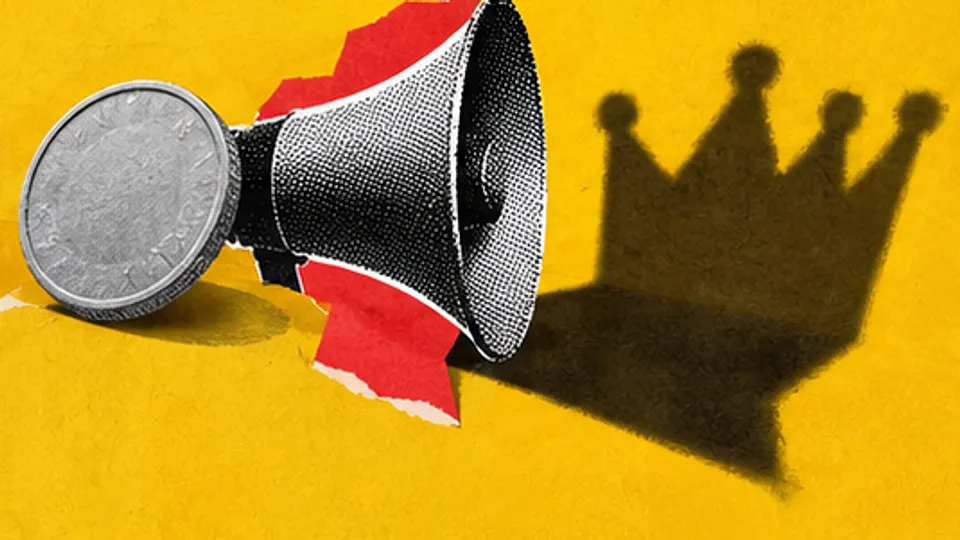
If you run a political campaign and you want to put out an ad saying the candidate is a messianic figure chosen by God to rustle the deep state, you have to raise money for it. Donors, super PACs, bake sales, whatever. That money is donated by people who chose to give it, and the ad has to say who paid for it, and there are rules. The system is imperfect but the basic transaction is legible: people who like the candidate voluntarily fund the promotion of the candidate.
The Trump administration has found a simpler approach. According to CNN’s Betsy Klein, the White House has produced at least 13 campaign-style ads promoting President Donald Trump, funded by you. Each spot ends with the words “Paid for by the U.S. Government” at the bottom of the screen, which has the virtue of honesty. A total of $20 million has been allocated for the effort, and at least an estimated $5.6 million in taxpayer dollars has already been spent, according to the ad-tracking firm AdImpact. The true figure is higher but unknowable, because public service announcements — which is what the White House calls these — face looser disclosure rules than campaign ads. That is a nice detail. The campaign-finance system makes you disclose your spending; the taxpayer-finance system, less so.
Where does the $20 million come from? Customs and Border Protection, two sources familiar with the matter told CNN. Try to reconstruct the meeting. Congress appropriates money to CBP to patrol the border, and some of it ends up paying LMD — the agency holding the government contract for the ad buys, in whose Dropbox account CNN found clips of 12 of the ads, ranging from 15 seconds to three minutes — to put spots on television. Three have aired so far, on CBS, CNN, MS NOW, Fox News and Fox, including one called “Final Battle.”
The content runs a range. There’s a trio of yet-to-air military spots covering operations in Iran and Venezuela, including one, “Maduro,” that cuts between a speech by Nicolas Maduro and Trump and his team at Mar-a-Lago following the Venezuelan leader’s capture. “Military Hype” pairs fighter jets and apparent missile launches with Trump’s February speech announcing the war with Iran — “This regime will soon learn that no one should challenge the strength and might of the United States Armed Forces” — a conflict now seven months old and deeply unpopular with the public whose money is buying the advertising for it. “UFC 250” promotes the June fight Trump hosted at the White House, with stretches of what is essentially a commercial for the UFC: Dana White, the fighters, the lit-up claw over the Octagon, the belt.
Then there is “King of the Jungle,” a two-minute spot featuring images of Trump’s perceived political enemies — Barack Obama, Joe Biden, Nancy Pelosi, Hillary Clinton and Gavin Newsom — intercut with hunting lions, a swooping bald eagle, a cover of “In the Air Tonight” and Christopher Walken’s lion speech from the 2002 film Poolhall Junkies. Your tax dollars, licensing Christopher Walken, to own the libs.
The standout is the three-minute “God Made Trump,” a riff on Paul Harvey’s “God Made a Farmer” that aired during Republicans’ midterm convention in Dallas.
I need somebody with arms strong enough to rustle the deep state, and yet gentle enough to deliver his own grandchild. Somebody to ruffle the feathers. So God made Trump.
That one was created by the Dilley Meme Team, a pro-Trump meme group, according to NPR, and went viral earlier this year before the government adopted it. Think of it as the state acquiring a meme the way a museum acquires a painting. Two Trump advisers told CNN the ads are mostly made in-house by the White House video team, part of the communications operation, and CNN previously reported that Trump has personally driven the project, including helping select imagery. Melania Trump, a rare presence at the White House this term, appears in many of the spots, along with the border wall, the 2015 escalator ride, his 2023 Fulton County mugshot and footage of the assassination attempt in Butler, Pennsylvania.
Now, the legal theory. Watchdog groups say the ads plainly violate appropriations law barring the use of federal funds for propaganda or partisan communications. But enforcement runs through the usual joke: it’s not clear outside groups have standing to sue, and Congress — the body with the clearest lane to act — has not. The criticism is bipartisan in a strictly ornamental sense. “It’s not an appropriate PSA. It’s just not, you know, it’s not how we should be spending taxpayer dollars,” said Sen. Thom Tillis of North Carolina, adding that a super PAC would be the fine place for this message. Sen. John Cornyn of Texas was asked whether the ads are an appropriate use of taxpayer money: “no,” and “it’s not even a close question.” Both men remain in a Congress that has done nothing about it.
Rep. Jamie Raskin, the ranking Democrat on House Judiciary, wrote on X that the ads “may be felony criminal theft and conversion of government property for political campaign purposes.” Raskin currently has no subpoena power, though he would get some if Democrats take the House next year. So one way to read the ads’ heavy rotation of midterm-friendly imagery is that the government is spending $20 million of CBP’s money on advertising in an election whose outcome determines whether anyone ever gets to investigate the advertising.
Asked for comment on Friday, the White House pointed CNN to a just-posted video compilation of the president criticizing CNN. Which, if you think about it, is the complete answer. The administration’s position is that messaging attacking its critics and glorifying the president is legitimate government business, produced by government staff, distributed in government files labeled “Paid for by the U.S. Government,” and defended with more of the same. The propaganda rules assume a government embarrassed to be caught doing this. The interesting innovation here is doing it so openly that the disclosure line itself becomes part of the pitch.