
Somewhere out among the numbered stars there is an object no telescope can see. It gives off nothing an astronomer can catch. And yet it is there, and it is heavy — perhaps 2.8 times the mass of our Sun — and it betrays itself the way the powerful always do, by the effect it has on those around it. Its companion, a red giant star, moves under its pull, and from that motion the invisible thing was found.
The discovery, made with the help of Europe’s Gaia space telescope and large spectroscopic surveys, was published on Wednesday in the journal Science Advances, as 404 Media reported. The system carries a catalogue name, J0008+0128, the kind of cold bureaucratic designation that states give to things they cannot otherwise grasp. What hides within it is likely a supermassive neutron star — the collapsed core left over when a very large star dies in a supernova — and it sits, awkwardly, precisely where the textbooks say almost nothing should sit.
The gap in the ledger
Astronomy, like any administration, keeps books. A star roughly the mass of the Sun ends its life as a white dwarf, an ember about the size of Earth. A star of ten to twenty-five solar masses collapses into a neutron star, a sphere mere miles across, packed with disassembled atoms — neutrons mostly, but protons and electrons too. Beyond about twenty-five solar masses, the star falls all the way down into a black hole. Between the heaviest neutron stars and the lightest black holes, in the range of two and a half to five solar masses, the ledger shows a strange emptiness. For decades astronomers have called it the mass gap, and they have argued about whether it is real or merely a failure of their instruments.
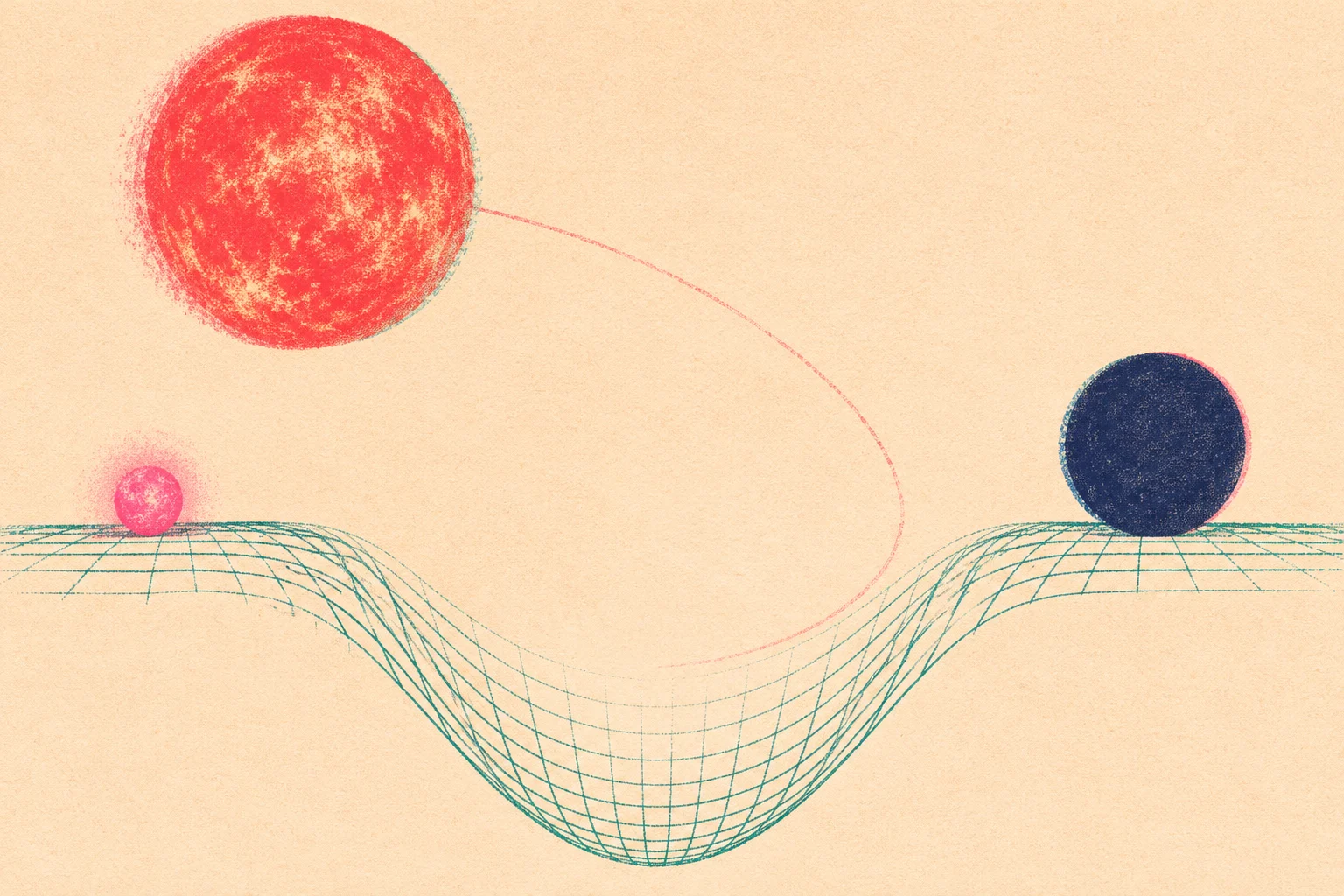
The unseen companion in J0008+0128, at up to 2.8 solar masses, “potentially places the unseen companion within the mass gap between neutron stars and black holes,” the study’s authors write. And its mass is only half the scandal. The object circles its red giant in an orbit 1,218 days wide — far too wide, by the standard models, for a neutron star to have grown fat by pulling matter off its partner, which is the usual explanation for how such objects become supermassive.
The models refuse
Every regime has its official history, and stellar astrophysics has its binary evolution models. The researchers tested the system against them. They ran thousands of simulations, and none, the study says, “reproduced physical and orbital properties similar to J0008+0128.” The universe, confronted with the paperwork, declined to conform.
Song Wang, an associate researcher at the National Astronomical Observatories of the Chinese Academy of Sciences and a co-author of the study, is not entirely surprised. “We search for compact objects (mainly neutron stars and black holes) using large spectroscopic surveys,” he told 404 Media by email. “We have found more than 10 neutron stars, and J0008+0128 is the most massive one among them.”
“In fact, many compact objects discovered in recent years cannot be explained by standard binary evolution models and supernova mechanisms,” Wang noted, pointing to two other unruly systems, Gaia BH2 and G3425. The anomalies are accumulating, as anomalies do before a doctrine falls.

Three stars, or one violent death
Wang and his colleagues offer a few possible biographies for the strange object. Perhaps supernovae, in rare cases, simply produce neutron stars massive enough to occupy the forbidden gap. Or perhaps the system was once more crowded than it is now — a triple, in which two members merged at some point in the past and left behind today’s supermassive survivor.
“There may be two massive stars forming an inner binary,” Wang explained. “They can merge at different stages. For example, a neutron star merges with a normal star, or two neutron stars merge. Either case could produce the supermassive neutron star that we observe today.”
“In addition, if J0008+0128 formed through single-star evolution, its discovery would suggest that supernovae can produce massive neutron stars,” he added. Either way, someone will have to rewrite the theory.
What the pressure hides
There is a deeper prize here than one odd system. Inside a neutron star, matter is crushed to densities found nowhere else in nature, and the relationship between that pressure and that density — the so-called equation of state — remains one of the great unsolved problems of astrophysics. How massive a neutron star can grow before it collapses depends on how stiffly its internal matter resists gravity, so each new heavyweight is a measurement of the unmeasurable.
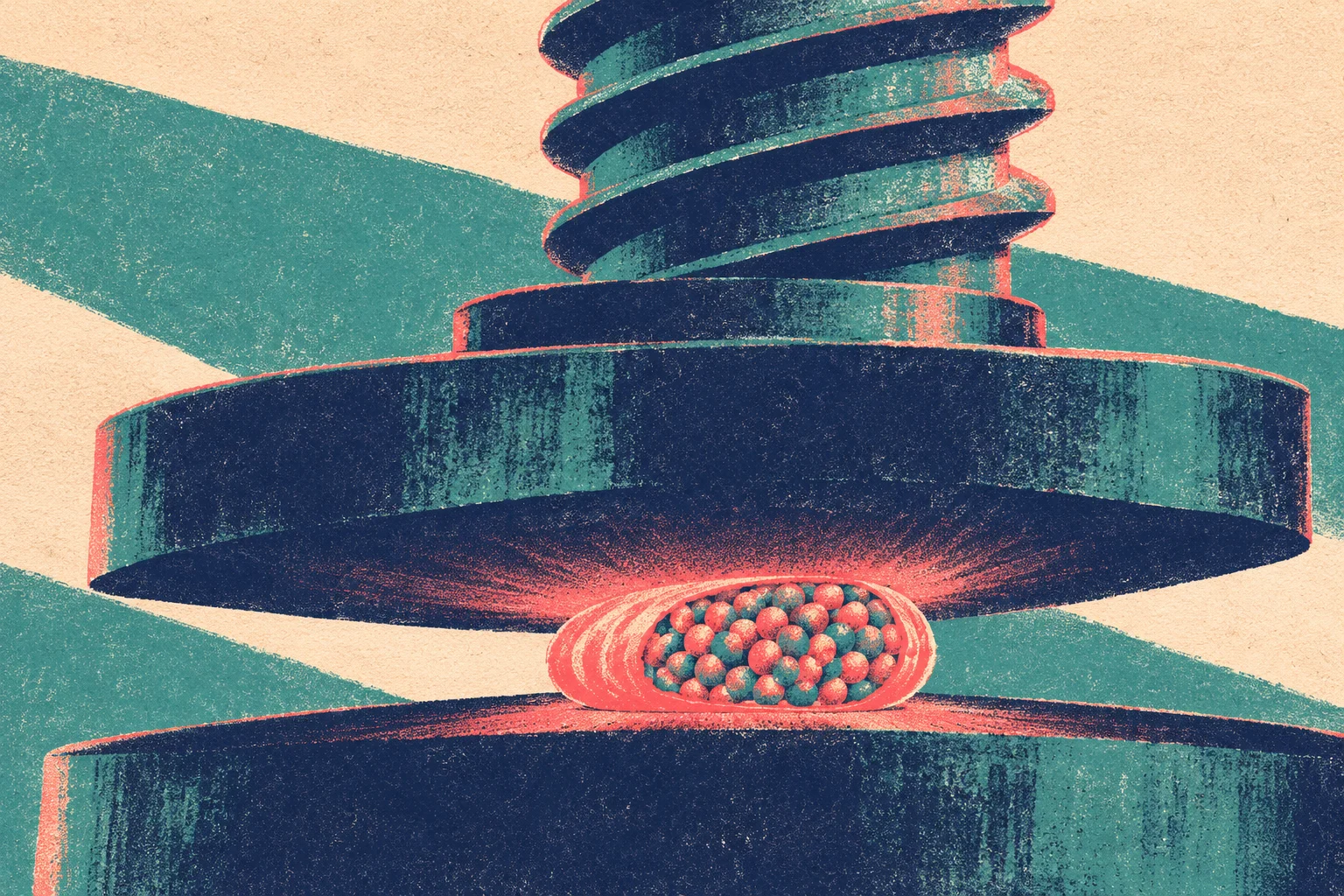
“The equation of state of neutron stars is a long-standing unsolved problem in astrophysics, and neutron star masses can provide crucial observational tests,” Wang said. “The discovery and measurement of supermassive neutron stars (i.e., those above two solar masses) can place important constraints on the equation of state of matter at extreme densities, helping to identify the theories that truly describe the behavior of matter under such extreme conditions.”
Such systems also bear on the study of neutron star mergers, the collisions whose gravitational waves — ripples in spacetime itself — detectors on Earth have learned to hear. The team now hopes that Gaia’s next data release, due next month, will narrow down the mass of the object in J0008+0128 and say more certainly whether it truly inhabits the gap.
“The discovery of J0008+0128, together with other systems discovered in these years (e.g., Gaia BH2 and G3425), suggests that much work remains to be done on binary evolution and supernova explosion theory,” Wang concluded. It is the scientist’s way of saying what the red giant already knows, circling its invisible partner through the dark: the heaviest powers in this universe are the ones we cannot see, and we learn of them only by watching what they bend.