
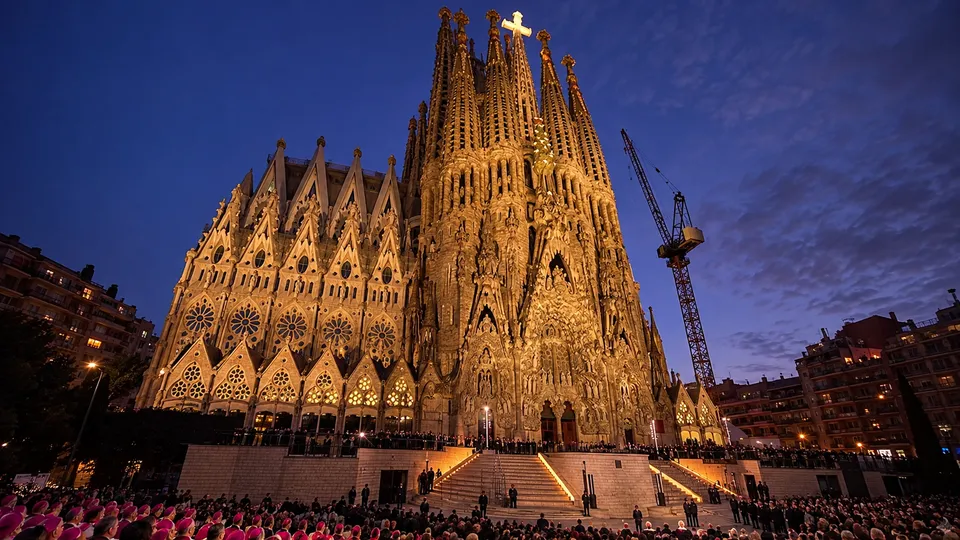
There are buildings that belong to their century, and there is the Sagrada Família, which belongs to none and has borrowed from all. In the heart of Barcelona, Antoni Gaudí’s basilica has been rising for more than 140 years, and the architect accepted this long debt to the future with the serenity of a man who worked for a patient employer. “My client is not in a hurry,” he liked to say. He meant God.
This year the patience of both clients, the earthly and the eternal, appears to be rewarded. After accidents, delays, a pandemic and setbacks beyond counting, the basilica may finally shed the scaffolding that has become part of its silhouette. The moment falls on a double milestone: the centenary of Gaudí’s death — he was struck by a tram in 1926 — and the completion of the Tower of Jesus Christ, which has carried the building to 172.5 metres and past Germany’s Ulm Minster, making it the tallest church in the world.
A Bible the faithful can read with their eyes
Gaudí, a devout Catholic now in the process of beatification, did not design a church so much as encode one. The Sagrada Família was conceived as a Bible in stone, what he called a “stone catechism”: twelve towers for the twelve apostles, a floor plan evoking the body of Christ, façades that narrate episodes from the Nativity to the Passion. On the Passion Façade, the attentive eye finds the architect’s own face carved among the figures. Higher up, the crucified Christ breaks with tradition — naked, his head replaced by the geometric form of an open book.
He worked from life, using real people as models for his sculptures. He gave the project 43 years; in his last twelve he refused all other commissions and raised money privately. The temple took no public funds — it has always been financed by the donations of the faithful, a cathedral built, in a sense, by subscription to eternity.
A building of such imaginative force leaks into the culture around it. Its interior evokes a forest, coloured light filtering through stained glass onto branching columns. Guides tell visitors that George Lucas found the inspiration for his Stormtrooper helmets in the figure of a Roman soldier on the façade. Elsewhere inside, a figure of Saint George stands beneath a white twisting structure that suggests the body of the dragon.
The tower and the lamb
Last week Pope Leo XIV came to Barcelona to bless the Tower of Jesus Christ, the central and tallest of the basilica’s towers, crowned by a monumental 17-metre cross. Inside it sits a glass lamb by the Italian artist Andrea Mastrovito, through which the Mediterranean light filters into the space. From 2027 the tower is expected to open to the public, with a walkable viewing platform at the highest vantage point in the Catalan capital.
Gaudí knew he would not see any of this. He left models and instructions and entrusted the work to generations unborn. In 1926, aged 73, crossing the Gran Via, he avoided one tram only to be struck by another; he died of his injuries days later, and the building passed to his closest collaborators. Since then, generations of architects have continued his vision while inevitably signing it with their own hands.
Stone, steel and invisible chemistry
The hardest problem left to those heirs was the six central towers — complex hyperbolic structures that must withstand wind, seismic forces and immense loads. The answer that allowed them to be finished in time for the centenary is partly chemical: a structural adhesive developed by the German manufacturer Henkel after a decade of research and testing.
The method inverts the old masonry. Instead of setting individual stones hundreds of metres above the street, the towers were divided into a giant puzzle of 826 modular panels incorporating more than 2,100 stone pieces, pre-assembled at the quarry. To make stone and steel behave as a single structural unit, engineers apply Loctite EA 9497, a two-component epoxy produced at Henkel’s factory in Montornès del Vallès — around 30 kilograms of resin per panel. The panels then cure for 24 hours under controlled temperatures, the adhesive filling the microscopic gaps between materials. Finally they are transported to the basilica, lifted and assembled level by level with millimetre precision, like building blocks on a monumental scale.
The speed is startling. Construction has progressed up to ten times faster than traditional methods allow; according to project manager Begoña Cantera, work completed in barely eight years would have taken between 50 and 60 by conventional techniques.
Built to outlast the city around it
In total, 24 tonnes of adhesive hold the towers together, and they must hold against a demanding neighbourhood. The basilica stands just 2.5 kilometres from the Mediterranean, in salt-laden air that corrodes steel. Humidity runs between 65 and 75 percent. Temperatures swing from around 5°C in winter to more than 30°C in summer, expanding and contracting the materials year after year. Two metro lines pass beneath the foundations, and their vibrations had to be written into the structural design.
The resin is engineered to absorb small movements between steel and stone without cracking. According to the project team, the bonded structure can bear loads equivalent to the weight of around 100,000 people per square metre — roughly the weight of a capacity crowd at FC Barcelona’s stadium — a strength that matters most where the monumental cross crowns the Tower of Jesus Christ.
Gaudí rests now in the crypt of the basilica that consumed his final years. He had designed the Sagrada Família with the height of Montjuïc in mind, believing that the work of man should not surpass the work of nature. At 172.5 metres his church has surpassed every other church instead — not by the methods of his time, he would have noted with satisfaction, but by his vision carried on the chemistry of a century he never saw.