
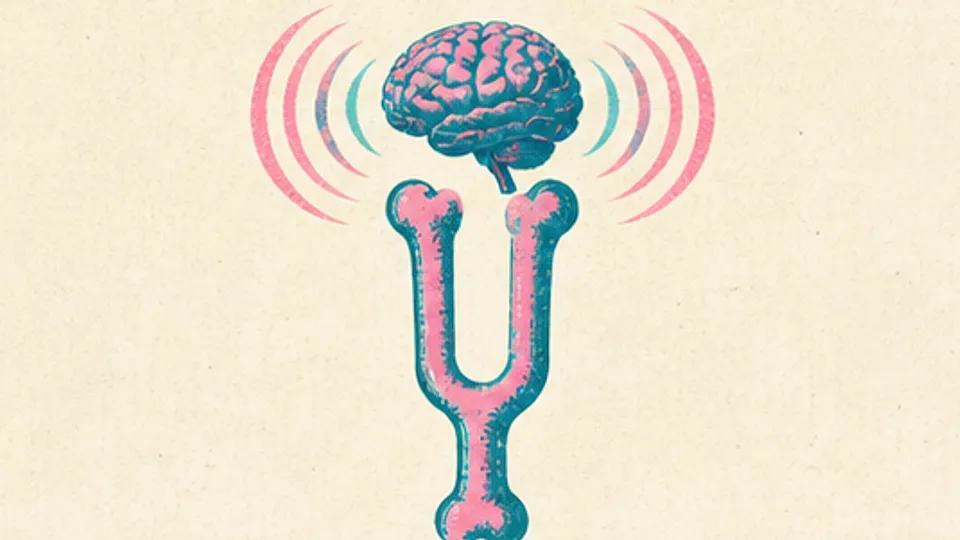
Doctors have long noticed something odd about patients with traumatic brain injuries: their bones mend faster than they should. The explanation, when it came, was stranger than the observation. Damaged brain cells release tiny vesicles packed with proteins, and these travel to bone stem cells and prod them into growth. The traffic, in other words, runs from brain to bone. Researchers at Southern Medical University in China asked the obvious next question: does it run the other way?
Their answer, in a study published in Nature Neuroscience, is yes. The team inflicted traumatic brain injuries and strokes on mice and pigs, then fitted the animals with electronic devices that tapped rhythmically on their shin bones — a couple of times a second, for five days. The tapping reduced the loss of brain cells, encouraged neurons to grow and eased chronic inflammation. The animals also lived longer, moved better and found their way through mazes more readily, which suggests their memory suffered less.
The mechanism, the researchers say, runs through a large protein in bone cells called PIEZO1. It is shaped rather like a propeller, with three spiral blades curving upward around an ion channel. Press on it and the blades flex down, the channel opens, and positively charged signalling particles — sodium, potassium, calcium — flow in. Animals bred without PIEZO1 got nothing from the shin tapping at all: no reduced cell loss, no new neurons, no benefit. The protein is the switch, and without the switch the message from bone to brain never gets sent.
That a bone should talk back to a brain is not as perverse as it sounds. Bones behave in part like glands. They regulate mineral levels, secrete a growth factor that acts on other organs, and produce hormones that can lower blood glucose and raise testosterone. Glands work by feedback loops, so a one-way road between skeleton and brain would have been the real surprise.
It is still an odd picture: a mouse with a broken head, cured — or partly cured — by a small machine drumming on its leg. Whether gentle tapping can do anything for a human being with a brain injury is a question this study does not answer, and the distance between a pig’s shin and a hospital ward is considerable. But the work establishes that the road between bone and brain runs both ways, and that a hand on the right switch at one end can do repairs at the other. The body keeps its accounts in more places than we thought.