
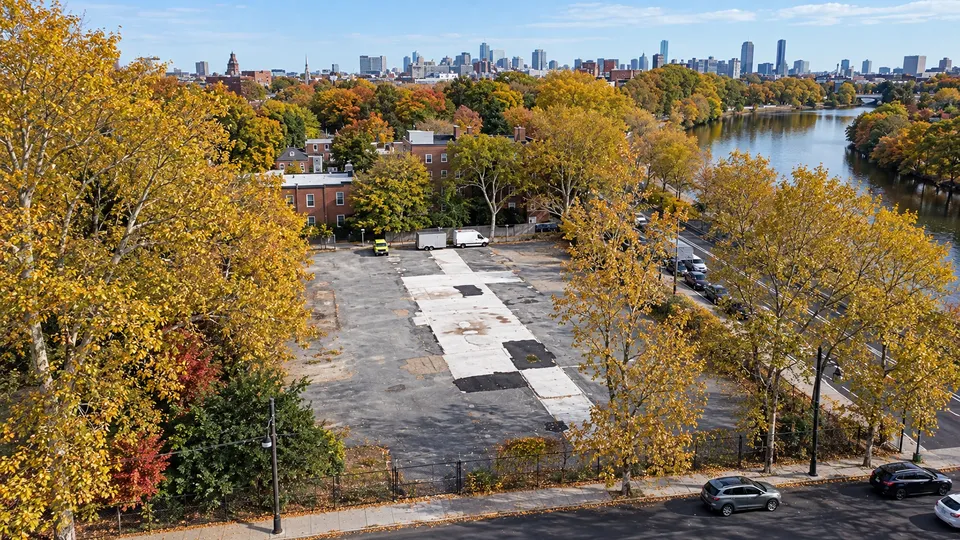
At 221 Mount Auburn Street in West Cambridge there is now a large rectangle of pavement. Until this year it held the Riverview: nine stories, 66 units, built in 1963, with floor-to-ceiling windows facing the Charles River. Most of the people who owned those units are in their seventies and eighties. They still own the pavement. They are not allowed to sell it.
As Spencer Buell reported in the Boston Globe, the bill for tearing down their own homes has now arrived, while the land that might pay for it sits locked in a courtroom.
The concrete
The trouble came to light, Cambridge Day reported, during a roof repair in 2023. The concrete holding up the building had been bad for a long time, and the damage could not be repaired. In 2024 the residents left. In July 2025 the state closed a lane of Memorial Drive beside the building amid fears that it could collapse. The owners asked the city to take on the demolition, and the city set aside $20 million for the job.
The machines started work on December 17, 2025. According to Cambridge Day, the demolition went in six phases, the last finishing at the end of February 2026, and the debris was trucked to an EPA-approved landfill in Ohio. A deputy city manager, Kathy Watkins, told that outlet: “My heart goes out to all of the residents of 221. They were doing regular maintenance.”

Regular maintenance. That is how these things usually begin: a roof, a repair, an engineer’s report. Then a whole life is in boxes.
The bill
In October the city began billing the owners for the demolition. The total came to $9 million, less than half of what the council had set aside. It covered taking the building apart, police details, getting rid of the asbestos and other expenses. A city spokesperson said individual bills ranged from about $36,000 to $244,000. An owner who does not pay faces a lien recorded against the property. By the end of the month, a third of the bills had been paid.
None of this replaced the costs the owners were already carrying. Through the evacuation and the demolition they kept paying condo fees, property taxes and lawyers. Their casualty insurance claims have so far been denied. The insurer could not be reached for comment, and the condo association’s leadership declined to comment.
The obvious way out is to sell. The land lies on the river, in one of the most expensive housing markets in the United States. But it cannot be sold yet.
Who is paid first
The sale is going through the state Land Court, in case number 25 MISC 000484. The owners say a dispute with the banks holding mortgages on some of the units has to be settled there before anything can be sold.

The association’s plan was simple. The money from a sale would be divided according to each owner’s share of the building, which comes to roughly 1 percent per unit, a little more for some and a little less for others. If someone still owed money on a mortgage after receiving their share, that was a matter between them and their bank.
Some lenders disagree, according to legal filings. Their lawyers say they hold mortgages with unpaid balances on units in the building, and that a 2008 federal housing law entitles them to be paid off first. They argue that this comes ahead of any lien the city records to recover the taxpayer-funded demolition, and holds even where the debt on a unit is larger than that owner’s share of the proceeds. Court documents indicate that unless some other agreement is reached, residents who own their units outright could end up helping to pay off their neighbors’ mortgages before they receive their own share. How much is still owed has not been made public.
A lawyer for one bank declined to comment, and lawyers for the other banks could not be reached. Two local real estate law experts said they had never seen lenders make this argument. One of them, condo attorney Richard Brooks, who is not involved in the case, said: “I suppose a bank could try that, but it doesn’t make any sense to me.”

It is one of several questions the Land Court judge is considering. An appraisal due this month may give some idea of the land’s value, but the price will finally depend on what developers think they can build on a large plot by the water.
“This just doesn’t happen. If everyone is fighting over what their share should be, I think that could take a long time.”
Brooks said that about a case with few precedents: an evacuation, an emergency demolition, and dozens of owners forced apart at the same moment. One reflection is hard to avoid. When a building fails, it fails all at once and for everyone. The paperwork afterwards puts people in a queue, and the people who lived there are not at the front of it.
Slowly
Linda Salter is 80. She had owned and lived in her unit for less than two years when she was told to leave.
“I think, for all of us, this has been a catastrophe,” she said. “There is a strong sense of not being in control. We thought at this age we would be in control, and we’re not.”
The people who lived there have scattered. Some now rent apartments, and some live with family. Those with more money moved to their second homes. Some are thinking about independent living facilities. At least four have died. The rest are waiting for the day the Riverview is finally settled and they can move on.
“It’s dragging on slowly,” Salter said. “Slowly is very different when you’re 80 than when you’re 40.”