
There is a version of being a spy where you are a careful professional: dead drops, brush passes, microdots. And then there is the version where you fly commercial from Las Vegas to Seattle, rent a car from Hertz at the airport under your own name, sit outside your target’s house in full view of the neighbor’s security camera building iPhone of the family as they pull into the driveway, and then text your government handler — over WeChat, which backs up to iCloud, where the FBI can get it with a warrant — “Saw him. Young male. It’s that young one,” followed by “I am videorecording” and two license plate numbers. The second version, federal prosecutors say, is the one Wanying “Heather” Zhang chose.
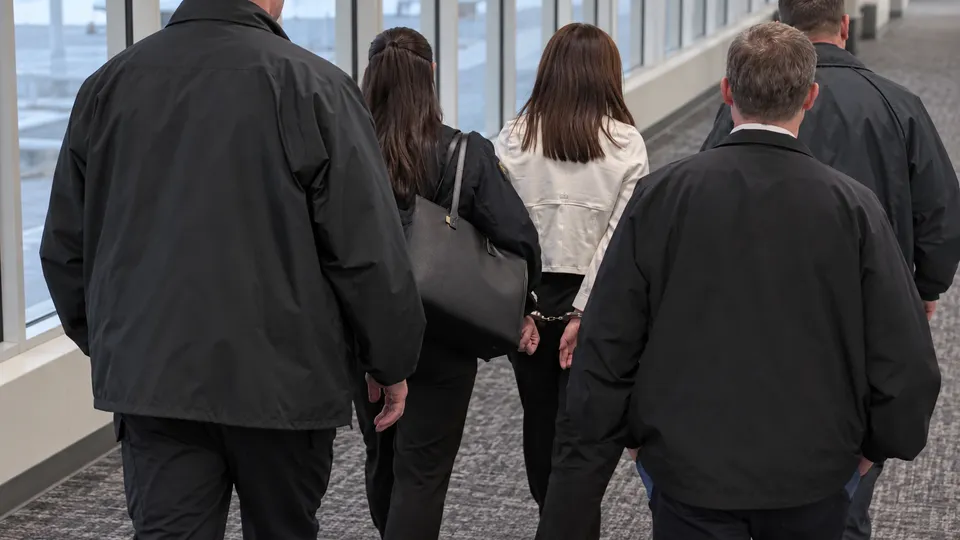
Zhang, a 34-year-old licensed realtor in Irvine, California, with JC Pacific Capital Inc. — her Zillow profile lists 130 sales and listings around Los Angeles and neighboring counties — was arrested by the FBI on Sunday at Los Angeles International Airport, shortly before she was due to board a flight to Shanghai. She is charged with acting as an unregistered agent of a foreign government. Bill Essayli, the first assistant U.S. attorney for the Central District of California, announced the arrest on X, and said Zhang was due in federal court in Los Angeles on Monday. The target of the alleged surveillance, law enforcement sources told CBS News, was Ting-Yu Lai, the son of Taiwanese President Lai Ching-te.
The oldest profession, subcontracted
The criminal complaint, signed Saturday by FBI Special Agent Kevin Holt of the bureau’s Los Angeles counterintelligence squad, lays out the alleged recruitment in some detail. Zhang graduated from Beijing’s University of International Relations, which Holt notes has close ties to China’s Ministry of State Security. In June 2025, a classmate from that alma mater allegedly introduced her to a Chinese government official. During a trip to China that month, the affidavit says, she booked a private room in Changsha, met the official, and received her assignment. She later texted him, “I can take care of this thing.”
On Aug. 26, 2025, according to the complaint, she wrote: “I will be busy with work in L.A. this week. I will probably go to Seattle next week.” The official’s reply: “Ok. Thank you for your hard work.” There is something almost touching about that exchange — the spy as gig worker, filing a status update to a supervisor who responds with the managerial warmth of a performance review. The FBI says Zhang was in contact with at least two people she appeared to acknowledge worked for the PRC government, and that the messages “make clear that Zhang was acting at the direction and request of one or more PRC officials.”
On Sept. 1, 2025, Zhang and a man identified only as “Individual 1” — described in the affidavit, per the Orange County Register, as someone employed in the construction field in the Los Angeles area — flew to Seattle, rented a black Nissan Rogue from Hertz, and drove to the home of a top Taiwanese official’s family. Security camera footage from the Hertz counter shows them waiting to pick up the car; footage from a neighbor’s camera allegedly shows them sitting in the SUV outside the house, then, as the family arrived home that evening, per CNN’s account of the complaint, quickly sitting up and holding out their phones “in a manner indicating that they were taking pictures and/or videos of the family.” The affidavit cites Zhang’s last-minute bookings and brief use of the rental car as “tradecraft methods used by foreign intelligence officers.” Sure. Tradecraft that leaves a paper trail at every step is still, technically, tradecraft.
Ting-Yu Lai, the man CBS News says was the target, is an engineer in his 30s who works for the Dutch electronics multinational Philips and lives near Seattle. He is about as far from Taiwanese politics as a president’s son can plausibly get: a bachelor’s in electrical engineering from Case Western Reserve in 2012, a master’s from Johns Hopkins the following year, a PhD in bioengineering from the University of Washington. Taiwan’s SETN reported that he met his wife, Hsiao Chen, during his doctorate; they married in 2018 and had a child in the U.S. in 2020, according to CNA, Taiwan’s national news agency. He is, in other words, a private citizen with a LinkedIn-friendly biography — which is precisely the point.
Here is the complaint’s own explanation of why China might want photos of an engineer’s house and cars, and it is worth quoting for its bluntness: “If the PRC [People’s Republic of China] wish to obtain leverage over the President of Taiwan during any potential conflict, the location and pictures of the close relatives of a high-ranking Taiwanese government official, including pictures of their homes and cars, could be useful to the PRC.” That is the whole mechanism. You cannot easily pressure a president directly; you can, at least in theory, make his family feel watched. President Lai, who champions the sovereignty of the self-ruled island of around 24 million people, is regularly denounced by Beijing as a separatist and, in state media’s phrasing, a “troublemaker” and “war maker.” Karen Kuo, a spokeswoman for Taiwan’s Presidential Office, called the alleged surveillance a case of “classic transnational repression.” CNN noted it reached out to the FBI, the Justice Department and the Chinese embassy; China’s government offices are closed for the weeklong National Day holiday.
The legal charge, meanwhile, is almost an afterthought to the espionage. The U.S. does not criminalize liking China, or even working for it; it criminalizes doing so without telling the attorney general. Zhang “never notified the Attorney General she was acting for a foreign government, a federal offense,” as Essayli put it. Her husband, Edric Ding, a realtor at the same firm, told CBS News by phone on Sunday: “I don’t know anything yet.” It was not immediately clear whether Zhang has an attorney.
The context, per CBS News and the Register, is a busy docket. Shujun Wang, 75, was convicted in 2024 of informing on a Queens pro-democracy group for the Ministry of State Security over 17 years. Two people were arrested in April 2023 over an unofficial Chinese “police station” in Manhattan. Quanzhong An, described by prosecutors as a U.S. leader of Beijing’s Operation Fox Hunt repatriation campaign, was sentenced in March 2025. And Zhang’s arrest comes four months after Eileen Wang, then the mayor of Arcadia, California, was charged with taking Chinese government “directives” for a Chinese-language news website she ran with Yaoning “Mike” Sun — including posting a prewritten essay denying forced labor in Xinjiang. Wang pleaded guilty on May 29, faces up to 10 years, and was scheduled to be sentenced Tuesday. Sun is already serving four years.
What is striking is less the audacity than the staffing model. Beijing’s U.S. operations, as described by federal prosecutors, run on a loose network of local professionals — a mayor here, a realtor there — recruited through old classmates, tasked over WeChat, and paid in who-knows-what. It is cheap, deniable and, judging by the conviction rate, not especially hard to roll up, one iCloud warrant at a time. The handler who typed “Thank you for your hard work” is presumably thanking someone else this week.