
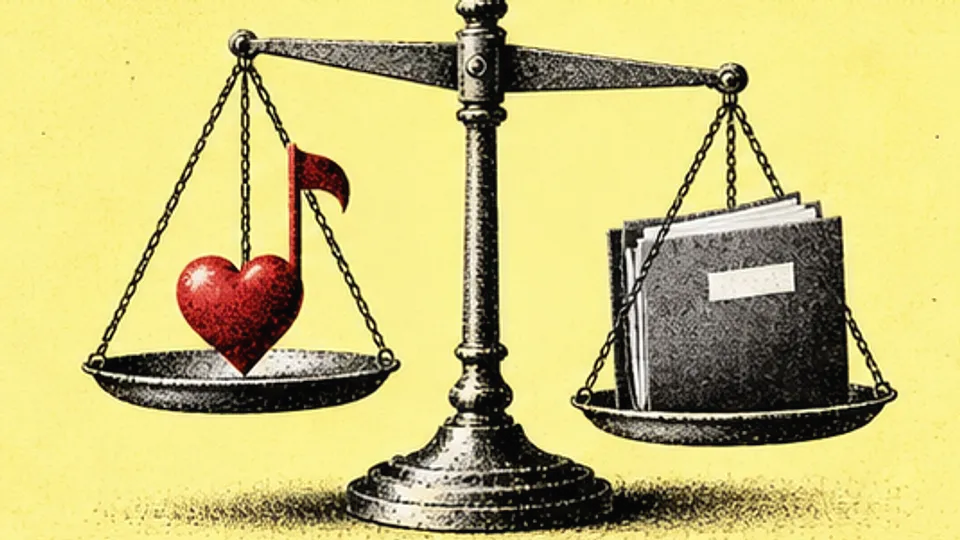
A murder trial is, by long convention, the one place where the machinery of entertainment is not supposed to intrude. There is a dead woman. There is a widower in a defendant’s chair. The whole apparatus of the state has put on its most somber uniform and gathered in a room where nothing, by design, is permitted to be funny. And then the prosecutor asks permission to publish the exhibit, and the judge says “You may,” and out of the courtroom speakers comes an AI-generated love song that a former American Idol contestant made for his mistress, in two different keys.
This is what happened Thursday in the trial of Caleb Flynn, who is accused of killing his wife, and whose proceedings—being livestreamed to a national audience—produced what 404 Media plausibly calls the most excruciating courtroom footage in recent memory. The crime is grave and the piece says so plainly. But the video of the songs playing to a room of people visibly wrestling with their own faces is a small, terrible anthropological document about the moment we live in.
The exhibit came from Flynn’s iPhone. Forensic investigator Joseph Wilhelm had cracked the phone with GrayKey, the law-enforcement unlocking tool, and found AI-generated audio files tied to Flynn’s relationship with his mistress, along with lyrics in his Notes app. Asked to describe what he’d found, Wilhelm offered the soon-to-be-immortal classification: “They’re in two different keys. One’s like a happy or upbeat sad song if that makes any sense, and one’s a sad, sad song. I think one’s in a minor key, one’s in a major key, but I’m not a music professional.”
Both songs were played. In full. The video, as 404 Media describes it, watches everyone in the courtroom spend the next few minutes trying not to laugh—during what is, again, a murder trial. When the songs mercifully ended, the court sat in silence for several seconds, and then the judge made the only ruling available to her: “We’re going to break for the day. It’s 10 after 4 [p.m.] We will reconvene tomorrow.”
One’s like a happy or upbeat sad song if that makes any sense, and one’s a sad, sad song.
The songs did not appear from nowhere. Earlier that day, the mistress had been asked to read Flynn’s texts into the record. “Do you want to hear the song I wrote for you with an AI voiceover,” he wrote, explaining: “I have this software called ElevenLabs where I loaded the song on piano and sent it with my computer microphone to which I can pick an AI voice to sing it better.”
She was, on the record, reluctant: “I don’t know if I’m ready to listen to this yet. I’m sorry... I don’t want it to be erased.” To which Flynn, an actual one-time singing-contest competitor, offered the musician’s eternal note that the demo isn’t quite right: “It messed up the outro as it’s supposed to be done and the vocals aren’t exactly how I want it, it was a little rock-ier at times but the melody is correct. I tried to sing it with passion and AI took it and went a little extreme.”
The man deleted an app called “AI music song generator” days before the murder. That is not color; it is from the forensic testimony, and it sits alongside a phone extraction that reads like a museum exhibit of modern self-surveillance. GrayKey’s Magnet tool gave investigators a full file system extraction, which delivered messages, the AI audio, location history, sleep data from an Oura Ring, heart-rate data from an Apple Watch, and AirPod connection and disconnection logs. One man, one phone, and roughly five overlapping machines keeping a diary of him.
Nothing about the underlying case is funny and everyone involved appears to know it, which is exactly what makes the footage so difficult to watch. The solemn ritual absorbed the least solemn artifact our species has yet manufactured—a mediocre synthetic love ballad with a rock-ier outro—and could neither laugh nor look away. The judge’s response, calling the day to an end at ten after four, may be the most honest ruling ever issued: court adjourned, because no one present could be expected to continue.
We have built machines that can fake a song before anyone can fake the grief that follows one. The courtroom is where those two facts just met, at ten after four, in two different keys.