
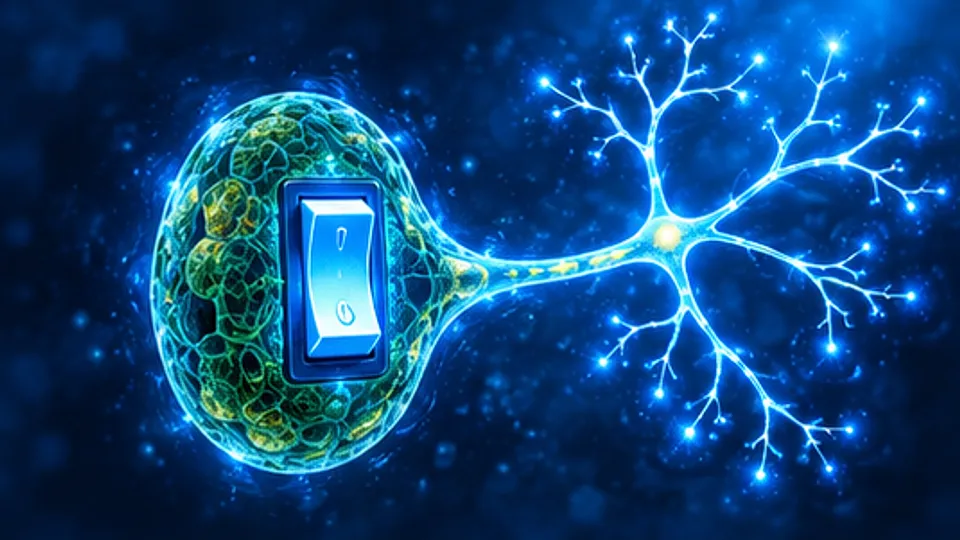
On Monday the Nobel Assembly at Karolinska Institutet in Stockholm gave the 2026 Nobel Prize in Physiology or Medicine to Karl Deisseroth of Stanford University and the Howard Hughes Medical Institute, Peter Hegemann of Humboldt University of Berlin and Georg Nagel of the University of Würzburg. The official press release gives the citation as “for their discoveries concerning light-gated ion channels and optogenetics.” Al Jazeera reported the Assembly’s wording as “for their discovery of a molecular switch for nerve cells,” which is the same idea in plainer language. The Associated Press and CNN put their ages at 54, 71 and 73; STAT lists Deisseroth as 55 and Hegemann as 72.
The prize is 12 million Swedish kronor, about $1.2 million, split equally. That is 4 million kronor each, or roughly $400,000. In return, the three have more or less ruined everyone’s ability to say “we don’t know what that brain cell does.”
The problem
Here is the problem they solved, as Ars Technica’s John Timmer lays it out. Neuroscientists had built a decent map of which genes switch on in which populations of neurons and where those neurons sit. They could even use those genes to delete particular neurons and see what broke. But a brain is flexible. It can adapt to losing some cells, and losing them early in development can change how the neighbouring circuitry grows. Imagine you are trying to work out what one employee does by firing her and then watching the company for a few years: by the time you look, everyone has reorganised around the gap, and you have learned mostly about the reorganisation. What you really want is to switch the employee off for an afternoon and then switch her back on.
People had tried. According to the Nobel Committee, as summarised by Ars, earlier methods tended to require inserting several genes, feeding the cells very specific chemicals, or shining lasers so intense they physically damaged the cells. None of those caught on.
Enter the algae
The answer was in Chlamydomonas, a single-celled green alga that swims toward light. Hegemann wanted to know how. Working at Humboldt, he and colleagues attached an electrode to the organism and found that a flash of light caused a very fast rush of ions into the cell, which suggested light was opening an ion channel. He spotted genes resembling a light-driven ion pump from an archaeal species, blocked them with RNA interference, and the light response weakened.
He then teamed up with Nagel, an ion-flux specialist. In the early 2000s they identified channelrhodopsin, a protein on the algal cell’s surface: hit it with blue light and a channel opens, charged ions flow in, and you get an electrical impulse. The committee said any cell they put the protein into became light-sensitive. According to the press release, Nagel put a second version, channelrhodopsin-2, into a frog egg cell, and a channel opened within 0.2 milliseconds. Ars notes he also got the genes working in cultured human cells and in the neurons of the worm C. elegans, whose behaviour changed under light. The German work was done at Max Planck institutes in Martinsried and Frankfurt, The Next Web reported.
The key commercial feature, if you want to think of it that way, is that it is one gene. The earlier approaches were complicated kits; this was a single part you could drop into almost anything.
Enter the psychiatrist
Deisseroth, born in Boston in 1971, entered Harvard on a scholarship at 16 intending to study creative writing, he told the New Yorker in 2015, then switched to science and started Stanford’s MD/PhD programme at 20. He is a board-certified psychiatrist who still practises. His Nobel profile says a stint at a psychiatric clinic left him wondering “Why do people with depression find it so difficult to feel joy?”
He put the channelrhodopsin gene into rat nerve cells, made them fire with blue light and published in 2005. Accounts of the next step vary slightly: The Next Web and Korea’s Chosun Ilbo say he got it working in living mouse brains two years later, CNN says he was controlling mouse whiskers around 2007, and the AP put the live-mouse work a year after 2005. Ars credits his Stanford team with the engineering that made it practical, including compact light sources and thin, flexible optical fibres so animals could move around normally, plus a variant that lets negatively charged chloride ions in, which switches neurons off.
What this buys you is causation. “Conventional electrical stimulation can stimulate many surrounding nerve cells together, but optogenetics can selectively control specific types of nerve cells,” Kim Jun-ki, a professor at Asan Medical Center in Seoul, told the Chosun Ilbo, so researchers can now establish “the causal relationship between nerve cells and behaviour.” The committee says circuits for pain, social behaviour, thirst, eating, reward and attention have since been identified. “Optogenetics provides opportunities for mapping the brain in a way that we could once only dream of,” said Per Svenningsson, who chairs the Nobel Committee.
The medicine part
This is a medicine prize for something that has so far mostly helped mice, and one of the winners said so. “There’s only, so far, I know of one patient who profited from optogenetics so … I thought it’s still too early to get this prize in medicine,” Nagel told the Nobel Prize website. That patient category is retinitis pigmentosa, which destroys the eye’s light-sensing cells. According to the committee, a person given a channelrhodopsin-like protein in the retina regained some vision and, wearing special light-emitting glasses, could make out and pick up objects on a table. The committee said optogenetics remains mainly a research tool; The Next Web reported that several clinical trials are under way, and other work aims at better cochlear implants.
I think Nagel is being too modest about how research tools pay off. The returns show up in other people’s papers, which is roughly what David Pendlebury of Clarivate’s Institute for Scientific Information meant when he described the work’s “extraordinary influence.” At the press conference, a committee member said it could guide future brain-computer interfaces; asked about AI, Thomas Perlmann, the committee’s secretary, said the similarities between AI and the human brain should not be exaggerated.
Nagel heard the news “on the terrace, in the sun” in Italy, having told friends who follow the October announcements to “Keep cool.” Deisseroth, a self-described night owl, had just lain down after working late. “No real sleep was achieved,” he told the AP. His remaining obligation for the morning was his children’s school sandwiches, which he makes every day, he told The New York Times. Physics follows on Tuesday, chemistry Wednesday, literature Thursday, peace Friday, and economics on Oct. 12.
So the man who worked out how to switch a mouse’s neurons on with light got switched on at the wrong hour himself. The sandwiches got made anyway.