
Adult Atlantic salmon returns to the Miramichi River in New Brunswick fell below 5,000 in 2025, according to figures from the federal Department of Fisheries and Oceans (DFO) cited by the CBC. In 1992, more than 185,000 adult salmon returned to the same river, according to Hatch Magazine’s reporting: a decline of roughly 97 per cent over 33 years, on a river the provincial government uses as a symbol on its own highway signs.
Over the same decades, striped bass went the other way. DFO’s Gulf Region science advisers put the spawning population in the cautious zone of the department’s precautionary framework in 2023 and 2024, and a 2025 environmental petition, reported by the auditor general’s office, put the estimate at 345,000 fish — just above the limit reference point below which the department considers the stock unable to reliably reproduce. Angling groups cite a higher number, north of 500,000, and the Atlantic Salmon Federation’s tagging work put the 2017 peak at 994,000 spawners. Three counting efforts, three different numbers: the one thing they agree on is the direction of travel since the 1990s, when DFO’s own closure order describes spawner counts in the low thousands.
The mechanism connecting the two trends is the smolt run: the few weeks each spring when juvenile salmon leave their nursery streams and swim through the estuary to the Gulf of St. Lawrence. Before bass numbers took off, about 70 to 75 per cent of smolts leaving the Northwest Miramichi survived that transit, according to the North Shore Mi’kmaq Tribal Council’s account of Atlantic Salmon Federation (ASF) acoustic-tracking studies. By 2017, with bass at their tracked peak, survival had fallen to roughly 8 per cent. The council’s partners now describe survival on the Northwest branch as “consistently below 10 per cent,” against “well above 60 per cent” on the nearby Restigouche and Cascapedia rivers, which have few or no striped bass. Biologist Joe Augustine of Metepenagiag First Nation, working with the Mi’kmaw conservation agency Anqotum Resource Management, told the CBC’s Jacques Poitras that the bass population is “definitely” the cause of the gap.

DFO has not endorsed the predation story as the whole explanation. The department’s website, quoted by the CBC, says bass eat “variable numbers” of smolts and that “it is not clear whether this natural predator-prey dynamic is limiting the number of returning adult salmon.” There is some backing for the caution: wild Atlantic salmon are declining across the North Atlantic in rivers that have no striped bass at all. The International Council for the Exploration of the Sea’s 2025 advice, published by NASCO, recorded northern-Europe salmon catches down 54 per cent from the preceding five-year average, and found stocks in Ireland, France, England and Wales mostly failing conservation limits — attributed to reduced marine survival, not bass. DFO biologist Cindy Breau told the CBC: “We don’t say that striped bass do not eat juvenile salmon,” stopping short of saying predation explains the collapse.
How the bass got here
The chain starts with a closure. In 1996 DFO shut the commercial striped bass fishery in the southern Gulf of St. Lawrence after overfishing had driven spawners down to a few thousand fish. The closure worked: bass numbers rebounded by roughly 800 per cent between 1994 and 2022, per DFO-cited data. What nobody managed on the way back up was a ceiling. DFO allowed a First Nations communal commercial fishery of 50,000 bass starting in 2018 and raised it to 175,000 by 2024, according to DFO’s question-period briefing note. The non-Indigenous commercial fishery has stayed closed for three decades; a separate communal allocation tied to a gaspereau bycatch order rose from 50,000 to 125,000 for 2025. None of those allocations has been filled, anglers told the CBC, because there is limited commercial demand and no dedicated non-Indigenous licence to catch the quota.
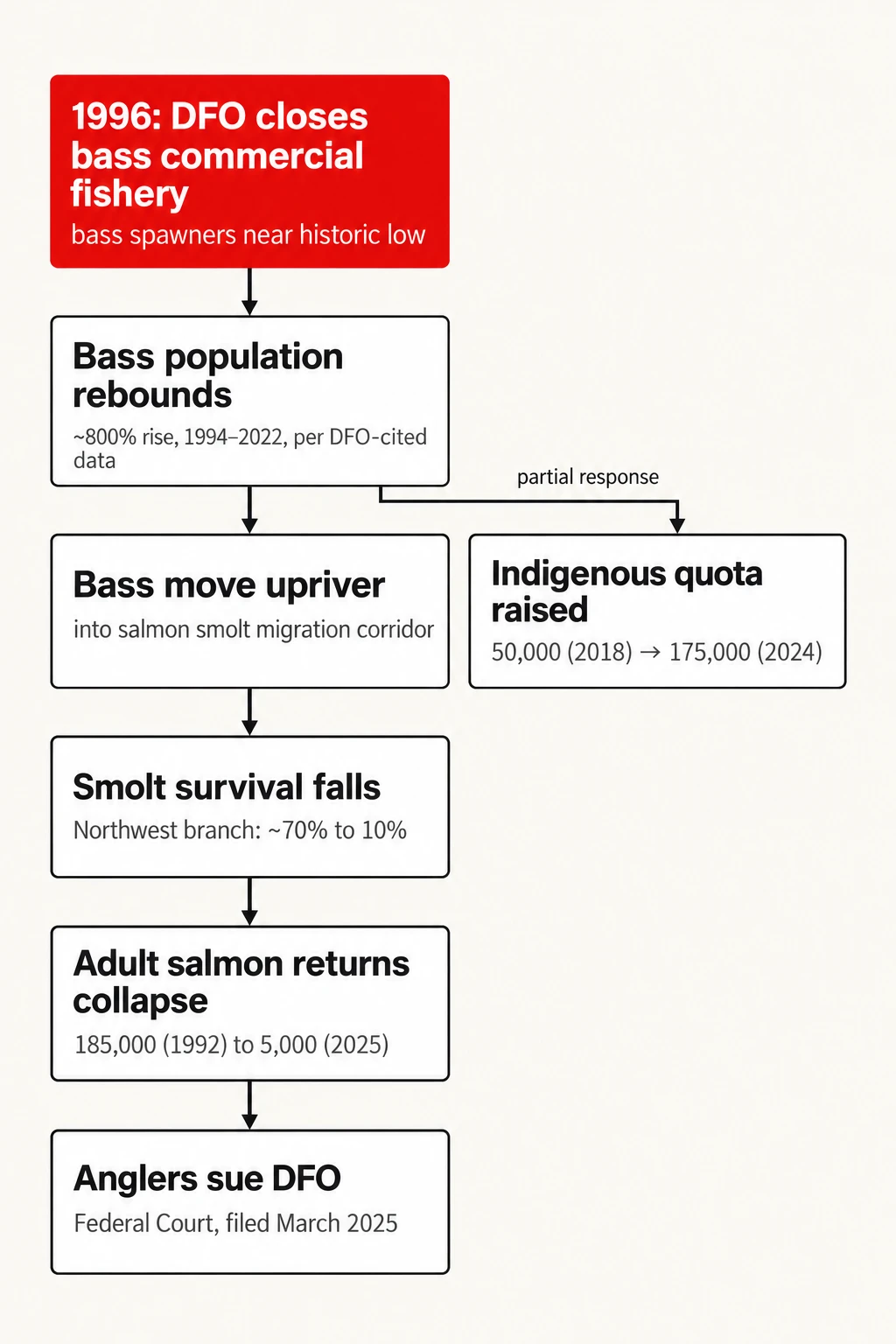
| From | To | How |
|---|---|---|
| 1996: DFO closes bass commercial fishery (bass spawners near historic low) | Bass population rebounds (~800% rise, 1994–2022, per DFO-cited data) | |
| Bass population rebounds (~800% rise, 1994–2022, per DFO-cited data) | Bass move upriver (into salmon smolt migration corridor) | |
| Bass move upriver (into salmon smolt migration corridor) | Smolt survival falls (Northwest branch: ~70% to <10%) | |
| Smolt survival falls (Northwest branch: ~70% to <10%) | Adult salmon returns collapse (185,000 (1992) to <5,000 (2025)) | |
| Bass population rebounds (~800% rise, 1994–2022, per DFO-cited data) | Indigenous quota raised (50,000 (2018) → 175,000 (2024)) | partial response |
| Adult salmon returns collapse (185,000 (1992) to <5,000 (2025)) | Anglers sue DFO (Federal Court, filed March 2025) |
The case against DFO
The non-profit Save Miramichi Salmon Inc. filed a statement of claim against DFO in Federal Court on March 13, 2025, alleging the fisheries minister breached a duty to conserve Atlantic salmon by favouring the bass fishery. The group, which the CBC reports includes anglers Bradford Burns, Rip Cunningham and Alex Mills plus lodge and camp owners, alleges the Miramichi salmon population fell about 96 per cent between 2010 and 2024. It wants the court to order DFO to open harvests large enough to cut bass toward 100,000 fish — the plaintiffs’ estimate of the level at which predation would no longer threaten the salmon run — and to fund hatchery supplementation aimed at 2010-era salmon numbers. Mills told a House of Commons fisheries committee this month that “we have a crisis facing Atlantic salmon and other species on the Miramichi.”
The government has tried twice to have the case thrown out. Federal Court Justice William Pentney rejected an administrative dismissal attempt and, on September 23, 2025, ordered an in-person jurisdictional hearing rather than the Zoom hearing the Crown wanted. That hearing took place in Fredericton on December 10, 2025, with Catherine McIntyre for the Attorney General arguing the plaintiffs lacked standing. Pentney reserved judgment; no ruling had been issued as of this month, per coverage by the Brooks Institute’s Animal Law Digest. A second filing, seeking judicial review of DFO’s refusal to let the Miramichi Salmon Association collect smolts for stocking, followed.

DFO’s management has moved, but not in the direction the plaintiffs want. For 2026 the department closed a 9.8-kilometre stretch of the Northwest Miramichi below the Red Bank Bridge to all angling for up to ten days once bass were observed spawning there, under a variation order described on DFO’s Gulf Region site. The rationale: the Northwest Miramichi estuary is, in DFO’s words, the only confirmed successful striped-bass spawning ground in the southern Gulf — and precisely the stretch the smolts must cross to reach the ocean.
A tournament that needs the bass to stay
The city of Miramichi has built a second economy on the fish anglers blame for killing the first one. The Miramichi Striper Cup, launched in 2015, drew 210 registered teams to its 2026 edition, held May 23–24. Earlier local reporting put the prize pool as high as $150,000 and the spin-off for the city above $1 million. Economic development officer Paul McGraw told the CBC the tournament’s growth is “one hundred per cent” attributable to the bass boom and declined to weigh in on the salmon dispute: “We’d be naive to think there wasn’t a controversy, but that’s not what we’re into.” At this year’s opening, co-founder Jeff Wilson urged anglers to lobby against a reopened commercial bass fishery: “It’s been here for millennia. They’re not bad. They’re good. Bass are good.”

Trucking fish around the problem
While the lawsuit works through the courts, ASF, the Miramichi Salmon Association and Anqotum run a trap-and-truck operation at Wayerton: smolts are caught in rotary drums, tagged, counted, and driven downriver past the bass concentration before release. The tribal council describes a target of up to 5,000 smolts a season, half held back as an untransported control group. ASF biologist David Roth called it an emergency measure to the CBC: “Concept-wise, it works. It’s really just about the numbers that you can catch in total. It’s not like we want to transport fish for decades to come.” Cunningham, the salmon-club angler, is less convinced: “You cannot get enough of them in tanks and move them around to make any reasonable difference to this river.”
A longer-range proposal came from the North Shore Mi’kmaq Tribal Council, which submitted a five-year, $38-million strategic plan to DFO on April 17, 2025 — habitat restoration, bycatch reduction and bass management alongside salmon stocking — according to reporting on the Plamu First plan. General manager Jim Ward said “what’s missing is the support to act.” DFO had not committed funding as of the most recent reporting.
The numbers to watch are Pentney’s ruling on standing — which will decide whether a Canadian court can second-guess a fisheries minister’s predator-prey trade-offs at all — and DFO’s next stock assessment, due to update the 345,000 bass estimate and the sub-5,000 salmon count that triggered the suit.