
Last week in Fort Worth, roughly a hundred asset managers, venture capitalists and tech founders gathered for something called the Rock Yard Roundup, an event whose agenda included a honky-tonk crawl and a visit to the Stockyards Rodeo. It was, on reflection, the perfect venue to discuss the artificial intelligence industry, because American finance has always done its clearest thinking within sight of a man being thrown off an animal.
The man doing the throwing, in this case, was Scott Wilson, who runs one of the largest university endowments in the United States. Wilson knows what it is like to make a contrarian bet and win: his early investment in SpaceX helped create a multi-billion-dollar windfall for Washington University. Now, Business Insider reports, he is making the opposite kind of bet. The frontier AI labs, he told the crowd, are doomed.
Wilson had his own chance to get into OpenAI early and passed, unconvinced the company would ever make money. “When we looked at the original OpenAI deal that some of our peers participated in and made tons of money on paper, we were highly skeptical,” he said. “I’ve gotten more skeptical over time.”
The peers did fine, it should be said. OpenAI has returned huge markups to venture firms and to schools like the University of Michigan, whose early $20 million stake is now worth more than $2 billion. Wilson’s position is that the story ends badly anyway.
These trillion-dollar-plus frontier companies are not worth the liabilities that they signed up for. There’s going to be a ton of free alternatives.
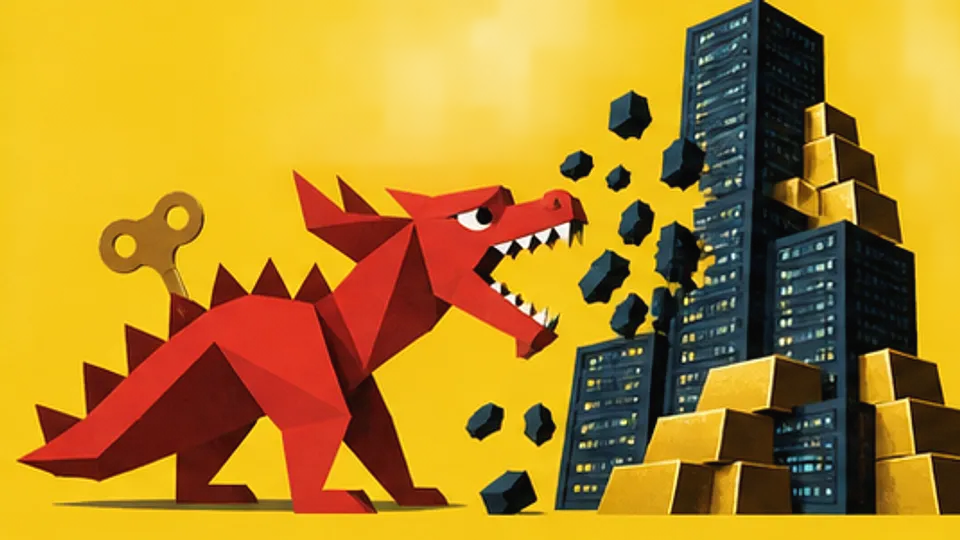
His argument is that OpenAI and Anthropic have committed to colossal spending at exactly the moment cheaper Chinese models are catching up. He says colleagues in China have watched open-weight models improve at speed, and the founders of companies his endowment backs keep telling him the same thing. “Whenever we talk to our portfolio companies, especially the ones who are heavy of AI, they are all moving aggressively towards open source,” he said. “It’s like any other high-cost U.S. good that has to compete with a low-cost import, particularly from China.”
The imports in question have names: DeepSeek, Alibaba’s Qwen, Zhipu AI, Tencent. They have narrowed the performance gap with the American frontier labs while undercutting them badly on price, which has set off a wider investor argument about whether OpenAI and Anthropic — the latter expected to go public next month — can sustain the spending required to stay ahead if customers can defect to something almost as good for a fraction of the cost.
There is a data point in Wilson’s favor, a limited one. On OpenRouter, a platform where developers route requests between models, DeepSeek accounts for 25.3% of text-model traffic, compared with 18.6% for OpenAI and 2.9% for Anthropic. It is a snapshot of one platform, not the whole industry — but it is a snapshot in which the free alternative is winning.
Khosla has never been more bullish
Vinod Khosla, the billionaire venture capitalist and early OpenAI investor, told Business Insider he strongly disagrees and has never been more bullish on the company. His review of Wilson’s thesis was not complicated. “People like that are silly, and they don’t understand how this works,” he said. “They have this notion that the model is the value.”
Khosla’s counterargument is that the value sits underneath the model, in the expensive machinery: a closed lab can design chips around its own systems, as OpenAI has done with its Jalapeño inference chip, reducing dependence on Nvidia hardware and third-party clouds. An open-weight model still has to run on somebody’s data center, and somebody — quite possibly Khosla’s portfolio — gets paid either way.
I’m not talking price, I’m talking about cost. From power to data center to chips, to infrastructure software to inference models, the cost of the stack is almost certainly going to be lower in closed-source models than open-source.
So there you have the debate in its entirety. One man, who passed on the deal, has studied China and his portfolio and concluded the whole edifice is a rodeo act. The other, who is inside the deal and several billion dollars richer on paper, says the skeptics cannot see the stack for the models. Both spoke with total confidence, which is the one thing the AI industry has never had trouble producing.
Perhaps both will be right in sequence, which is how these things usually go: the skeptics are early, the bulls are rich, and then everyone is surprised. The crowd in Fort Worth at least had the advantage of watching the principle demonstrated nightly. A cowboy always believes he is in charge of the bull, right up until the moment he isn’t.