
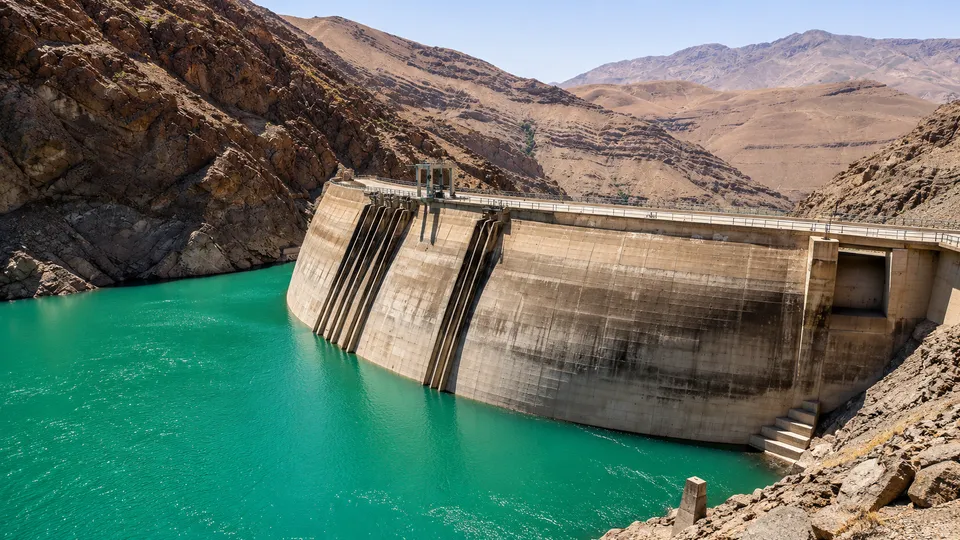
A New York Times investigation into Iran’s dams has prompted an unusual public rebuttal from researchers whose work and comments informed it. The dispute concerns a suggestion that some water infrastructure might have supported Iran’s underground missile programme, and whether that suggestion was supported by enough evidence. It is unfolding amid threats of further attacks on Iranian civilian infrastructure, which gives the distinction between a geographical observation and a conclusion about military purpose immediate practical significance. Al Jazeera detailed the report and the response.
Published on Tuesday under the headline “War May Answer Longtime Riddle of Iranian Dams Built for No Clear Reason”, the Times story examined possible connections between dams, pipelines and water-transfer projects and the missile programme. It cited researchers who observed geographical similarities between dam locations and sites targeted by US and Israeli strikes. Some water and military experts concluded that the “water projects may have been developed to support the country’s military buildup”.
The newspaper also stated the limitation plainly: “Given the secrecy surrounding Iran’s missile program, any connection between it and Iran’s ambitious, decades-old initiative to develop water infrastructure remains speculative. But some experts find the evidence highly suggestive.” The report therefore did not claim to have established that particular dams were built for missile facilities. Its suggestion rested on spatial relationships and interpretations offered by experts.
Kaveh Madani, director of the United Nations University’s water institute and a former senior Iranian environmental official, challenged that reasoning. “Speculation is not evidence. Spatial proximity is not causality,” he wrote on X. He called the narrative irresponsible and said it could have dangerous consequences for civilian water infrastructure. Madani also disputed the newspaper’s account of expert support: “I’m one of the people quoted in the article, but my comments had nothing to do with dams or missiles!”
Nima Shokri, a water-security expert at Hamburg University of Technology whose research featured prominently in the investigation, issued his own clarification. “The proximity of dams to military targets does not establish why those dams were built, nor does it justify attacks on them,” he said. Amir Aghakouchak, a water expert at the University of California, Irvine, said he fully agreed. Aghakouchak stressed dams’ roles in water supply, food security, energy and environmental sustainability, and said they must never become military targets.
The political concern is that describing civilian facilities as potentially military could make them appear easier to attack. US-Israeli attacks on Iran since February 28 have damaged oil facilities, power plants, water reservoirs, bridges, hospitals and other civilian infrastructure. President Donald Trump has repeatedly threatened further attacks, saying last week that key Iranian infrastructure could be destroyed within three days. In that setting, critics argue, speculation about dual purposes carries risks beyond an ordinary academic dispute.
Political analyst Rami Khouri called the report “troubling” and accused US mainstream media of complicity in attacks on Iran, referring also to Iraq and, in his words, “the ongoing genocide in Gaza”. He pointed to the accumulation of conditional language: “The telltale sign of non-credible wobbly journalism is when conditional words like ‘speculative’, ‘suggestive’, ‘may have developed’, ‘may shed light’, ‘suspect’, and ‘long-term riddle’ occur more often than any definitive, evidence-based facts.” He said the article was not definitive, verified reporting.
Iranian officials made a similar argument in more confrontational terms. Foreign Ministry spokesperson Esmaeil Baghaei called the allegations baseless and said they formed part of a campaign to manufacture security pretexts for attacks on vital infrastructure. Foreign Minister Abbas Araghchi dismissed them as “rubbish”, writing: “Spare us the Iraq War-style propaganda, especially with Israeli fingerprints all over it.” Parliament speaker and chief negotiator Mohammad Bagher Ghalibaf responded: “New rule: Any dam, port, or power plant near a US or Israeli base is dual-use. We’ll apply your logic consistently and even-handedly.”
The Times rejected the accusation that its report could furnish a pretext for violence. Spokesperson Nicole Taylor said: “Our report on Iranian dams accurately cited research and analysis by seven international experts on Iran’s environment and military presence.” She said the journalists had sought to explain Iran’s infrastructure investment and the effects of US and Israeli attacks on civilians. “Framing the independent reporting as a pretext for violence is dangerous,” Taylor added.

Co-author Sanam Mahoozi said that “neither I nor our report endorses or justifies attacks on dams or other infrastructure”. She welcomed rigorous, constructive criticism while asking readers to assess what was actually written. The story was co-written with Erika Solomon, the Times bureau chief for Iraq and Iran. The disagreement is therefore partly about accuracy and partly about implications: the newspaper describes a carefully qualified investigation, while quoted researchers dispute how their expertise supports its central suggestion.
The comparison with pre-Iraq War reporting has particular historical weight. In September 2002, former Times journalist Judith Miller co-authored a report saying Iraq had intensified its pursuit of nuclear weapons, citing US officials who said Baghdad sought aluminium tubes for uranium enrichment. Vice President Dick Cheney used that reporting to support the Bush administration’s case against Iraq. The claims were later discredited.
Two months after the March 2003 invasion began, Miller co-authored a report saying US intelligence agencies had concluded that two trailers found in Iraq were mobile units to “produce germs for weapons”. A year after the war started, the Times acknowledged serious shortcomings in its prewar coverage, including reliance on Iraqi defectors and exiles seeking regime change. “We have found a number of instances of coverage that was not as rigorous as it should have been,” it said.
That history does not settle whether any particular Iranian dam has a military connection. It does explain why readers examine the evidence and attribution so closely. Three researchers associated with the report have now publicly narrowed or rejected its implications. A dam being near a struck location tells us where the dam is. Establishing why it was built requires something more.