
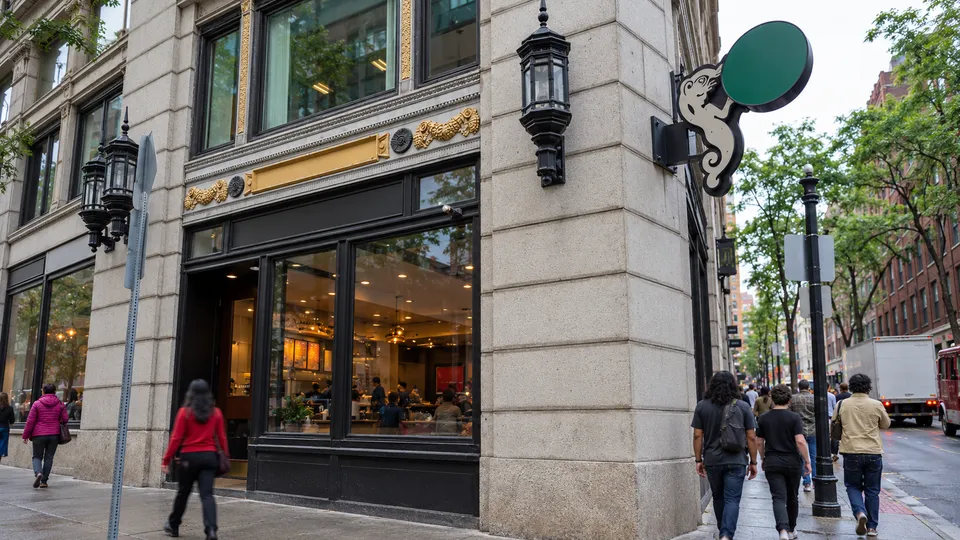
Above a corner doorway in Government Center hangs a copper kettle, perpetually steaming, a relic from an older Boston. The Starbucks beneath it is gone — the green branding stripped last fall — yet the company still holds the lease and pays the rent, a corporation paying for a room it no longer inhabits. It is as good a monument as any to what has happened to the coffee chain that once ruled downtown Boston. In recent weeks it closed 125 Summer Street and the shop at 8 North Market Street by Faneuil Hall, adding to nearly twenty stores shuttered across Greater Boston last year. What remains of the empire downtown is a single outpost at 84 State Street, the Boston Globe reported, where customers now crowd week mornings into the last room left to them.
A billion-dollar retreat
The Boston closures are one front in a $1 billion restructuring launched last year: hundreds of stores closed across the US and Canada, 900 corporate employees laid off, all to reverse sluggish sales and long waits at the counter. Chief executive Brian Niccol has framed the cuts as an effort to bring the soul back to Starbucks — shedding weak stores, improving the survivors. The analysts describe it with less poetry. “Starbucks spent two decades behaving like a music artist who parks a dozen tracks on the Hot 100 and then wonders why none of them hit number one: cannibalization,” said Michael Ashley Schulman, a Cerity Partners partner and a Starbucks cafe manager in his college days. Closing weaker stores, he said, herds loyal customers toward better-equipped ones nearby. The chain is pulling out of dense city cores like downtown San Francisco while expanding toward suburbs and drive-throughs, where rent and labor run cheaper.
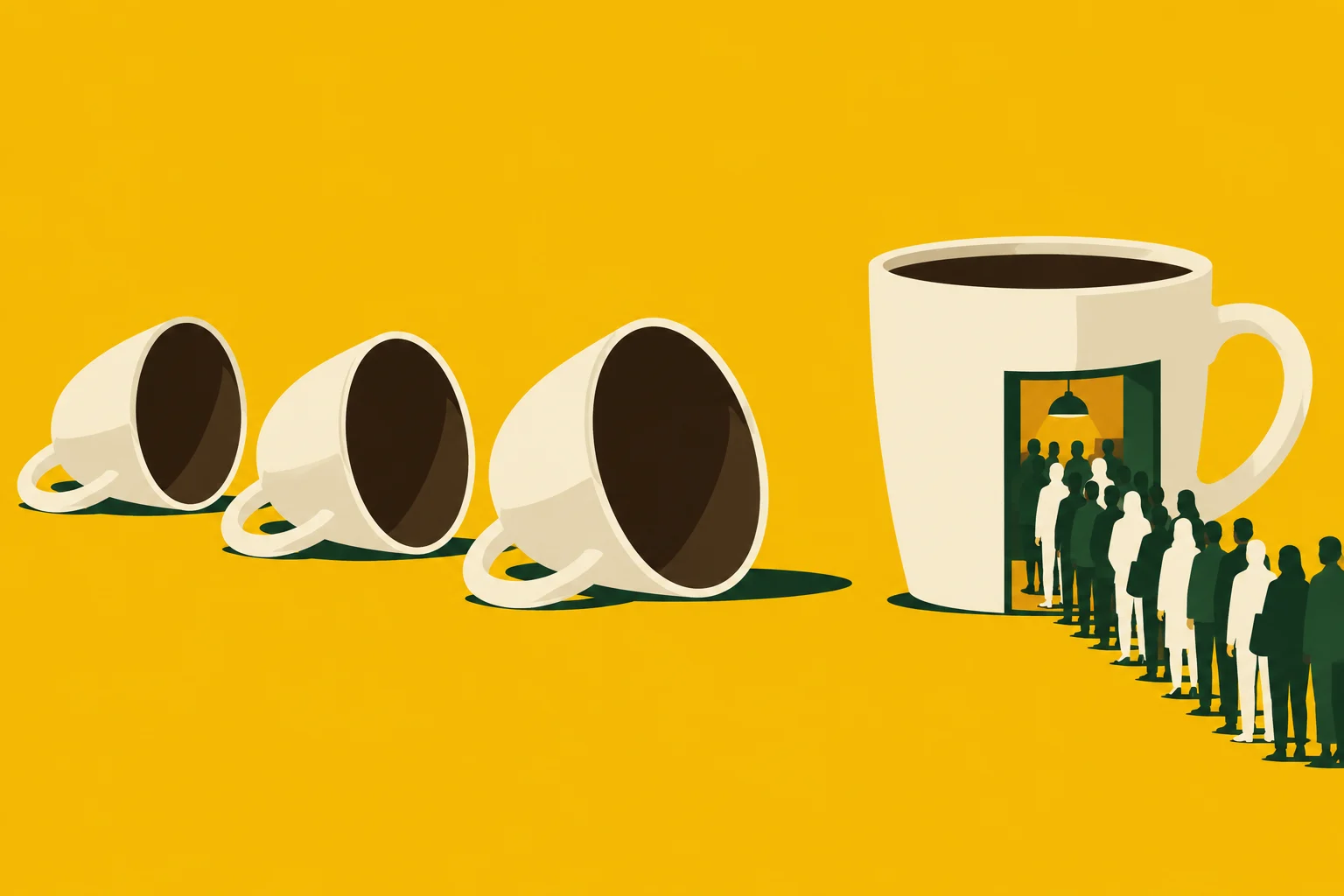
There was a time when Starbucks sold itself as the “third place” between home and work. But it increasingly opened small takeout boxes instead of cafes, said William A. Masters, a Tufts professor of food policy and economics — and “those locations turned out to be less profitable than their earlier outlets.” Mobile ordering, meant as a convenience, piled digital orders on top of the line at the counter until pickup areas became what even founder Howard Schultz has called “a mosh pit.”
The customers who left on purpose
Not everyone departed for want of convenience. Five of the local shops closed last year were unionized, including the once-teeming cafe on Commonwealth Avenue near Boston University, where workers held a lengthy strike in 2022. Labor supporters say the closures appeared to target union stores. Starbucks insists union status played no part in its national decisions. “These store closures are being implemented through a thoughtful, lawful process. We used an objective set of criteria, including long-term performance and customer experience,” a company spokesperson said — while declining to answer questions about the Boston locations or the city’s strategy.
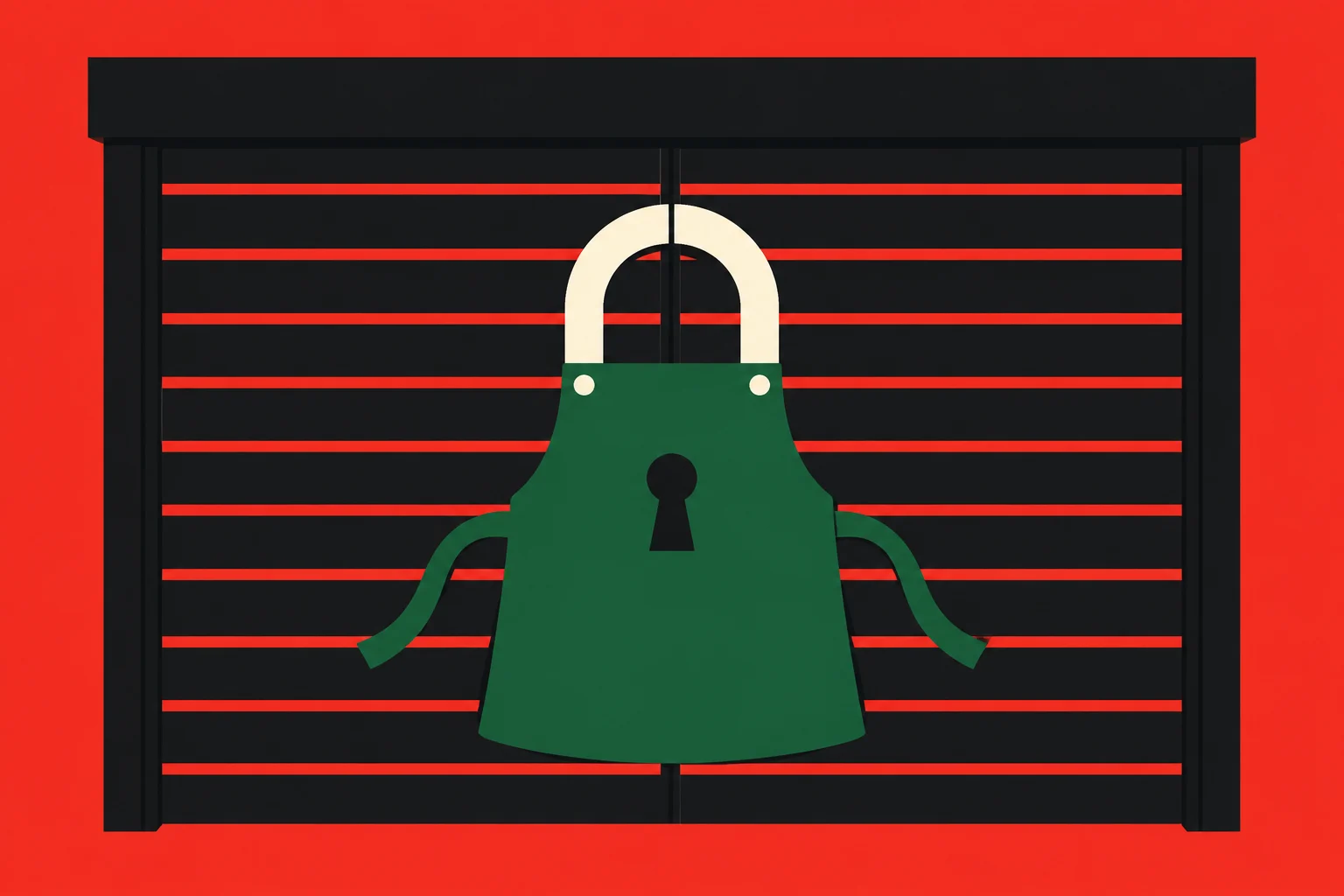
Sara Osborn, a Watertown business analyst, began boycotting last year after labor disputes at stores near her home and office; she was once regular enough to keep the company’s vanilla syrup in her own kitchen. “I won’t go back to Starbucks until the workers have a contract,” she said; she now pays $20 for another company’s cold brew concentrate, shipped to her house every two weeks. Lia Kahan, an Allston resident in public health, puts the matter as a creed: “We vote with our money,” Kahan said. “I subconsciously judge people when I see them with a cup of Starbucks. It’s meaningful to invest back in Boston, instead of corporations that don’t care about their people.” Calvin Cestari, a downtown resident who works in marketing, offered the bluntest epitaph: “I’ve had it... I’m not going [there] for my own sanity.” He goes to Espresso Love, a locally owned shop nearby.

The thirst remains
Boston has not lost its taste for coffee — only, perhaps, its patience for one brand of it. The locally owned Tradesman Coffee Shop & Lounge opened its fourth location near South Station on The Greenway this summer. Blank Street Coffee, which has raised more than $105 million in funding, and MOTW Coffee & Pastries, bound for Broad Street in the Financial District under franchisees who run a Shrewsbury location, are hunting prime downtown real estate. Ralph Lauren’s luxury Ralph’s Coffee has arrived in the Seaport. Since the start of 2025, roughly 40 new brick-and-mortar coffee shops have opened across Boston, according to the city’s Office of Economic Opportunity and Inclusion — though only a handful of them downtown, where the empty storefronts, some vacant more than a year, mark the corridors of the retreat.
At the kettle building, listing agent Ben Ravelson of Atlantic Retail said the landlord feels little urgency while Starbucks remains a paying tenant. “We do have a deal that’s in process, but it’s not signed yet,” he said, declining to say when the lease ends or who would come next.
There is a fine historical irony at the end of Washington Street. George Howell — the “godfather of specialty coffee” — sold The Coffee Connection to Starbucks in 1994 for $23 million, a deal that helped fuel the very chain that came to define American coffee culture and then overran his city’s downtown. Today, as the empire contracts, Howell’s own cafe cannot seat its customers. “Even I have to go sit in the lobby of the [Godfrey] hotel,” he said. “It’s always jammed.”