
The odds are good, but the goods are odd.
One woman said that to New York magazine, and for a certain kind of modern dater it will carry the weight of a sentence typed at midnight. Possible mates abound now, in app stores and in the databases of professional matchmakers. What does not abound, by many accounts, is a person anyone actually wants. Olga Khazan, writing in The Atlantic, collects the evidence the way you would collect complaints at a bar: a man interviewed by The New York Times, 38 years old, stood at forty first dates without finding one that held. He went out with a woman who looked right on paper. He said afterward that “there was something that was … off.”
The ellipsis is doing the work there. It always is.
Something was off, and no one could say what, and that inability is itself the story. Khazan’s colleague Faith Hill has reported that more and more Americans are having trouble finding love, and that the trouble does not change with the app or the service or the price tier. The inventory keeps growing. The transactions keep failing.
Explanations have been offered. There is the paradox of choice. There is the gamification of courtship, the swipe as slot machine. But Khazan, after talking with several academics, lands on an explanation that is quieter and more structural: people do not hang out anymore. Or, more precisely, men and women do not spend time together the way they once did, in rooms where no one was dating anyone, in mixed-gender contexts that had nothing to do with courtship — a job, a dinner, a friend’s kitchen, a Tuesday.
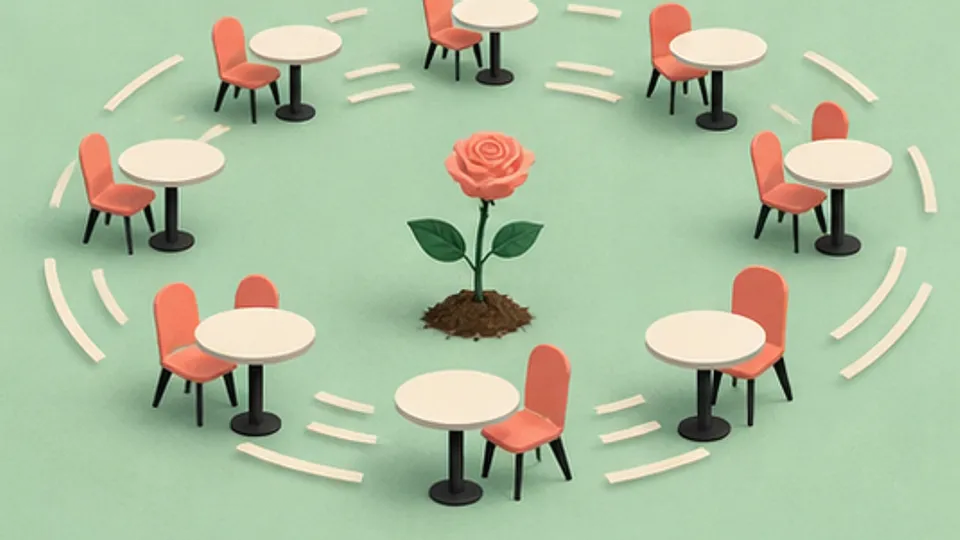
What replaced those rooms is a procedure. A matchmaker makes a selection, or an algorithm does, and two strangers sit down across a restaurant table. They conduct what Khazan describes as 90 minutes of small talk. They are each, in the same ninety minutes, conducting an evaluation. Is there a spark. Would there ever be a spark. The format is an interview, and it behaves like one: both candidates perform, both are guarded, neither is at their best, and at the end each party fills out a mental scorecard on the basis of an interaction that revealed almost nothing about who the other person is at a barbecue, or on a bad day, or in the seventh week of knowing them.
The interview model
Notice what the old way did that the new way does not. In the room where no one was dating, attraction had time to arrive unannounced. You met someone three times before you thought about them twice. You watched how they treated people who could do nothing for them. The romance, as Khazan puts it, had the opportunity to build before the first date — often before either party could have told you there would be a first date. The app inverts the sequence. First comes the declared intention, then the meeting of strangers, then the demand that a feeling justify the arrangement on the spot, in ninety minutes, over drinks that somebody chose.
It is not a system designed to produce intimacy. It is a system designed to produce datedness — a countable output, a weekly appointment, forty entries in a spreadsheet of first meetings, each one certified and evaluated and found to be somehow off.
And it is hard, reading the accounts people give of this process, not to notice that the language has been borrowed from the supply side of the economy. There are goods. There are odds. There are pools and pipelines. What there is not — or not enough of, several academics told The Atlantic — is the unhurried, unscripted, unofficially coeducational social life in which a person might, without scheduling it in an app, become interesting to someone.
The goods are odd. Perhaps they always were. Perhaps the difference is only where we used to find that out.