
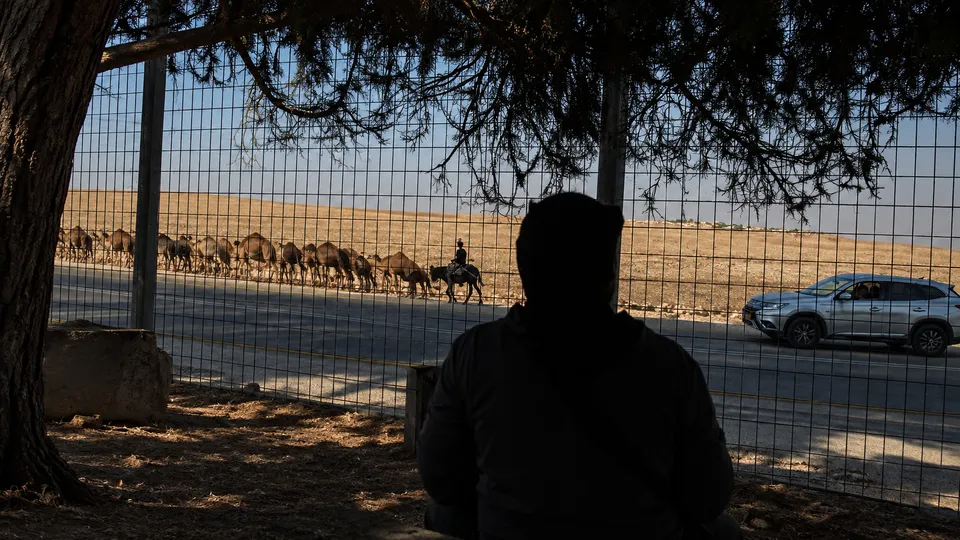
In the occupied West Bank, even paradise requires planning permission — or, failing that, a hosepipe. Over the summer, water from a natural spring feeding the Palestinian village of Fasayil was illegally siphoned off to an ancient pool nearby, which was promptly declared a new tourist attraction and named after Herod, the Roman-appointed king of Judea. The episode is a small theft that tells a large story.
The victim, at least, is easily identified. Saad Nemer, a Palestinian farmer from Fasayil, says the diversion has devastated his fields. COGAT, the Israeli military body overseeing civil affairs in the West Bank, has acknowledged the water was diverted “without authorisation” and says it will investigate. The spring, like many across the territory, is a lifeline for Palestinian communities that depend on such sources for irrigation and tourism.
The antiquity of the prize is genuine if murky. It is unclear when the pool was built; other ruins in the area date to the first century BCE, during Herod’s reign, according to excavations by the archaeology unit of Israel’s Civil Administration. Amihai Eliyahu, Israel’s far-right heritage minister, told the Associated Press the pool will be drained in early October so archaeologists can complete a full survey. He praised whoever originally diverted the water and announced that around $1 million could be set aside to rehabilitate the site. “We’ll turn this place into the Garden of Eden,” he said during a visit.
Critics see method rather than enthusiasm. B’Tselem, an Israeli rights group, says the push to take over heritage sites is part of a broader effort to “elevate the historical, cultural, and religious ties of the State of Israel and the Jewish people to the West Bank”. Archaeology, in this telling, is annexation with a trowel: unearth a biblical past, and the present-day claims of the people farming nearby tend to sink beneath it.
Dry taps and sharper elbows
Fasayil is no outlier. Palestinians have faced water shortages and restrictions in the West Bank since Israel took control of the territory in 1967, and rising settler attacks have made matters worse. According to a recent report from the UN Office for the Coordination of Humanitarian Affairs, settlers damaged, destroyed or seized approximately 160 water and sanitation structures in Palestinian communities in 2026 alone. The report found attackers increasingly targeting shared water infrastructure, disrupting supply to all or large parts of several communities. Thirst, it turns out, is a policy instrument.
Governments further afield have begun to respond, if modestly. Earlier this month 12 countries — Canada, Denmark, Finland, Iceland, Ireland, Norway, Poland, Portugal, Spain and Sweden, joining Britain and France — announced plans to introduce restrictions on trade with settlements. In a joint statement, their foreign ministers described a “rapidly deteriorating” situation with “unprecedented levels of settler violence and settlement expansion”, and declared that the Israeli government’s actions “are undermining the possibility of a two-State solution”. “Together, we are resolute: the two-state solution must be protected,” the statement said.
Resolution has its limits. Trade with settlements is a sliver of commerce, and the sanctions stop well short of touching Israel proper. The Israeli settler population in the West Bank, including East Jerusalem, stood at around 737,000 as of October 2024, according to the UN human-rights office, and violence has surged since the war in Gaza began after Hamas’s attacks on Israel on 7 October 2023. The settlements remain illegal under international law — a judgment that has done little to slow their growth, or to refill Fasayil’s spring.
The pool by Fasayil will be drained next month, surveyed, polished and renamed. Whether the water ever flows back to Mr Nemer’s fields is a question for an investigation that has yet to be completed. In the meantime the pattern holds: take the water, cite the Bible, and let the diplomats express their resolve.