
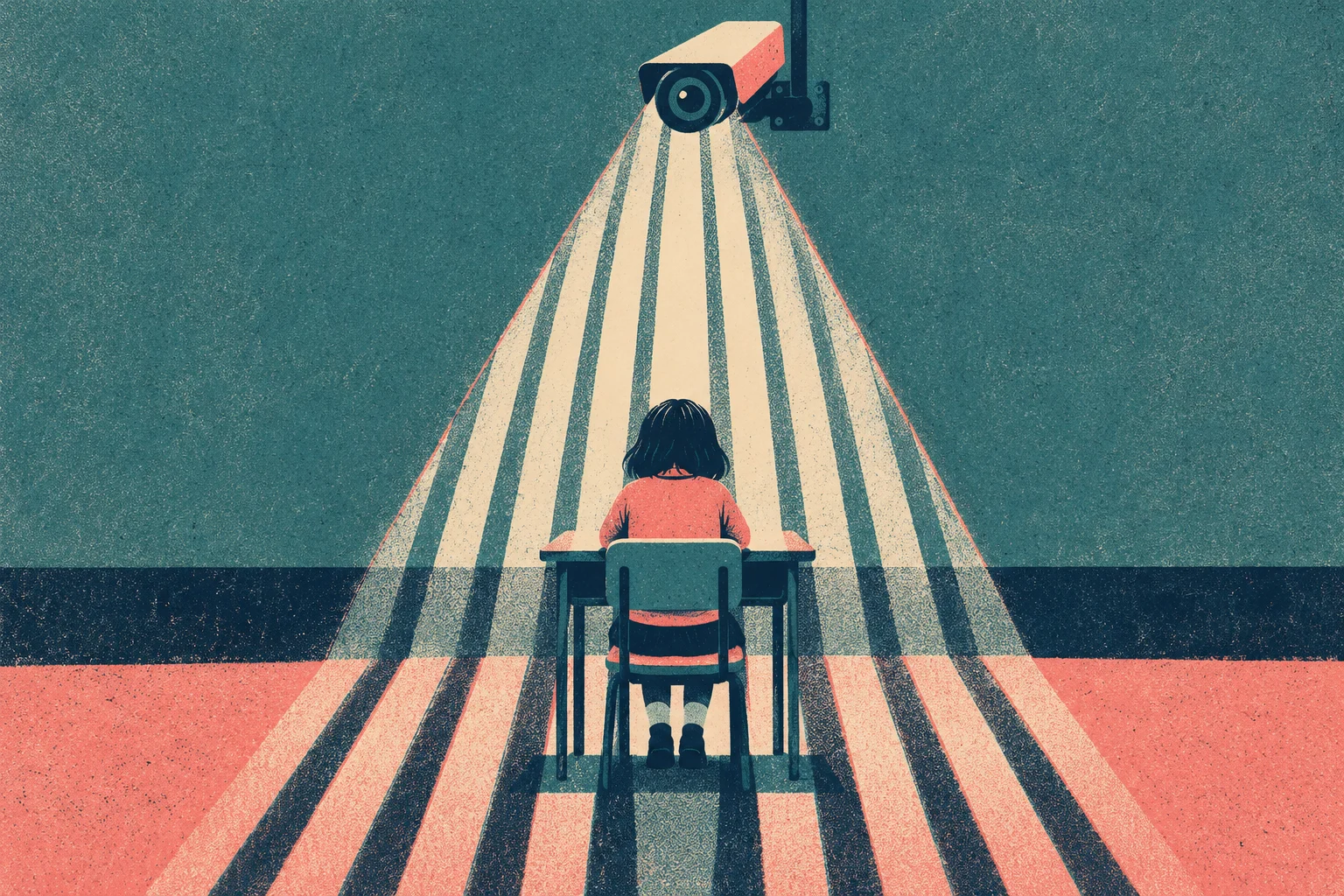
Every regime that has ever watched its citizens has offered the same defence: the watching is for their own good, a tool, a lesson. In London, Ontario, in a church building in the Wortley Village neighbourhood, the argument has descended to the smallest of citizens — children, some as young as four, living their school days beneath cameras, then gathering to watch the footage of their own misbehaviour projected on a screen. As CBC News reported, the Office of the Privacy Commissioner of Canada is investigating the practice at a private school called Infinity School after receiving a complaint.
Lincoln Sandle, 11, attended Infinity School from August 2023 until January 2026, through Grades 3, 4 and 5. “The whole class was in one room, and we had a projector and we watched us with audio,” he told CBC. “[We watched] how we were misbehaving and who needed the most help. People watching me is weird. I just don’t like people invading my privacy.”
His parents gave CBC permission to interview and photograph him. His account of the school is the account of a child who learned early what it means to be observed. “You couldn’t really talk about anything private with your friends,” he said. “It just cages us up.” Lincoln estimates there were up to 10 cameras around the school — in classrooms, hallways, the gym, the library.
The network and the design
Infinity School describes itself as devoted to hands-on, self-directed learning. It rents space in the Wortley Village church for its multi-grade classrooms, and it is an affiliate of Acton Academy, a U.S.-based network of schools built around Socratic discussions and project-based “quests.” Each school is independently owned by what the network calls “parent entrepreneurs,” who must follow a “shared learning design and high standards of excellence.” A map on the network’s website shows nearly 300 Acton schools around the world, nine of them in Canada.
Jake Thompson, head of the Acton Academy Network, and Infinity School principal Eric Brown defended the cameras in a joint emailed statement to CBC, calling them a tool. “At Acton, we trust young people with the responsibility for their own learning, and an important part of that learning is leadership,” Thompson wrote separately. “Cameras give learners the ability to document, review and reflect on their leadership and learning experiences.” Neither man agreed to an interview. They did not answer questions about when and how parents were informed, beyond saying the cameras are “openly discussed and visible to families.”
Lincoln’s father, Greg Sandle, tells a different story. He did not know the school had cameras when he enrolled his two children, though he began noticing them on visits. “I thought they were just for security … I didn’t believe that the cameras would be used for anything other than what I thought they were intended for, which was just safety of kids in the school,” he said. He learned otherwise in a December 2025 correspondence in which the principal referred to camera footage. Other parents told CBC they discovered the cameras only earlier this year, when the topic began circulating among parent circles.

Whose eyes, and under which law
The law here is a divided map. Ontario’s public schools answer to the Municipal Freedom of Information and Protection of Privacy Act; school boards must have “lawful authority” to collect personal information, consent is not required, but public notice is owed as a matter of transparency, a spokesperson for the province’s information and privacy commissioner said. Private schools are another territory. The federal Personal Information Protection and Electronic Documents Act, overseen by the OPC, may apply to private schools “if they engage in activities that are commercial in nature” — and Infinity School is listed on the Ontario Business Registry as a corporation. “PIPEDA provides that, unless certain exceptions apply, the knowledge and consent of the individual is required for the collection, use, or disclosure of their personal information,” said OPC spokesperson Vito Pilieci. He would not describe the complaint but said the office is reaching out to the school to gather information and decide next steps.
Then there is the question of the livestream. Sarah Starrs, who enrolled her then seven-year-old son in September 2024, recalls being told at her admissions interview that cameras would be used as a learning tool in the older students’ classrooms — not, she assumed, in her son’s mixed-age room, which held children as young as four. Searching the school’s parent portal in February, she found for the first time a privacy policy spelling out camera use and livestreaming capability. “I felt surprised and confused,” she said. According to a July 2026 privacy policy on Infinity School’s website, Acton Academy requires every school in its network to have cameras with livestream capabilities “for schoolwide inspection purposes only.” But who inspects, and from where — the network is based in the United States — the parents do not know. CBC asked Thompson and Brown repeatedly and received no direct answer. “We regularly revisit our policies and are currently reviewing not just camera use, but our broader approach to privacy, to ensure we are best serving families across our campuses,” they said. Starrs withdrew her son in May for unrelated reasons, though she says the opaqueness around the cameras contributed to the decision.

What watching does to the watched
The deepest testimony belongs to the child. Lincoln said the cameras made him anxious about going to class. “I always tried to be the favourite person because then I wouldn’t have bad stuff happen to me, like people watching me.” When his parents pulled both children from the school in January — after unrelated difficulties, his father said — Lincoln finally told them about the in-class footage reviews. “It was heartbreaking [to hear] because we wanted to do the best we could for the kids, and it makes us feel like it was the worst decision of our lives to put him in that situation,” Greg Sandle said. Lincoln, his family reports, is happier at his new school.
Alissa Centivany, co-director of the Starling Centre for Just Technologies & Just Societies and a professor at Western University, hears in all this an inversion of purpose. “Schools have a responsibility to student safety and well-being,” she said. “I think what we’re seeing with the use of cameras in schools is that it’s actually having the opposite effect, and it’s diminishing schools’ ability to carry out their legitimate and legal responsibilities.” Surveillance, in her judgment, belongs where law authorizes it and necessity demands it — illegal activity on school grounds, fights outside the building. The men of power always say the eye is there to protect. An eleven-year-old, it turns out, can tell the difference between being protected and being watched.