
India counts 1.4 billion people. One in a hundred of them, by the estimate of a 2022 EY India report, has ever been screened for cancer. Four in five who get the disease arrive at a hospital already at stage three or stage four, past the point where the finding is news anyone wants to receive. The record is not complicated. There are not enough doctors, not enough time, not enough money for 1.4 billion checkups. So a startup in India decided to skip the hospital part.
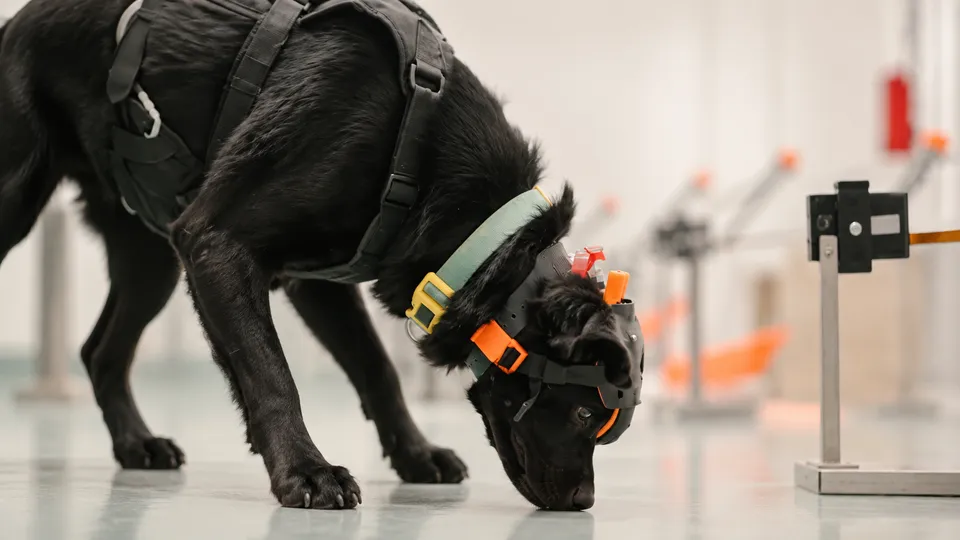
The company is called Dognosis, and its product, BreathEasy, is a mask. You breathe into it, you mail it, and a trained dog smells it. Ten minutes later the screening is done. What the dog is reading are volatile organic compounds, the molecular traces a body gives off, and what a private AI system is reading is the dog: its behavior, its breathing, its brainwaves, all of it analyzed to decide which breaths smell wrong.
The company says the wrongness is measurable. In a phase 2 study published this past April in the Journal of Clinical Oncology, the dogs’ diagnostic attempts registered a sensitivity of 90.8 percent and a specificity of 91.3 percent across more than 20 distinct cancer types. Head and neck, breast, lung and thoracic, gynecological, upper and lower gastrointestinal, genitourinary. At stage one, the earliest and most treatable, sensitivity held at 90.3 percent. Even at stages three and four, the figures stayed within a single percentage point. The numbers are the company’s, from its own trial. More cancer types, the company believes, could be proven detectable, but that awaits data from clinical trials still underway.
BreathEasy is scheduled to launch in early 2027, in Bengaluru.
The question of what the dog smells
It is easy to say a dog smells cancer. It is also wrong, and Akash Kulgod, the company’s chief executive, is precise about it. “The dog is not smelling ‘cancer,’” he told WEEKLY BIZ in a written interview. “Through training, the dogs detect specific VOCs and signal that to a person.” Cancer changes the chemistry of the body, and the chemistry leaves the body, in breath among other ways. Breath carries 1,488 kinds of volatile compounds, and different cancers produce different patterns among them. The dog learns a chemical signature, not a disease.
And then, apparently, something more. Kulgod says the dogs have shown an ability to detect cancers of types they were never trained on. The company is testing whether dogs conditioned on VOCs from different cancers can generalize what he calls “the smell of cancer,” whether there is some shared element in the VOC signatures different tumors release. Training the dog on specifics, in other words, may have taught it a category. The record of the study and the record of the claim are two different things; Kulgod himself says only that this is what they are working to confirm.
How it started
The founding story begins, like so many stories of this decade, in 2020. Kulgod, from Belagavi in southern India, was two years into a cognitive science program at UC Berkeley when the pandemic broke. He went home. His father was treating COVID patients at the hospital in his hometown. Somewhere in there he came across the research: dogs could smell COVID-19, and in some studies they outperformed PCR testing, the standard itself. Back at Berkeley he turned the fact over. A dog detects a scent and shows a response. How do you make a diagnosis out of the response?
Itamar Bitan arrived at the same question by another road. He had spent four years working with elite detection dogs in an Israeli K9 unit, an experience that led him to an Israeli researcher studying whether dogs could sniff out breast cancer and Parkinson’s disease. The two men, who say they have now spent more than five years on this, founded Dognosis to give the dogs’ ability what the dogs themselves cannot have: infrastructure, technology, and what Kulgod describes as scale, the reach to touch enormous numbers of screenees.
Scale is the whole argument. India is the market where the case is written largest, and Kulgod does not pretend otherwise. “It is difficult for 1.4 billion Indians to get adequate cancer testing in the current situation,” he said. Most cancers there are found only when symptoms drive someone to a hospital. BreathEasy is designed to sit at the very top of the funnel, the broad, sensitive first screen. The people it flags would go on to imaging, to biopsies, to the expensive confirmatory work. Everyone else, the theory runs, simply blew into a mask.
What remains unverified
Whether any of this saves money at scale is an open question, and Kulgod says so. “Whether this actually leads to cost savings at scale is something we may be able to say confidently only after further validation and real deployment,” he allowed. Earlier detection means better outcomes and lower costs across cancer types; that part is not his claim but the field’s consensus. His caution is its own datum. The phase 2 numbers describe what trained dogs did in a trial. A launch in Bengaluru will describe what they do in the country that needs them.
Beyond cancer, the company concedes, the same machinery applies to any disease that rewrites a VOC profile. Dogs trained on different illnesses could, in principle, read one sample for many diseases. For now, everything Dognosis has is pointed at cancer.
There is also the matter of the dog itself, which Kulgod treats as infrastructure of a kind no insect colony can be. Competing approaches use insects or nematodes, which must be bred and kept. A trained dog works for years. And the bond with humans, Kulgod notes, means the pool of potential workers is not small. “I believe that in the future, even pet dogs at home could be trained for cancer detection at local training facilities.”