
The robot that Cologne police seized on October 11 sells for $4,900 before tax and shipping, comes with a handheld controller in the box, and is not, whatever two days of wire-service coverage implied, autonomous, mysterious or new. It is a Unitree R1, a 1.2-meter, 25-to-29-kilogram humanoid made by a Chinese robotics company that went public on the Shanghai exchange two months ago. According to the Cologne police press release, the machine, dressed in a tracksuit, gold chain, sunglasses and fake moustache, approached a 16-year-old girl from behind outside a fast-food restaurant on the Hohenzollernring between 11:45 p.m. and midnight on October 10, touched her buttocks and made repeated thrusting motions against her.
The girl was standing with two friends, 17 and 18, according to the police. Officers who responded found the suspects nearby, at the corner of Magnusstrasse and Hohenzollernring, with the robot already stashed in the trunk of a Volkswagen. They seized the machine and two phones as evidence. The suspects: the robot’s 16-year-old owner, from the town of Wegberg, and his 19-year-old companion, who police say filmed and livestreamed the encounter while providing commentary. Cologne police spokesman Christoph Bermel told reporters neither has been charged; investigators are still trying to establish, as CBS News reported, whether the robot’s movements were pre-programmed or driven live by remote control.

None of that required much digging, which is the point made by Jason Koebler, writing in 404 Media. The Cologne police statement described the device’s workings as something investigators would need to figure out and called the physical evidence “unusual”; the Associated Press called the whole phenomenon “new territory.” Koebler’s rejoinder is that the robot and the people operating it are both a matter of public record: a 16-year-old livestreamer who went by Agaamuza had been running the robot, nicknamed “Ahmad,” around Cologne nightlife strips for weeks, filming the same bar-prank content that has circulated on Twitch, TikTok and YouTube for years, mostly performed by men filming women’s reactions on the street. Twitch has since suspended the account. The capabilities of the robot being used, Koebler notes, are documented on Unitree’s own site and in a long catalogue of gadget-YouTuber videos of it doing backflips and cartwheels.
A remote control, not an AI
The R1 line starts at $4,900 for the base Air configuration and runs to $8,990 for the Basic model with a fuller 26-joint actuator set, according to pricing compiled by Robot Sourced from Unitree’s own listings; a 100-TOPS “EDU” developer version with programmable autonomy runs $15,950 to $18,900. German media identified the Cologne unit as selling locally for about €4,999, or roughly $5,600. It carries a binocular camera, a four-microphone array, Wi-Fi 6, and a battery good for about an hour before it needs swapping. Unitree markets the base model as a developer and hobbyist entry point, not a crowd-safe product: the company’s own documentation instructs buyers to “maintain a sufficient safety distance from the robot at all times.” Nothing in the specification sheet or the footage suggests the unit in Cologne was doing anything other than what a 16-year-old told it to do with a joystick.
That price ladder matters because Unitree is no longer a hobbyist curiosity. The company priced its Shanghai IPO in August at a base valuation of 61 billion yuan, and its shares then surged as much as 460 percent on debut trading, according to Fortune, pushing the market capitalization to roughly $66 billion, ahead of U.S. rival Figure AI’s $39 billion private valuation. Caixin Global reported 2025 revenue of 1.7 billion yuan, nearly a quadrupling from 2023, with humanoid-robot sales of 867.8 million yuan overtaking the company’s quadruped “robot dog” line as its largest business and about 45 percent of revenue coming from overseas buyers. A machine built and priced for that volume of unsupervised consumer sales was always going to end up in the hands of livestreamers looking for a reaction.
A law written for hands, not joysticks
Cologne police are investigating on suspicion of “sexuelle Beleidigung,” a sexually motivated insult, rather than the harassment statute that would more obviously fit, because of a specific drafting problem. Germany’s sexual-harassment law, §184i of the criminal code, added in 2016 to close the gap exposed by mass gropings on New Year’s Eve 2015, punishes anyone who “touches another person in a sexually determined manner” — bodily contact between two people is the statute’s explicit, load-bearing element. A robot operated by remote control raises a question the drafters didn’t anticipate: whose body touched whom, when the contact was mediated by 1.2 meters of actuated aluminum.
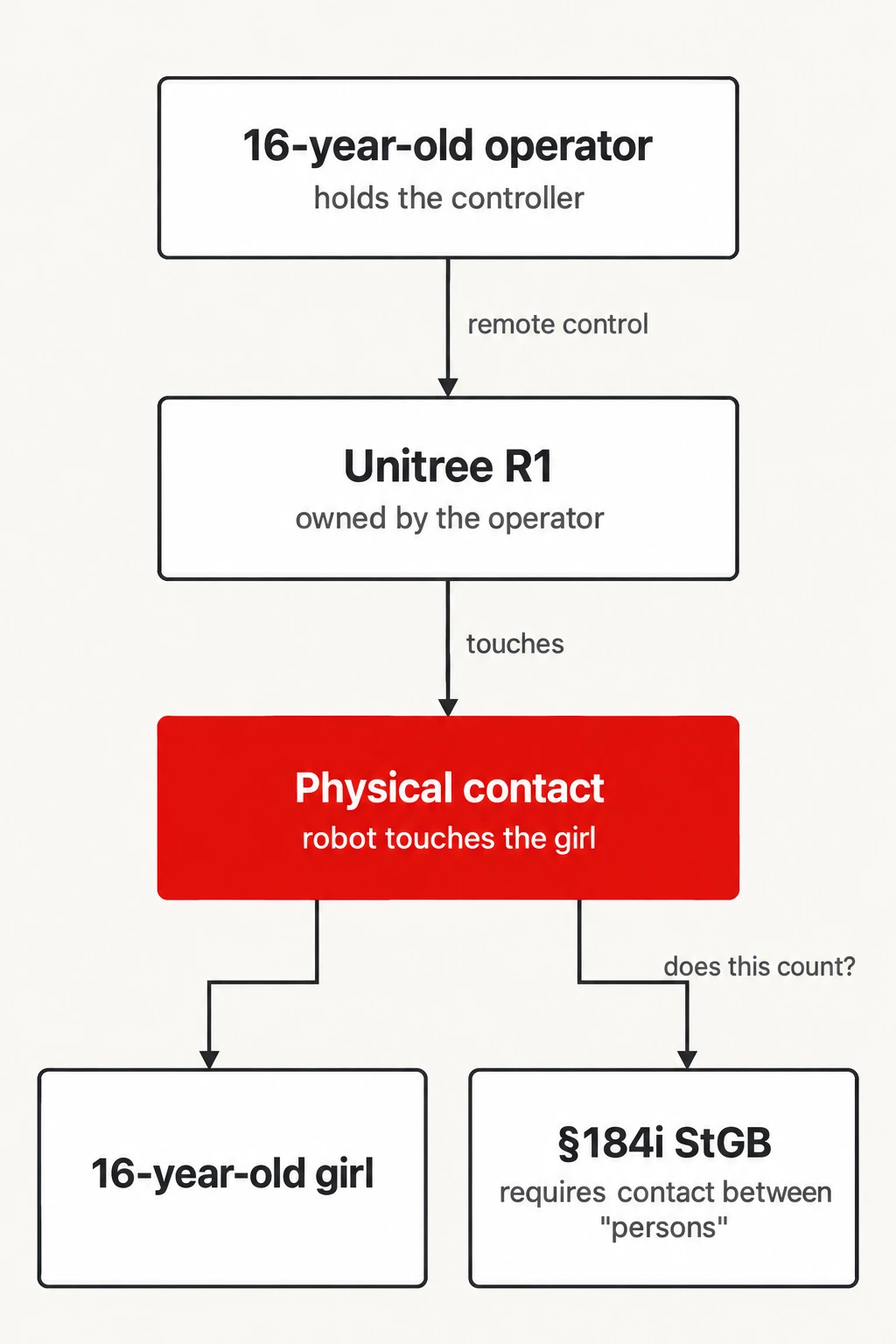
| From | To | How |
|---|---|---|
| 16-year-old operator (holds the controller) | Unitree R1 (owned by the operator) | remote control |
| Unitree R1 (owned by the operator) | Physical contact (robot touches the girl) | touches |
| Physical contact (robot touches the girl) | 16-year-old girl | |
| Physical contact (robot touches the girl) | §184i StGB (requires contact between "persons") | does this count? |
Legal scholars interviewed by Tagesspiegel describe the gap in two directions. Martin Ebers, who studies technology law, says the harder cases are ones where a robot’s autonomy makes its actions genuinely unpredictable: “Dann entstehen Haftungslücken” — liability gaps arise. Criminal-law scholar Eric Hilgendorf argues the code can’t be patched machine by machine: “Wir können nicht jedes halbe Jahr das Gesetzbuch erweitern” — lawmakers can’t expand the criminal code every six months to cover each new gadget. The European Union’s revised product liability directive, Directive (EU) 2024/2853, reclassifies software and AI systems as “products” subject to no-fault liability and takes effect across member states on December 9, 2026 — but that addresses a manufacturer’s liability for a defective robot, not a teenager’s criminal liability for how he drove one.
Under §184i(3), prosecution generally proceeds only on the victim’s complaint, filed within three months, unless prosecutors find a “particular public interest” that justifies acting without one — a threshold German commentary on the statute puts well below the bar for violent or coercive sexual offenses. Whether Cologne’s prosecutors stretch the existing contact-based wording to cover a remote-operated machine, or wait for the legislature to write a version that mentions robots by name, is the next number worth watching: not whether the robot is sentient, but how many months pass before a court decides that a joystick counts as a hand.