
For a conference last week, Michael Irwin made something with his hands. He is a principal software engineer at Docker, a platform that helps developers adopt models, tools and agents securely, and he built a gaming controller: a wooden base he made himself, red, blue and green buttons, wires. The game it played had been coded by AI. The controller was bait. It brought people to his booth, and once they were there he talked to them about AI agents. Before AI sped up coding, he would not have spent the time on such a thing. “It’s been a dream of mine for a long time, and it’s just now more accessible than it’s ever been,” he told Amanda Hoover of Business Insider.
A man whose trade was code, standing at a booth beside a wooden box, the code written by a machine, his real work now the talking. It is a small scene. Large changes tend to show themselves first in small scenes.
The end of the headphones
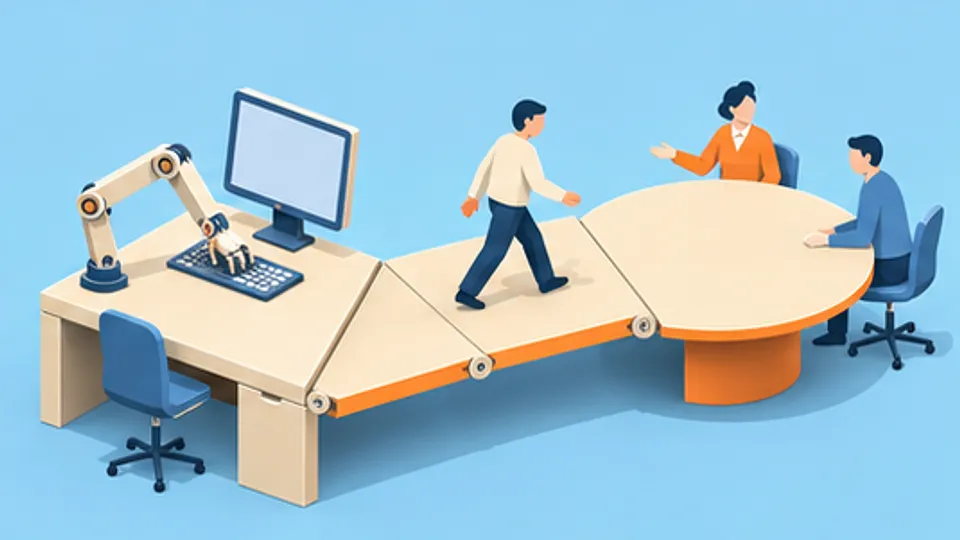
For years the software engineer was the hermit of the white-collar world: working remotely, writing alone, seldom in meetings. That arrangement is coming apart. Amazon and other companies increasingly expect engineers to deal with customers in person. People outside engineering now generate code themselves; as of June, a fifth of the users of OpenAI’s Codex were not developers. Bosses want engineers to direct teams of agents, explain complicated work in simple terms, and think as designers and architects rather than as cogs. “The micro level is mostly able to be passed off,” Irwin says. “It takes a different mindset.”

“This new way of working, it might not suit the typical engineer personality,” says Sam Dhar, an engineer at Galileo, an AI startup Cisco bought earlier this year. It still leans on the expertise and judgement engineers spend careers acquiring. But the shift is expected fast, and the developer who lags risks being laid off and replaced by someone who can charm an interviewer rather than ace a take-home coding test. Dhar does not think the change will stop with his profession. “It’s only happening to engineering first,” he says. “It’s potentially going to manifest in a way where all work is done in some respects with AI, where the accountability still resides with the humans who are reviewing and fixing and asking the right questions.”
Counting heads
The apocalypse foretold for coders has not arrived, at least not in the headcount. About 1.9 million people worked in software development, testing and quality assurance in the United States last year, up from about 1.5 million in 2020, according to the Bureau of Labor Statistics. The bureau’s Occupational Outlook Handbook puts the group at 1,905,400 jobs in 2025 and projects 2,090,800 by 2035, growth of 10 percent, down from the 15 percent the bureau forecast in its previous projection.
The job inside those numbers has changed beyond recognition. Vibe coding upended the trade last year. Big companies, Microsoft among them, said AI had written large parts of their newest code, and engineers began spending more time reading machine-written code than typing their own. Experienced developers finished projects faster; companies hired fewer juniors. The man who gave vibe coding its name declared 2026 the year of “agentic engineering.” Amazon Web Services recently had agents generate 100% of the code for a new emulator tool.

From code to customers
What remains for the human is the why. Engineers still need deep technical knowledge to judge what the machines produce, but they now need business sense as well. “You have to really understand a lot more about why we’re doing whatever it is we’re doing, and ask a lot of the right questions,” says Paul Elliott, vice president of product and engineering at the software testing company Chromatic. That means more conversations across the company. “It’s definitely a trainable skill,” he says.
At Amazon Web Services, Marc Brooker, a vice president and distinguished engineer, says his engineers spend more time with customers and prospects, talking to decision-makers and developers at other companies. Training is informal, often a matter of listening in on calls with colleagues more used to public work. “The outcome of that is so that the engineers can go back to their teams and their organizations and turn what they learned into really great product decisions, really great technical decisions,” he says.
Dylan Wight, founding software engineer at Flagler Health, an AI-native operating system for musculoskeletal care, now spends his days sorting code issues flagged by agents into real problems and oversensitive alarms. Several times a week he meets the system’s users in healthcare, and he likes it. “If people wanted to just think about code, I think it would get harder, because that part is mostly done.”
The wall comes down
Product managers used to carry those client conversations, shuttling between business needs and the engineers. Now AI companies call their people “members of technical staff.” In a report on its own workforce published last month, Anthropic found that technical individual contributors spent 16% more time in meetings than a year earlier, which the company put down to the importance of “human trust and accountability.” There are now about 17 engineers for every product manager. TechCrunch noted that junior staff fell from 21% to 14% of the company’s technical departments.

“Engineers are definitely taking on more product level autonomy, but product managers are also taking on more technical work,” says Frank Fusco, chief executive of Silicon Society. “I think the definitions of those jobs are changing.” The forward-deployed engineer, who works inside a client’s own systems, has become a fashionable figure of the period.
Back to the office
Then there is the desk. Michelle Volberg, chief executive of the recruiting firm Twill, says about half the roles her company filled last year were remote; now some 95% require hybrid or full-time office work. Employers hold the power in a tight labour market, but they may also simply want engineers talking to the rest of the company more often. Robert Half’s data show the share of tech job postings with in-office requirements rising from 63% in early 2024 to about 84% this autumn, while postings for remote tech roles fell from 10% in early 2023 to 3%. “A lot of these managers are bringing engineering on site now to have this collaborative approach,” says Kareem Osman of Robert Half.
Some hiring managers now ask for public speaking. Volberg looks for developers who already post about their work on YouTube or LinkedIn. “It also comes down to the soft skills of, ‘can you talk to the CEO and the founder about what the business needs directly as an engineer and then translate that into something that you’re going to go to your desk and build?’” she says. According to CompTIA, the IT industry’s trade association, 47% of open software engineer roles in early 2020 listed communication skills; now nearly 60% do.
At Akeneo, which brought engineers into customer conversations before the AI boom, Chuck Hardy, director of product and engineering, role-plays sample questions with candidates before they face a panel. “We’re not there to test you or to trick you,” he says. “We’re there to create an environment where you can figure out how to demonstrate your best self in a short period of time.”