
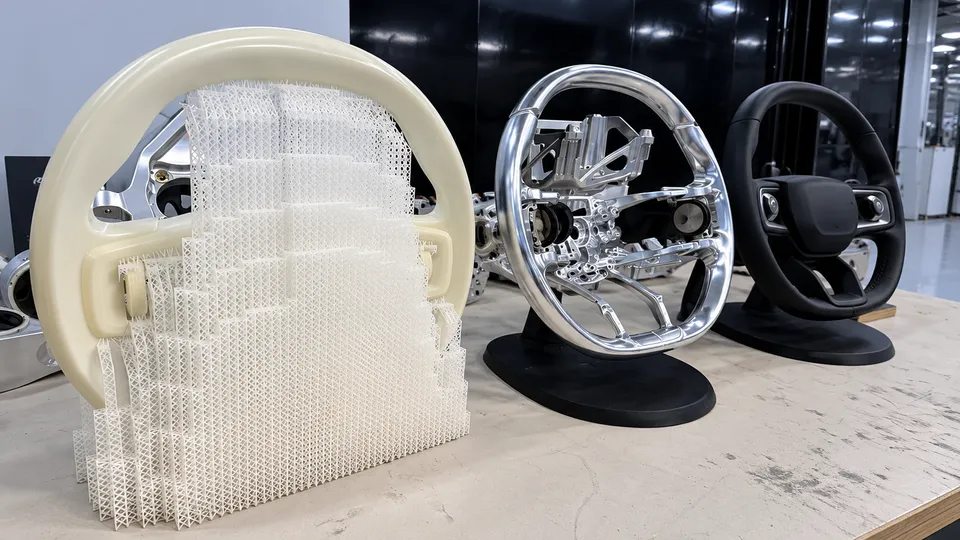
3D printing is roughly four decades old as a technology, which makes the news here oddly specific: it is becoming factory equipment. CNBC’s Michael Wayland toured Rivian’s expansive additive-manufacturing operations in suburban Detroit, where the electric-vehicle maker has decided it is no longer experimenting. “At this point, we don’t have a choice but to scale up and begin using it through all factions of Rivian,” said Jared Beck, the company’s head of additive manufacturing. “We’re going to be democratizing 3D printing for the entire company.”
A quick definition, since the phrase sounds fancier than the thing is: 3D printing builds a three-dimensional object from a digital design by laying down material one layer at a time, like an inkjet printer with a much bigger budget for ink. The “ink” can be plastic, composite, ceramic or metal, and the machines run from a few hundred dollars for a hobbyist’s desktop box to hundreds of thousands of dollars for industrial equipment.
The business case is surprisingly easy to state, because Rivian states it. The company has spent more than $5 million on 3D-printing machines, plus about $1.7 million a year on materials. Beck says the machines typically pay for themselves within a year, by cutting supplier tooling costs, trimming logistics expenses and compressing the time to get a part from weeks to days or hours. How much does the whole operation save? “It’s well in the millions [for savings], but the main thing is speed for Rivian,” Beck said. That sentence is the entire economics lesson: the savings are nice, but what you are really buying is the elimination of waiting.
What does Rivian actually print? The tooling and fixtures nobody will ever see in a showroom, mostly: models of electric motors for fluid testing, screw guides for assembly tooling, stamping press inserts, and some actual production pieces, like trim used to fill gaps in early builds. The company’s latest expansion adds machines that build flexible silicone parts and installs a full bay of printers at its plant in Normal, Illinois, so engineers can produce parts on demand. “3D prints should be readily available for every engineer so that they can make a part and get it in their hands as soon as possible,” Beck said. There is also a printed version of Gary, Rivian’s cartoon Yeti mascot, standing in the facility — presumably not load-bearing, but nice for morale.
Ford, which has printed at scale for years, has gone further with the democratization idea. Rather than one central lab, it has additive-manufacturing departments at many plants — plus, near its Dearborn, Michigan, headquarters, a vending machine dispensing 3D-printed parts for the F-150 pickup line. “By putting the vending machine up, all the team leaders have access,” said Gregory Foresi, a Ford mechanical engineer who ran the plant’s 3D-printing lab from 2024 until last month. “We’re able to keep that thing stocked rather than have a bunch of parts laying around in the lab. So that’s been pretty huge.” His roughly two dozen machines have turned out thousands of tools, some designed by line workers themselves: torque bit sockets, hood jackers, hand tools for smoothing adhesive. Employees request items through an app, and Ford’s printing teams work out what to build next, with machining times running from hours to days or weeks.
It is worth noting what the printers are good for, and Ford is admirably honest about it. When a large machining wheel was needed to keep an assembly line running, the company printed a stand-in until the supplier’s permanent replacement arrived. “They didn’t perform as well, and it’s not really a replacement for the ones that we were purchasing,” Foresi said, “but they kept the plant running.” “Kept the plant running” is the whole pitch: an idled assembly line is catastrophically expensive, and a slightly worse wheel is not. Ford says it now has more than 200 machines in its official printing program — plus others outside it — and expects 3D labs at more than 23 plants by the end of this year.
General Motors takes a third approach: printing for the cars themselves, at the expensive end. The Cadillac Celestiq, its bespoke flagship, uses 135 3D-printed components, and the performance Cadillac Blackwing sedans carry printed parts too, including a unique medallion on the manual shifter knob. GM has expanded its use of industrial printers from Stratasys, machines that can cost hundreds of thousands of dollars depending on use case, training and certification. Fadi Abro, Stratasys’s senior global director of automotive and mobility, calls GM a model of how to “standardize and then scale,” and says the company works with virtually every major automaker. “The material properties improved so significantly that the use cases improved,” he said. “From a product perspective, we have to get the technology to become faster and more accessible, in an economic sense.”
The deeper logic is that a modern car plant is a hostage of its supply chain: one missing tool can stop a billion-dollar line. Printing does not change that so much as shorten the hostages’ list. Your car is still made by suppliers. The tools that make it, increasingly, are not.