
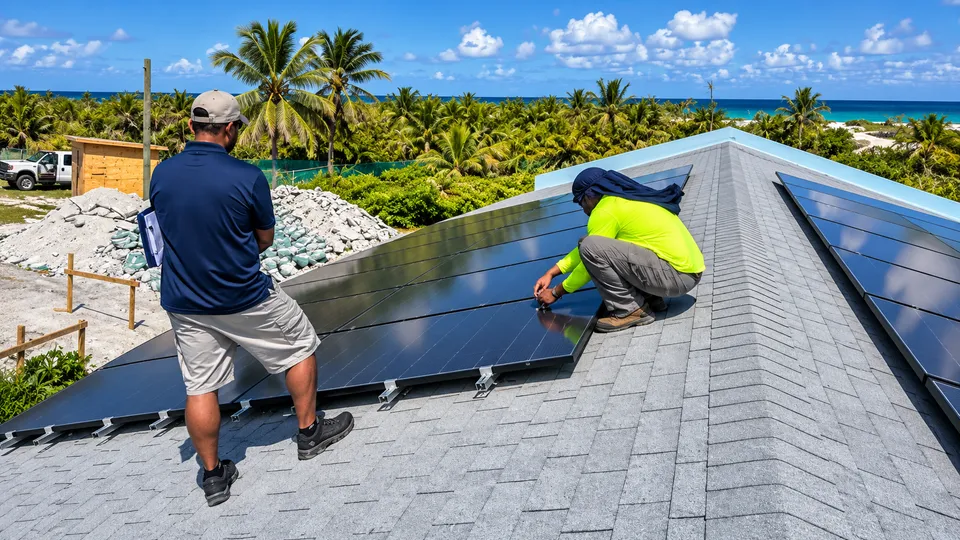
Zero. That is how many Atlantic hurricanes had formed by September 10, 2026, the climatological peak of the season, according to the National Hurricane Center. The driver is a strengthening El Niño that NOAA’s Climate Prediction Center, in its August 6 update, put at 90% odds of reaching strong or very strong status, enough to raise the agency’s own confidence in a below-normal season from 55% in May to 75% by August. The revised range: 7 to 13 named storms, 2 to 6 hurricanes, 0 to 2 major hurricanes, against a long-run average of 14, 7 and 3, according to NOAA’s Climate Prediction Center outlook. Every strong El Niño on record since 1950 has produced a below-normal Atlantic season, NOAA notes, because the same warm Pacific water that defines the pattern also raises wind shear over the Caribbean, which tears storms apart before they can organize.
The Bahamas is treating that shear as a construction deadline. “One lesson many of us have learned is the islands that use the quieter years to prepare are often the ones that recover most effectively,” David Gumbs, who has spent much of his career building renewable microgrids across the Caribbean, told the BBC. He was sheltering in his bathroom in Anguilla when Hurricane Irma, a category 5 storm, destroyed 90% of that island’s electricity infrastructure in 2017. The Bahamas has its own reference number from 2019: Hurricane Dorian caused $3.4 billion in damage and losses on the islands, according to an Inter-American Development Bank assessment, equivalent to roughly a quarter of national GDP. Abaco, the hardest-hit island, absorbed 87% of that total. Bahamas Power and Light had to rebuild its Abaco network from scratch; residents went two years without a reconnection to the main grid.
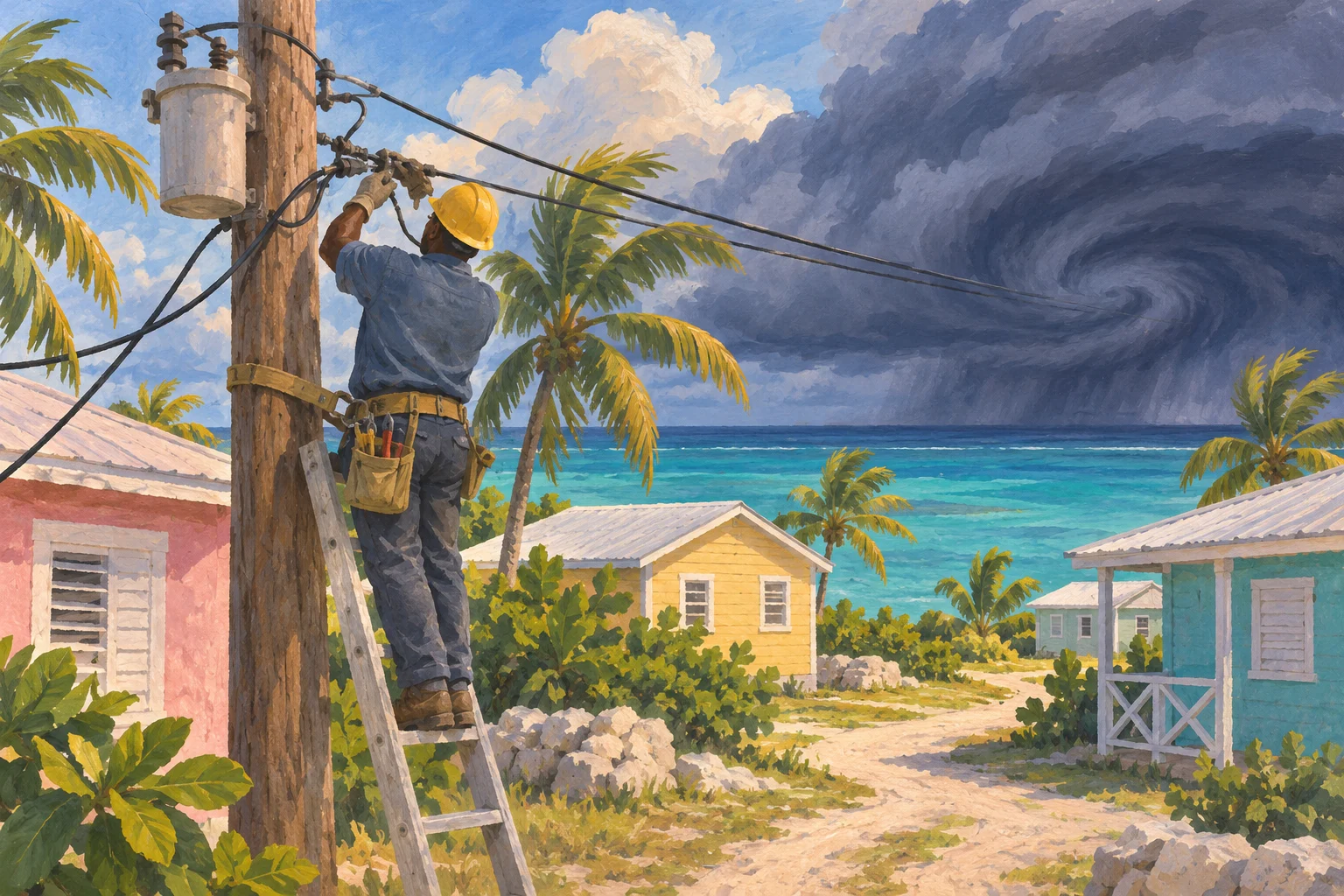
The old system was expensive even when nothing was blowing it down. The Bahamas generates about 99% of its electricity from imported fossil fuel, almost all of it diesel brought in by boat, exposure that leaves households paying $0.28 per kilowatt-hour against a Caribbean regional average of $0.24, according to the IMF. Fuel accounts for more than half of Bahamas Power and Light’s operating costs, and the utility loses a further 12.3% of generated electricity to technical losses and 9.6% to unbilled commercial losses, costs ultimately recovered from customers who already pay among the highest rates in the region. Regional fuel charges rose by an average of 33% in a single year, the BBC reported. None of that is storm damage; it is the baseline bill the islands were trying to escape even before Dorian made the question unavoidable.
Islanding
A microgrid is a local electricity network, typically solar panels plus a battery and sometimes a backup generator, that can generate and store power close to where it is used instead of importing it over long transmission lines. Its resilience comes from a specific capability called islanding: the ability to disconnect from a damaged main grid and keep running on its own. “[Small island nations] often have the opportunity to leapfrog directly to modern energy systems by placing solar, wind, and battery storage close to where electricity is used,” says Mundu Mustafa, a renewable-microgrid researcher at Kampala International University, who has authored several papers on the subject. Many island communities, he adds, “depend on a single centralised power station or fragile transmission links, meaning one damaged line can leave entire communities without electricity for days or even weeks.” During Dorian, Abaco’s main power plant largely survived the storm; the lines that carried its output to customers did not, which is exactly the single point of failure islanding is built to route around.
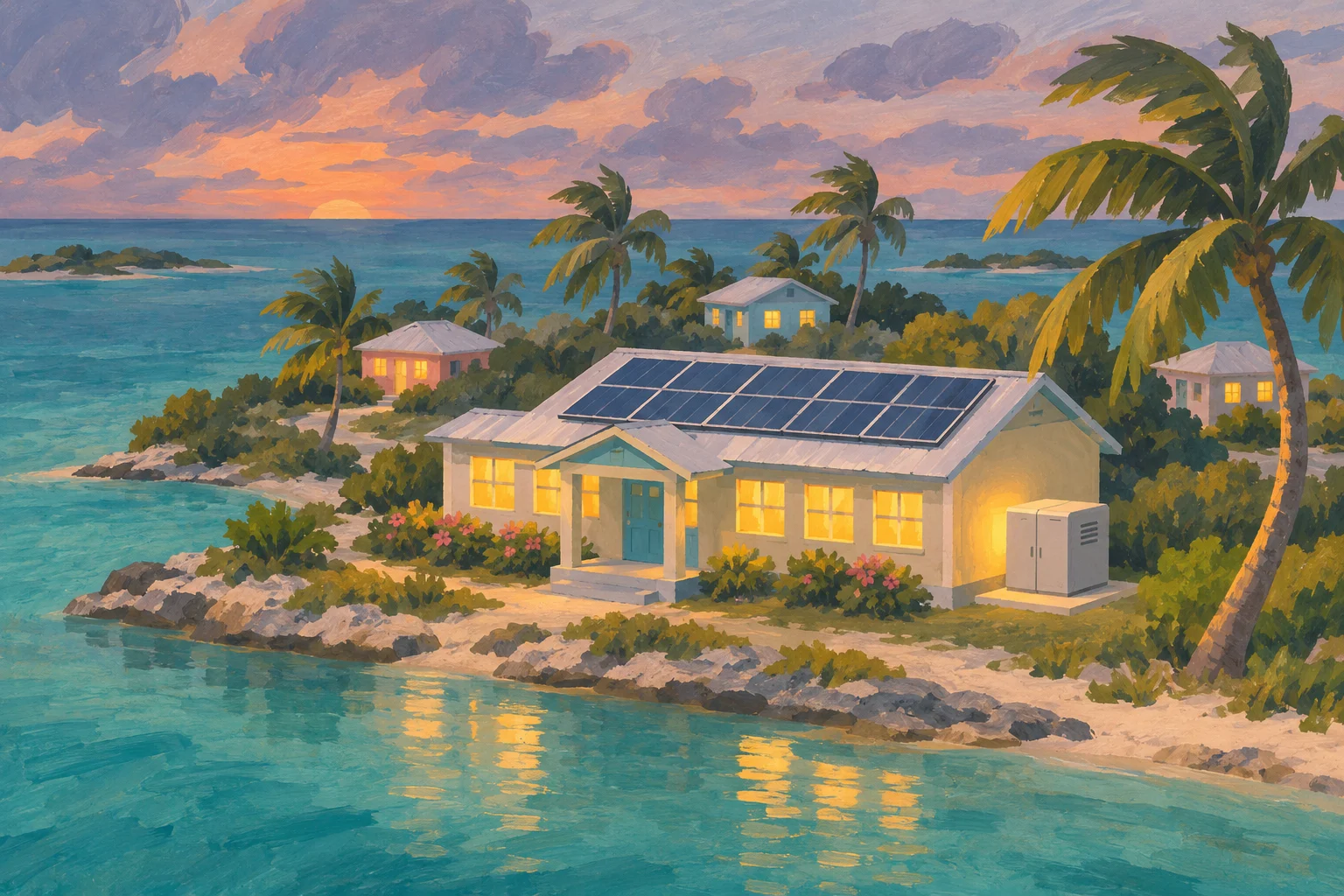
The clearest demonstration so far is small: three Abaco primary schools, retrofitted with solar panels and battery storage in a $700,000 project led by the non-profit RMI, Gumbs’ organization, with the Center for Disaster Philanthropy, Rotary Bahamas Disaster Relief and the installer Compass Solar, according to RMI’s own account. Central Abaco Primary, Man-O-War Primary and Great Guana Cay School now draw 90% of their power from solar and storage, serving a catchment of roughly 10,000 residents, and double as hurricane shelters. One of the three had been losing power up to five times a day before the retrofit. “The principal of Man-O-War Cay Primary described looking across Abaco during an island-wide outage and seeing the school still illuminated because its solar panels and batteries were supplying power,” Gumbs told the BBC. “In the principal’s words, the system meant that ‘life can continue.’ That is really the resilience value of a microgrid.” Two more microgrids, for two medical clinics and a government complex, are underway.
The bigger bet, and a number that doesn’t check out
The schools are a proof of concept costing less than a rounding error on Dorian’s $3.4 billion bill. The larger wager is a hybrid plant at Wilson City, Abaco, built by EA Energy, a company the BBC describes as 70% owned by a mix of Turkish and Bahamian private shareholders and 30% by public shares. The project pairs LNG-fuelled gas engines, which supply a stable baseload, with solar panels and a battery that absorbs midday surplus and discharges it as demand shifts, so renewable generation covers as much of the load as the sun allows while the gas engines handle the rest. The BBC, citing EA Energy’s project director Emre Ozer, reported the plant would deliver “1,305MW of electricity with a 20MWh battery capacity,” enough for 2,000 to 3,000 households and all of Abaco’s power needs when it comes online in May 2027.
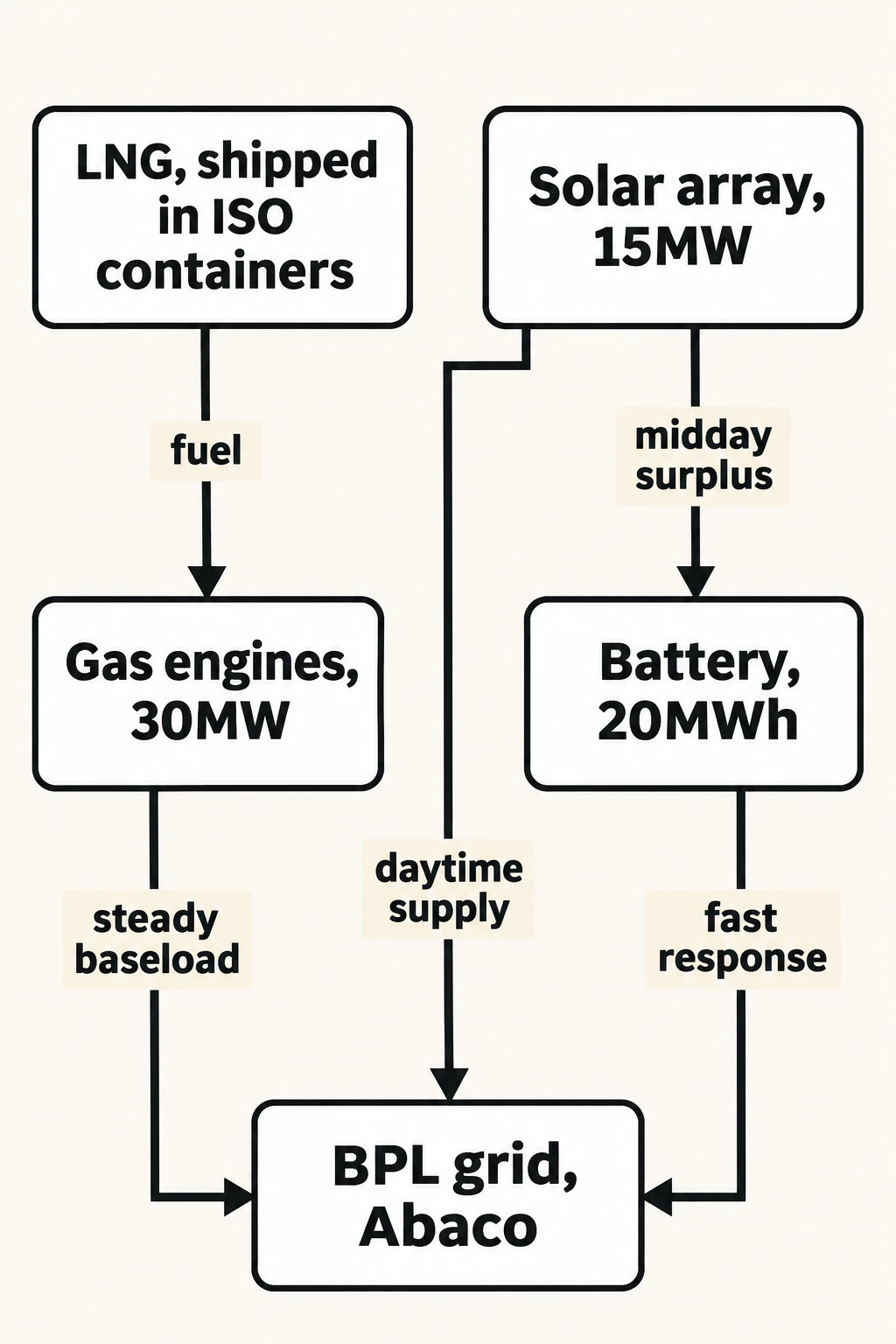
| From | To | How |
|---|---|---|
| LNG, shipped in ISO containers | Gas engines, 30MW | fuel |
| Gas engines, 30MW | BPL grid, Abaco | steady baseload |
| Solar array, 15MW | Battery, 20MWh | midday surplus |
| Solar array, 15MW | BPL grid, Abaco | daytime supply |
| Battery, 20MWh | BPL grid, Abaco | fast response |
That 1,305MW figure is almost certainly wrong, and by a lot. Tribune242’s reporting on the same $90 million project, drawn from EA Energy’s own chief executive and site visits by Prime Minister Philip Davis, puts the plant’s capacity at 30 megawatts of LNG-fuelled generation plus 15 megawatts of solar, on a 60-acre site, matching the 20-megawatt-hour battery figure the BBC also reports. That is 45MW of generation capacity, not 1,305MW, a gap of close to 30-fold. A plant 29 times smaller than the headline figure cannot simultaneously be the one covering “100% of Abaco’s energy needs,” so either the capacity or the coverage claim overstates the project; nothing in the public record EA Energy or the Bahamian government has put out supports the larger number. The solar phase is slated to start feeding Bahamas Power and Light’s grid this November; the gas engines and battery are due in May 2027, after which the plant reverts to BPL and public ownership after 25 years, per the government’s own announcement of the project.
EA Energy employs 60 people on the project, 10 of them Bahamian, with the company’s stated focus on training locals for long-term jobs. RMI runs a parallel six-month training program to teach islanders to install and repair microgrid equipment themselves, so that a storm does not mean waiting for outside technicians to arrive. “Our approach is very different because we want to empower our community,” Gumbs says. RMI has been active in 20 Caribbean jurisdictions since 2014 and has backed more than two dozen solar and microgrid projects, 15 of them solar-and-storage systems, including the Ragged Island installation that predates the current Abaco push.
El Niño does not last. The pattern typically peaks and fades within a year or two, often giving way to La Niña conditions that lower Caribbean wind shear and historically coincide with more active Atlantic seasons. NOAA’s own forecasters flagged the limit of their confidence even inside this quiet year: “Although El Niño’s impact in the Atlantic Basin can often suppress hurricane development, there is still uncertainty in how each season will unfold,” said Ken Graham, director of the National Weather Service. The number to watch next is May 2027, when the Wilson City plant’s gas engines and battery are due to come online, and whichever ocean pattern the Atlantic is running on by the time they do.