
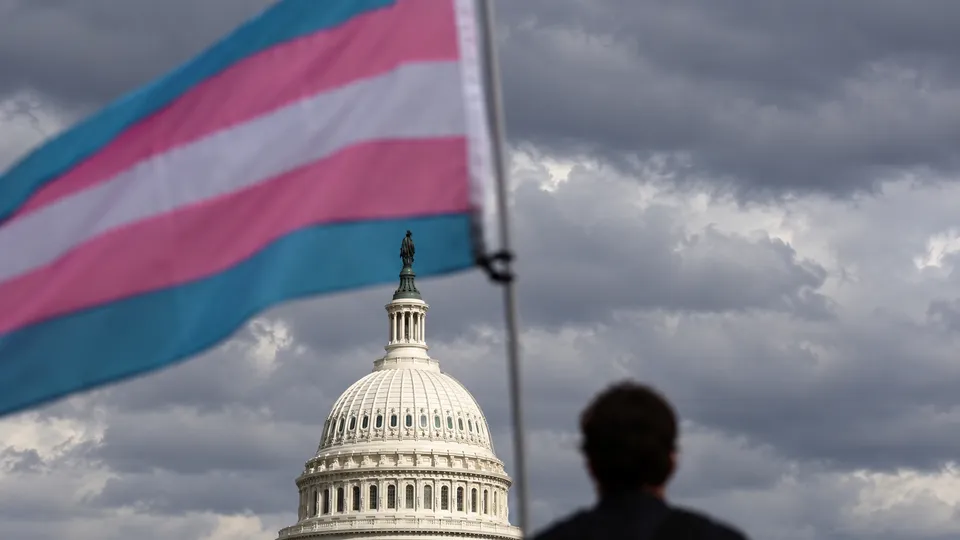
Two years ago the sentence arrived at the end of the campaign like a verdict. “Kamala is for they/them, President Trump is for you.” Donald Trump’s operation built the tagline on a comment Kamala Harris had made in 2019, supporting gender-affirming care for transgender people in federal prison, and ran it until she was buried under it. In her memoir, Harris conceded it was a “winning message,” one her campaign should have “given even more attention to how we might mitigate Trump’s attacks.”
The ads are back. According to AdImpact data cited by CNN, Republican advertisers have spent more than $60 million airing more than 190 television ads invoking transgender policy since the start of the year. This time, after what CNN describes as a party reckoning over how to address the topic with voters, Democrats are answering — more forcefully, and not always comfortably.
A CNN poll released Wednesday explains both the money and the nerves. Transgender issues ranked below ten others in importance to midterm voters, the economy first among them. But asked whose side they took on the subject, voters gave the GOP the edge. The issue is small. The opening is not.
So some Democrats in competitive races are stating outright opposition to trans athletes in girls’ sports, or even to trans “ideology” — a word that, until recently, belonged to the other side’s script. Ohio Rep. Marcy Kaptur, whose redrawn district went for Trump by almost 11 points in 2024, aired ads noting she “voted with Republicans to keep transgender ideology out of schools.” On Tuesday, the Democratic Party of Lucas County — her own county, Toledo — called on her to take the ads down, saying she had “stooped” to the Republicans’ level. Her campaign stood by the message. She “supports parents having more insight into their children’s education.”
The accounting came quickly. Equality Ohio cut its rating of Kaptur from a “B” to a “D,” and downgraded Amy Acton, the Democratic nominee for governor, from an “A” to a “B” after Acton said in June that she does “not support boys playing in girls’ sports.” “Targeting trans people isn’t the winning strategy some people think it is,” the group’s chief executive, Dwayne Steward, said in a statement. “Real leadership means refusing this culture war bait, not reaching for it.”
There are other versions of the answer. Texas Rep. Vicente Gonzalez, another Democrat drawn into hostile territory, met the attacks head-on in 2024 with a Spanish-language ad: “I have never promoted sex changes.” He held his seat even as South Texas lurched right. “I took some very heavy pushback,” he told CNN, “and I think they were all wrong and we were right.”
Kentucky Gov. Andy Beshear, whom Democrats credit with handling the issue in his 2023 reelection and who now floats in the 2028 conversation, locates the error of 2024 precisely. “It wasn’t that Vice President Harris had a certain view on an issue, it was that Trump made it look like it was the No. 1 issue for her.”
Then came Virginia, 2025. Republican nominee Winsome Earle-Sears blanketed the airwaves with ads casting Abigail Spanberger as “being for they/them.” Spanberger answered with spots calling to “get politics out of our schools and trust parents and local communities,” and won by 15 points. Tyler Hack, executive director of the transgender advocacy group the Christopher Street Project, said she took the issue on head-on “but also didn’t throw anyone under the bus.” The Human Rights Campaign folded her response into its guidance for 2026 candidates, urging them to “address concerns directly.”
“There’s a school of thought that says, don’t answer the attacks, you give them more airtime. In practicality, that’s not helpful,” one national Democratic strategist told CNN, granted anonymity to discuss tactics. “It’s important because once you neutralize the attack, you can run the campaign you want to run.”
In Alaska, a state Trump won by 13 points, Senate nominee Mary Peltola looks into the camera and says it plainly: “No, I don’t want kids getting surgery to change genders or men in girls’ bathrooms.” In Texas, James Talarico tried a finer edge — after voting against restrictions on transgender athletes in the state House, he told Fox News he would “oppose trans athletes playing in girls’ sports if it risks safety or fairness.” Other Democrats reach for the parent card, vowing to protect kids without mentioning transgender people at all.
And then there is the dismissive version, brought by former Sen. Sherrod Brown of Ohio, whose ad opens with Ohioans sighing at the Republican fixation. “In Ohio, it’s against the law to perform transgender surgeries on kids,” one man says. “That’s right — it’s illegal.” Rep. Mark Pocan of Wisconsin, co-chair of the Congressional Equality Caucus, likes that one best, and he explains it in tennis: “A slam we have is the economy. Hit (the transgender attack) back over the net and just get ready to win the game, and I think Sherrod Brown showed the classiest, most intellectual way to do it that was very real and really honest.”