
In the summer of 1986, a college student in Pennsylvania named Samuel Paparo took his future wife to see Top Gun. Most young men left those cinemas wanting to be Maverick. Paparo took a different lesson, and he told it to TIME forty years on. “The hero of the movie is supposed to be Maverick, but the hero of the movie is actually Iceman. Maverick’s got all the personal charisma, but Iceman is fastidious, quiet. He’s the hard-working guy that does the right thing, that doesn’t do flashy, dangerous stuff for its own sake.”
Paparo had already passed the Navy’s entrance exams when he sat down in that theater. His career then traced Iceman’s, and went past it: the Navy Fighter Weapons School, a fighter pilot’s seat, four stars, command of the Pacific Fleet, and now command of the U.S. Pacific Command, the oldest and largest of America’s geographic combatant commands, covering about half the earth’s surface.
Few Americans know his name, which suits him. “If I do my job right, history will never know my name,” he said at his headquarters in Hawaii, on a hill above Pearl Harbor. The job, in essence, is to stop a war. Beijing has vowed to bring Taiwan, self-ruled since 1949, under its control, by force if need be; Xi Jinping has called unification “a historical inevitability.” Paparo’s command is the obstacle placed in front of that ambition. The plans he makes and the forces he builds last for decades and outlast presidents.
The power behind him is large and mostly unseen: some 400,000 military and civilian personnel, a Pacific Fleet of roughly 200 ships with five aircraft carrier strike groups, and more than 1,000 aircraft, spread across oceans and bases most Americans will never think of. With President Donald Trump set to meet Xi for their third face-to-face summit since returning to office, the cameras will be on the two leaders. It is Paparo’s task to make sure that whatever comes of the talk, American power holds first place. He must do it while wars elsewhere drain the munitions he may one day need.
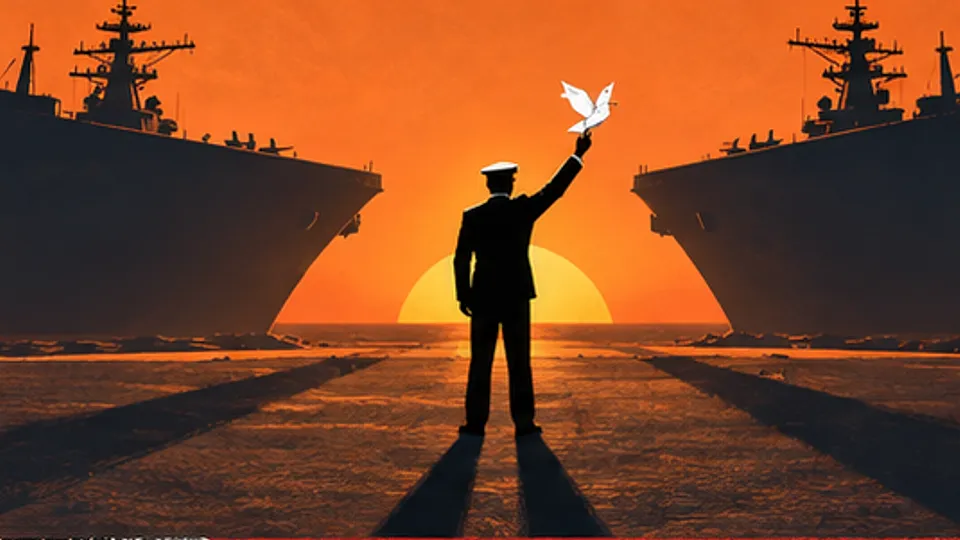
He is, at 61, a soft-spoken man who smiles often and goes grave when the subject does. “We don’t seek to become great wartime leaders,” he said. “We seek to be great peacetime deterrers.” And: “I’m almost quoting Sun Tzu when I say winning without fighting is the acme of skill. Mission success for me is not to fight and win a war; it’s to provide a deterrent capability so that we never go to war in the first place.”
Whether deterrence will hold is the open question. China’s defense spending has risen thirteen-fold over three decades, and it now outspends the next 22 Indo-Pacific countries combined, according to the Center for Strategic and International Studies. Its navy, once a coastal force, is now the world’s largest by hull count. Brian Hart of CSIS calls the effort a “comprehensive, across-the-board modernization” and says the People’s Liberation Army has “significantly transformed the balance of power.”
Paparo can read the change from his office window, above the harbor where American supremacy was last truly tested. He calls the buildup “historic” and “an exponential increase in military power”. “Twenty-five years ago the People’s Liberation Army Navy was about 37 warships, and today it’s 12 times that,” he said. “Just in the last 18 months they’ve delivered two cruisers, eight destroyers, eight frigates, an aircraft carrier, 11 submarines, four amphibious ships, and four long-range combat logistics ships.” What troubles him most, TIME reports, are China’s advances in space, missiles and its fast-growing nuclear arsenal. “They’re moving toward world reach,” he said.
Much of it was built with one target. US intelligence judges that Xi has ordered his military to be able to take Taiwan by force by 2027, the PLA’s centenary. The annual threat assessment released in March suggests no invasion is now planned for next year, but by then the pieces for one will likely be in place. The politics may decide the timing. Xi says he would prefer to take Taiwan without a fight if a path exists. Taiwan’s presidential election in January 2028 will bear on that: the Kuomintang, China’s old enemy, is now the more amenable party in Beijing’s eyes, while a second term for President Lai Ching-te, who flatly rejects Beijing’s claims, could bring, in Hart’s words, significantly heavier pressure.
Paparo’s part is to convince Xi that the military price will be too high whatever island politics do. By act of Congress, America must sell Taiwan the weapons it needs; the law stops short of promising direct defense, but it could extend that far. Paparo describes the strategy as a balancing act. “It’s demonstrating credible combat power, demonstrating capability and will, but keeping the crown jewels of the nation that are going to deliver combat success opaque to your counterparts, so that they can’t build a counter for it.”
He calls the doctrine deterrence by denial. “It’s a way of expressing that we’re not seeking the overthrow of the Communist Party,” he said. “It’s just that you should know that where America’s direct vital interests are involved, there’s a high probability of denying your aggression.” It is a curious arrangement for peace: a contest measured in cruisers and submarines delivered by the year, waged by two powers whose leaders shake hands under chandeliers, and whose admirals count themselves successful on the days nothing happens. Paparo’s hope is that the counting continues, quietly, for the rest of his career.