
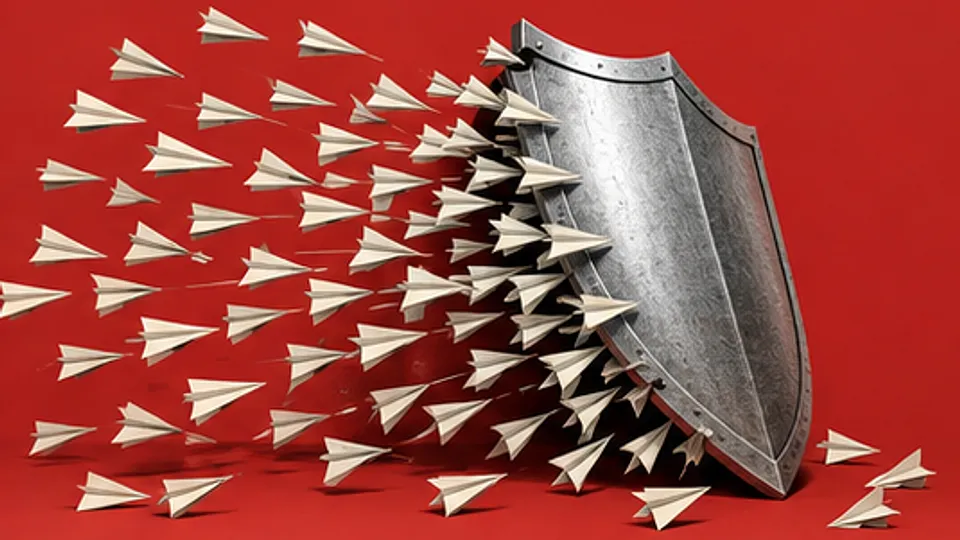
Here is a sentence that should not make sense, and yet: when the United States and Israel killed Iran’s supreme leader, its defense minister, and the head of the Islamic Revolutionary Guard Corps, and hit something like 13,000 targets over 38 days, they lost. Not obviously, not on the scoreboard many people were watching, but in the way that actually matters — six months later, the Iranian regime is still there, arguably stronger, and it has closed the Strait of Hormuz and won itself real political leverage over a superpower that is visibly annoyed about all this.
How? Michael C. Horowitz, writing in Foreign Affairs, has a one-phrase answer: “precise mass.” That is his term for high-volume, low-cost, precision-guided weapons — drone loads of drones, basically, that are each cheap enough to be disposable and accurate enough to hit things. Iran, having been locked out of the market for fancy military hardware for decades, did the obvious thing and bet everything on one-way attack drones and cut-rate ballistic missiles. The result is a war in which the country with the world’s most expensive military dealt its adversary billions of dollars of damage and still did not get its way.
The opening numbers are worth sitting with. In the first 24 hours, American and Israeli forces hit roughly 1,000 targets. Over the next 37 days, they destroyed 12,000 more. Supreme Leader Ali Khamenei, the defense minister, the IRGC chief — dead. But Tehran had planned for exactly this. It replaced its lost officials immediately, it imported enough goods to keep its economy wheezing along despite a U.S. naval blockade, and it had spent years building a vast underground missile network, spread across the country, that has proved impossible to eliminate thus far. Its dispersed missile production facilities were even harder to knock out. This inverts the doctrine that has guided American air campaigns since Operation Desert Storm in 1991, which assumed you won by destroying an enemy’s existing stockpiles. Iran built its war around replenishment, not stockpiles — the factory, not the warehouse.
That is the production-side insight. The consumption-side insight is even uglier.
Imagine you run a defense ministry procurement office. (This is a hypothetical; you probably don’t.) Your budget buys you exquisite things: Tomahawk missiles, F-35s, Patriot interceptors. These are very good. They are also scarce, so everything your military does — the training, the doctrine, the organizational culture — is built around not wasting them and not losing them. Now along comes an adversary whose entire concept is the opposite: weapons that cost tens of thousands of dollars each, meant to be expended in swarms, where the right tactic is to move fast and not make the perfect the enemy of the good. You cannot defend against this style of fighting using your style of equipment, Horowitz argues, not because your equipment is bad but because your organization is built around it. The most successful militaries, he notes, often struggle most with this kind of disruptive change, precisely because their success hardened into bureaucracy.
The arithmetic of the air ledger
And here is where it becomes an accounting problem. Offense, at the moment, is cheaper than defense. A Shahed-136 attack drone costs about $35,000. A Patriot missile costs about $4 million. There are “very few reliable interceptors,” Horowitz writes, that cost less than $1 million. So every defensive engagement is — if it works — a trade of $4 million for $35,000. You can win that trade, of course. What you cannot do is win it endlessly. As Horowitz puts it:
Militaries cannot endlessly block salvos of $35,000 Shahed-136 attack drones with $4 million Patriot missiles.
The actual wartime numbers bear this out, and they are startling. To repel Iran’s barrages, the United States used about 65 percent of its Patriot interceptors and 35 percent of its THAAD interceptors. That leaves roughly 1,000 Patriots and 250 THAADs on hand. Washington’s Middle East partners are also running low on air defenses. Meanwhile the U.S. burned through stockpiles of Tomahawks and SM-6 missiles doing the offensive damage, which is why it is now sprinting to resupply itself and its partners elsewhere — Taiwan, Ukraine. Every missile fired over Iran is a missile not sitting in a warehouse facing the Taiwan Strait. The war’s opportunity cost is denominated in other wars’ deterrence.
Now, to be fair, the exquisite-weapons era is not dead. Horowitz is clear that the United States had great success hitting valuable Iranian targets, partly thanks to AI systems that can identify and recommend targets faster than ever, and partly because expensive munitions are still harder to intercept and more likely to kill a target in one strike. The point is not that precision is obsolete. The point is that precision alone, in small numbers, no longer wins a full-blown war. Weaker states, as he puts it, “are no longer priced out of the military power game.”
Everyone reads the same memo
The market for that idea has, unsurprisingly, gone global. North Korea has received Shahed technology and production equipment from Russia and is developing its own cheap uncrewed vehicles. A company in Nigeria has contracted with a Turkish manufacturer to build 100,000 one-way attack drones at local assembly facilities. Poland has increased spending on drones and counterdrone systems from about $27 million in late 2023 to roughly $6.9 billion this year — a 250-fold jump in under three years — and set up domestic drone factories. Six European states, including France, Germany, and the United Kingdom, have signed a letter of intent to jointly develop a one-way attack drone with a range of over 300 miles and a target cost below $100,000. Saudi Arabia has unveiled its own Shahed-modeled attack drone, said to reach more than 900 miles. And Japan’s governing party has requested a record $55.6 billion defense budget, largely to buy attack drones in bulk.
The defense side is scrambling for a reply. Washington and other governments are experimenting with directed energy weapons and high-power microwave systems that could zap incoming drones, plus interceptors that only need to get near a drone and explode rather than hit it head-on. Ukraine is fielding interceptor drones that cost just $1,400 apiece — finally, a defensive weapon that is cheaper than the thing it shoots down. European and Gulf startups are building their own budget interceptors. But none of these systems, Horowitz cautions, appears ready to scale right now. Which means that at the moment, the finance of war favors the attacker: you can spend your way into offense faster than you can invent your way into defense.
This is an uncomfortable thing for Washington to learn from a war it started expecting to end quickly. The United States invented precision guidance. It has, by consensus, the best military in the world. And it is the power being quoted in the press as frustrated — because its adversary closed one strait and opened one very cheap supply chain, and the diplomatic endgame is now partly Tehran’s to set. The price of deterrence used to be a defense budget. Iran’s price was a factory.