
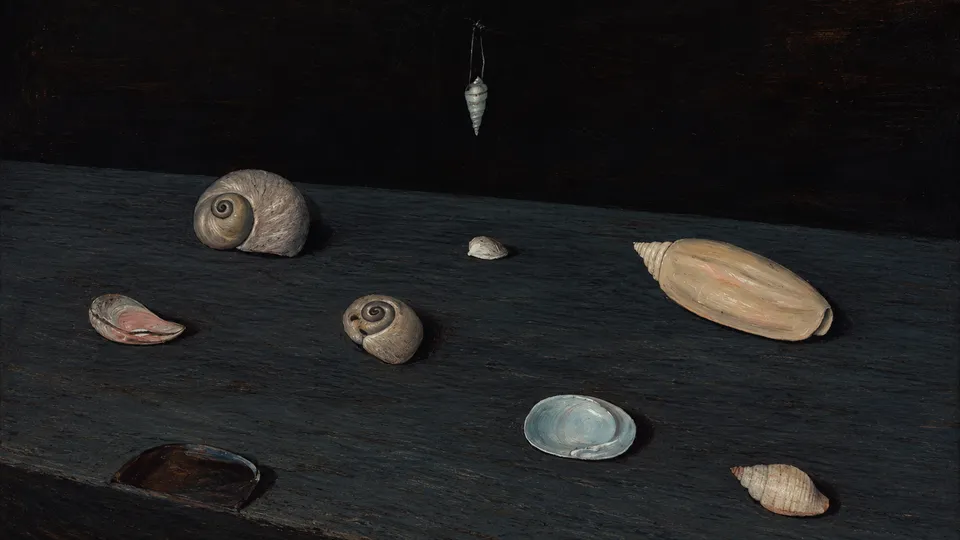
The efficient markets hypothesis, estate sale edition: everything is priced correctly, except the things tucked in a dark corner of a hallway leading to the garage, which are priced at $30. In July, a buyer described by the auction house Freeman’s as “a longtime hunter of record albums and mid-century furniture” spotted a small oil painting in exactly such a corner of a Michigan home — “overlooked by every other buyer that day” — noticed a barely legible signature reading “Abercrombie, ’51,” and took a $30 gamble. The gamble has now paid out at more than $1.35 million.
The painting is Gertrude Abercrombie’s Alderman Merriam’s Shells, an 8-by-11-inch still-life from 1951 depicting ten seashells, and it had been unseen in public for almost 75 years. The provenance is wonderful. Abercrombie — the Chicago surrealist often called American art’s “Bohemian Queen,” who hosted Hyde Park salons where Dizzy Gillespie and Charlie Parker played — showed the work in six solo exhibitions over its first two years, priced it between $50 and $150, and never sold it. Instead she gave it to a doctor in Kalamazoo, Michigan, in exchange for medical services, which is either a touching story about art and friendship or a devastating data point about mid-century American healthcare billing, and honestly both. The painting passed down through the doctor’s estate after his death and surfaced at the July sale.
What elevates this from lucky find to parable is what the buyer did next, which was diligence. They diverted a family vacation to the Milwaukee Art Museum, where an Abercrombie retrospective happened to be on, and found in the exhibition catalog a 1952 newspaper clipping showing the painting photographed beside the actual shells it depicts. Then they took it to Freeman’s, one of the exhibition’s sponsors, where Susan Weininger — an art history professor at Roosevelt University and an Abercrombie expert — authenticated it, still in its original frame. Restorer Julian Baumgartner cleaned it and pronounced it in “perfect condition” under the grime and clouded varnish: “It was drab, missing its life, but now cleaned, retouched, and revarnished, it’s alive and radiant.”
Freeman’s estimated the painting at $150,000 to $250,000. Thursday’s sale blew past that to set an Abercrombie auction record, topping the $1.02 million Sotheby’s got for Message for Mercy in 2025 — which itself more than tripled its high estimate. So the market has now repriced Abercrombie twice in two years. One reasonable reading is that a largely self-taught artist who died in 1977 and painted, in her own words, “simple things that are a little strange” — cracked shells, owls, black voids — was simply undervalued for decades and is being discovered. Another is that auction records are getting easier to break because each new record becomes the next sale’s comparable. These readings are not mutually exclusive.
The buyer’s return on $30 works out to roughly 45,000 times the stake before fees. For comparison, Abercrombie’s own return on the painting was one doctor’s visit. Her works were deeply autobiographical — “I always paint myself,” she said — and Freeman’s listing notes that shells “served as a talisman of friendship, typically gifted to those closest to her.” So the object functioned, at various points, as a gift of friendship, a medical co-pay, garage-adjacent clutter, and a seven-figure financial asset, all without changing at all, give or take a varnish.
Freeman’s senior vice president Zachary Wirsum called the rediscovery “magnificent,” and admitted he had told visitors at the Milwaukee show that Abercrombies do occasionally turn up at estate sales. “Little did I know that one of those ‘once in a while’s would occur less than a month later,” he said. The lesson for estate-sale shoppers is obvious: buy the dark-corner painting. The lesson for the rest of the market is that somewhere out there is a hallway to a garage containing next year’s auction record, priced at $30 because nobody looked at it yet.