
Tesla sold an estimated 144,094 vehicles in the US in the third quarter of 2026, up from 124,800 in the second quarter — a gain of 19,294 units. Over the same period, every other EV brand in America combined sold fewer vehicles than the quarter before. Those are the two numbers in Cox Automotive’s latest sales report, as reported by Business Insider, and the second one is the more interesting.
Americans bought 262,649 new EVs in Q3, roughly 6% more than in Q2, which implies a second-quarter total of about 247,900. Strip Tesla out of both quarters and the rest of the market fell from about 123,100 to 118,555 vehicles — a decline of roughly 3%. The arithmetic is blunt: Tesla’s quarter-on-quarter increase of about 19,300 units was larger than the entire market’s increase of about 14,800. The recovery, such as it is, is one company’s.
A 54% share of a 40%-smaller market
Tesla supplied 54% of US EV sales in the quarter, extending its lead over Q2. That share figure needs its denominator. Total US EV sales were down almost 40% from a year earlier, which puts Q3 2025 at roughly 438,000 units — an unusually strong quarter, because buyers rushed to claim federal incentives before they expired. Tesla itself was down about 20% against that year-ago comparison, implying around 180,000 units in Q3 2025. Both the market and Tesla are recovering from the slump that followed the end of federal support; both are doing so from a depressed base.
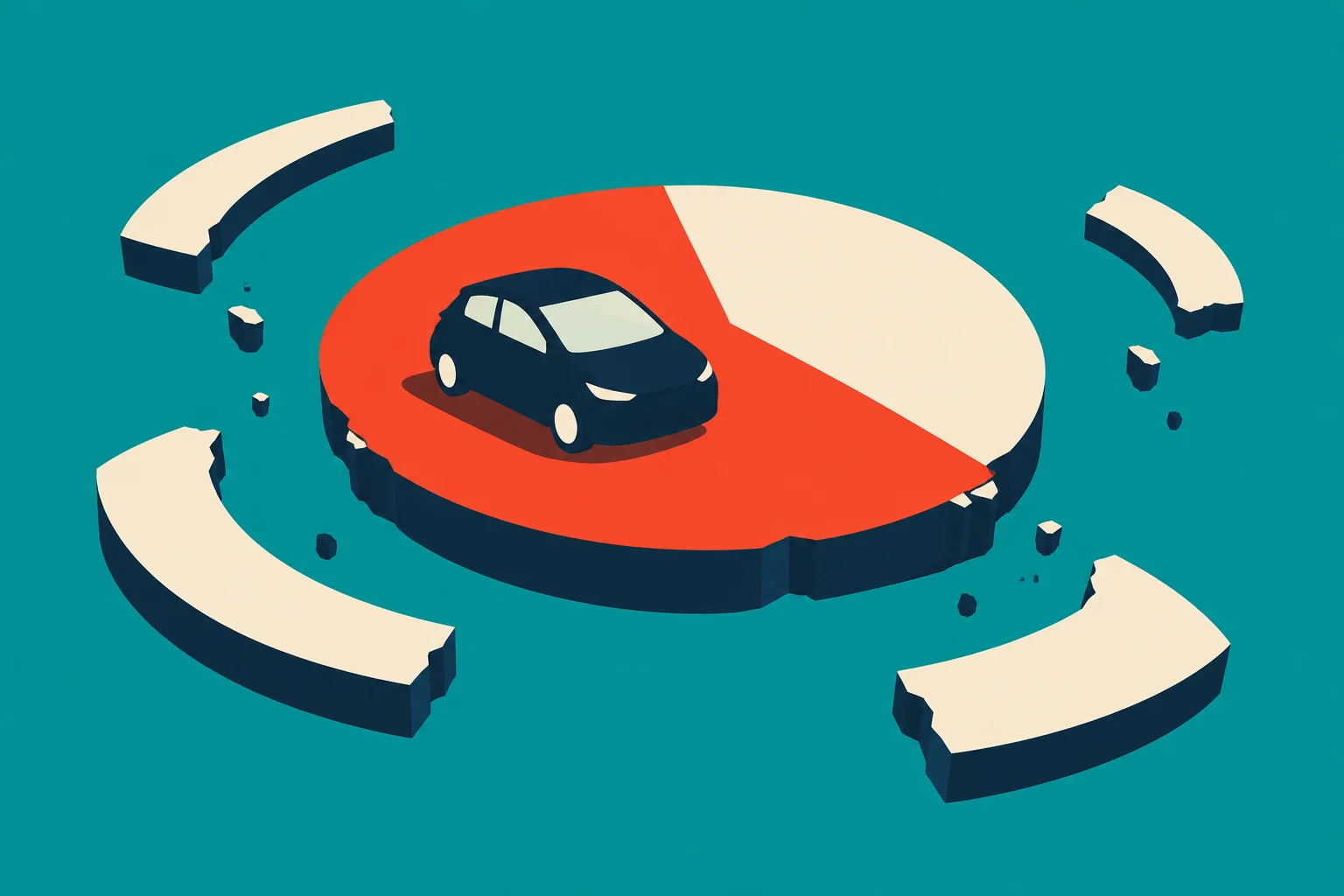
So the quarter produced two true statements that point in opposite directions. Tesla is more dominant than it was three months ago: 54% of EV sales, with the rest of the field shrinking while it grew. And Tesla sells fewer cars in America than it did a year ago, in a market that is nearly two-fifths smaller. It is winning a larger share of a smaller market.
Gas above $4 did the marketing
Cox attributes part of the EV rebound to fuel prices. “With gas prices well above $4 a gallon, electric vehicles look better than ever,” said Stephanie Valdez Streaty, the firm’s director of Industry Insights, in its quarterly analysis. The mechanism is straightforward: expensive gasoline raises the per-mile cost of a conventional car, and a driver who can charge at home replaces that cost with a much lower one per mile. That logic applies to any EV, though, not just Tesla’s — which makes the ex-Tesla decline harder to explain by fuel prices alone.
Two cars are doing 97% of the work
Inside Tesla’s 144,094, concentration is extreme. The Model Y and Model 3 accounted for roughly 97% of US sales — on Cox’s estimate, about 140,000 units of just two vehicles. The Cybertruck sold over 4,300 units. The Model S and Model X are no longer in production, and the Roadster is not due until 2028. Whatever demand exists for Tesla in America, it is demand for two mass-market models, one of them a crossover.
That leaves the open question for Q4. If gasoline stays above $4 a gallon, Cox’s fuel-price mechanism keeps working in EVs’ favor. But Q3 showed the mechanism lifting one company and not the other forty-some brands in the segment. Whether rivals’ slide was model-cycle noise or the start of a shakeout is the number to watch: ex-Tesla US EV sales, now at 118,555 a quarter and falling.