
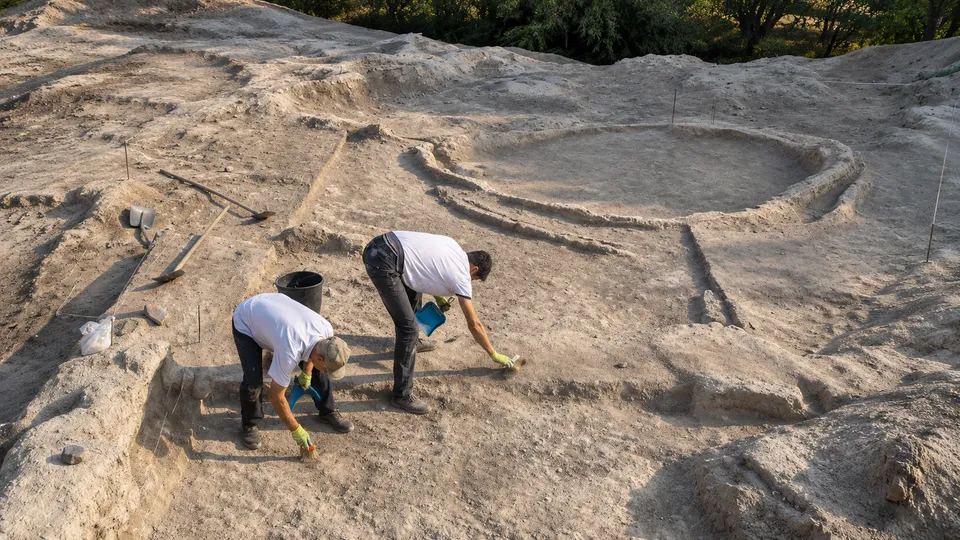
Ten bins of straw-tempered clay, each between 40 and 70 centimetres across, turned up this summer in a single excavation square at Göytepe, the Neolithic mound in western Azerbaijan’s Tovuz district. The Institute of Archaeology and Anthropology of Azerbaijan’s National Academy of Sciences (ANAS), which ran the dig, says the bins sit close enough together that they form one storage complex rather than ten unrelated containers. Arkeonews.net reported on the Institute’s November 19 excavation write-up; the Institute’s own field report gives the numbers behind the claim.
The bins sit in sub-square 3A2 of excavation locus 3, labelled TA1 through TA10, in a horizon the dig team assigns to the settlement’s fourth occupation phase. The 2026 season ran 60 days, from July 22 to September 19; 28 of those days were spent digging rather than processing finds. The team, led by Valeh Ələkbərov under Institute director Fərhad Quliyev and including Səidə Abbasova, who has worked the site since 2012, took the excavation down 3.20 metres below its fixed reference point on the square’s north side and 3.90 metres on the south, then stopped, just above the boundary of the fifth occupation phase.
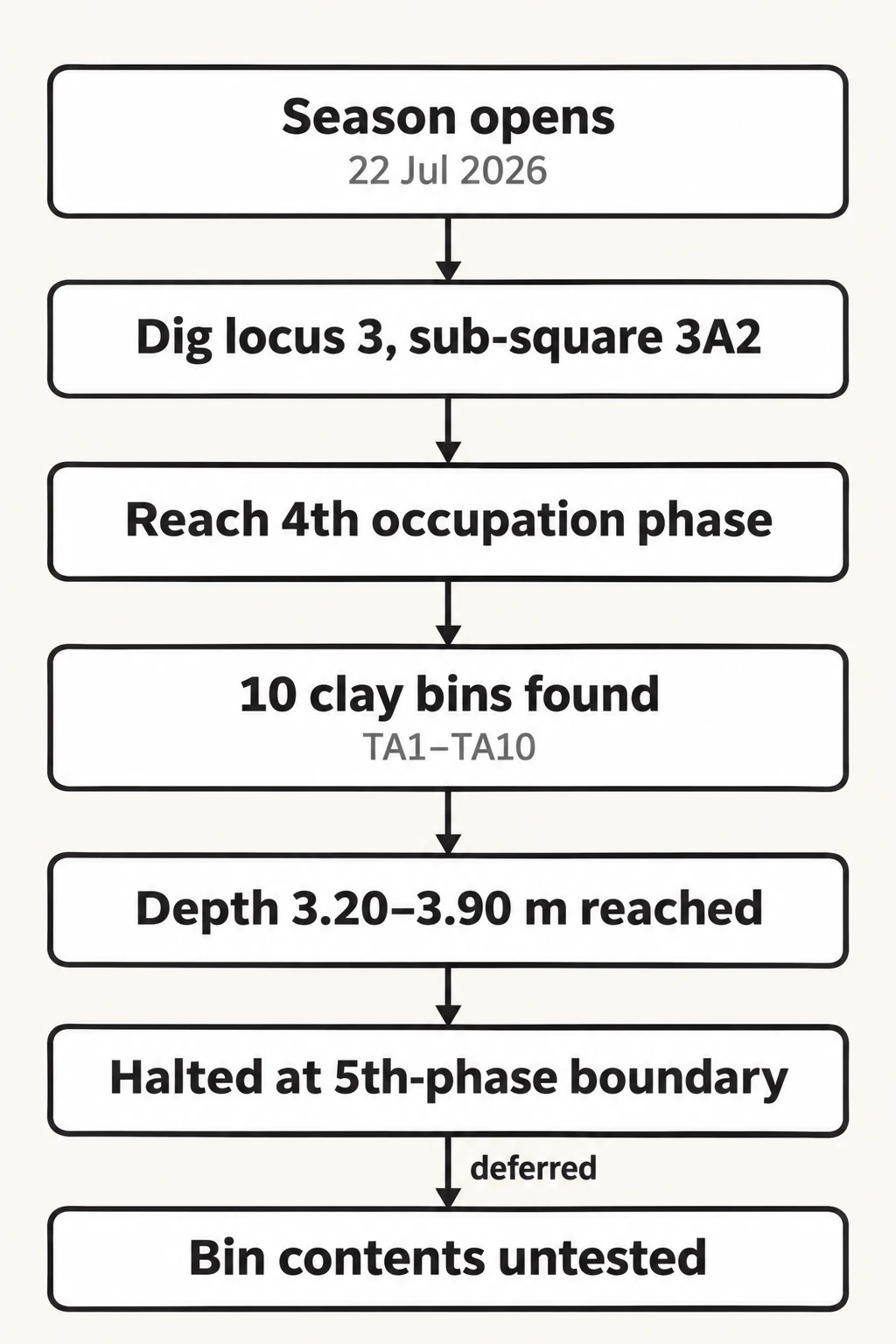
| From | To | How |
|---|---|---|
| Season opens (22 Jul 2026) | Dig locus 3, sub-square 3A2 | |
| Dig locus 3, sub-square 3A2 | Reach 4th occupation phase | |
| Reach 4th occupation phase | 10 clay bins found (TA1–TA10) | |
| 10 clay bins found (TA1–TA10) | Depth 3.20–3.90 m reached | |
| Depth 3.20–3.90 m reached | Halted at 5th-phase boundary | |
| Halted at 5th-phase boundary | Bin contents untested | deferred |
The dense clustering of the storage units indicates they could be elements of a single economic complex.
That hedge, “could be,” is doing real work and the English coverage drops it. Spacing is not residue. Nobody has yet run the test that would turn “could be” into a finding: what, if anything, was inside TA1 through TA10. Arkeonews reported that botanical and micromorphological analysis is deferred to a future season, and that the Institute does not yet know whether the complex served one household or several sharing a courtyard.
What a decade-old study already proved
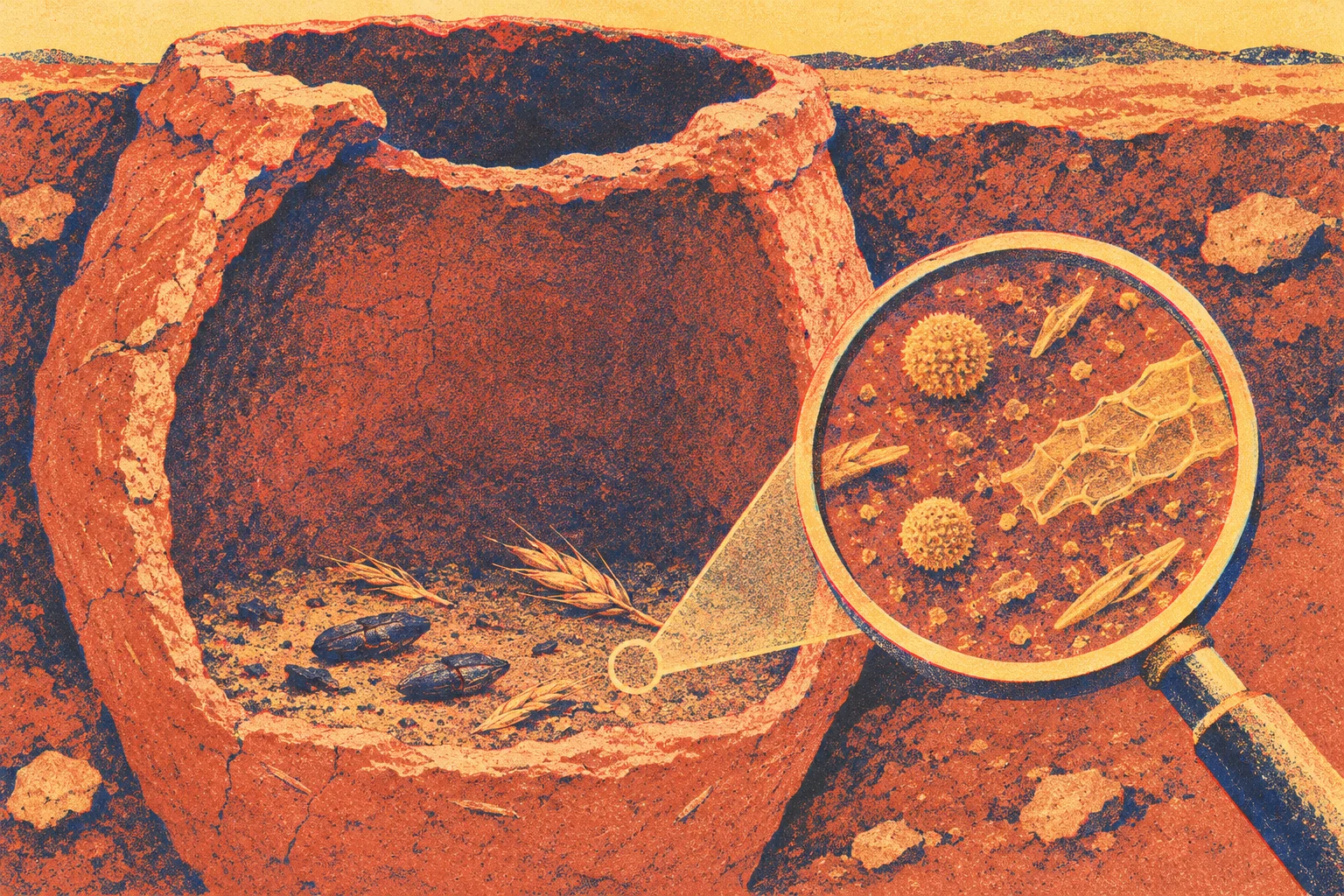
The only hard evidence Göytepe has produced so far about what its bins held comes from a different set of them, excavated between 2008 and 2013. Seiji Kadowaki, Lisa Maher, Marta Portillo, Rosa M. Albert, Chie Akashi, Farhad Guliyev and Yoshihiro Nishiaki published the analysis in the Journal of Archaeological Science in January 2015: micromorphology of the bin fills, combined with phytolith counts, found grass-dominated bottom layers with dung spherulites, and charred rachises and chaff of wheat and barley survived among them. That is a slower, more direct kind of proof than counting centimetres between bin walls — residue analysis, not spacing — and it is the only reason anyone can say with confidence that some Göytepe bins held cereal rather than water, tools or nothing. Those earlier bins ran roughly 50 to 60 centimetres across and about 50 centimetres deep: similar in size to this year’s ten, dug a decade earlier in a different square.
Arkeonews and the Institute both describe Göytepe as “8,000 years old.” The radiocarbon dates behind that round figure, run on organic samples from the mound, cluster between roughly 5650 and 5460 BCE — 7,486 to 7,676 years before 2026, depending which end of the range is used. That puts the site 300 to 500 years short of a round 8,000, which is the gap between a measured calibration range and a number that reads better in a headline.
A dig that paused, then resumed
Göytepe’s excavation history explains why this season stopped where it did. Formal fieldwork ran from 2008 to roughly 2013 as a joint project between Azerbaijani researchers and a University of Tokyo team led by Nishiaki, covering about 1,000 square metres and defining the 14 occupation phases the site is now known for; the results were published as a monograph by Archaeopress in 2021. Work continued informally through 2019, then paused. By 2025, protective covering over the exposed mud-brick walls had degraded enough that researcher Fuad Hüseynov had to run cleanup work before anyone could resume digging, and specialists ran training in LiDAR scanning and digital architectural documentation at the site in August 2026, methods the 2008–2013 excavation never used, according to a report from the Keşikçidağ State Historical and Cultural Reserve. The Institute itself was renamed from Archaeology and Ethnography to Archaeology and Anthropology in January 2024, which is as good a marker as any of the gap between the site’s first excavation era and its second.

Göytepe is a mound of about two hectares, roughly 145 metres across, built up through its fourteen superimposed habitation phases into 11 metres of cultural deposit — one of the thicker Neolithic sequences known from the South Caucasus. It belongs to the Shomutepe-Shulaveri culture, the sedentary farming communities that spread across what are now Azerbaijan, Georgia and Armenia during the sixth millennium BCE, building circular mud-brick houses linked by curving walls, keeping domesticated sheep, goats and cattle, and growing naked barley and free-threshing wheat — crop forms rare at Neolithic sites elsewhere in the Middle East but common here. A related, slightly older settlement, Hacı Elamxanlı Tepe, sits about a kilometre north and dates to roughly 5950–5800 BCE; its lower ratio of pottery to stone tools is one of the data points used to track how gradually ceramic technology spread through the region.
The Institute’s report defers the one test that would confirm what TA1 through TA10 actually held, and with it whether ten bins functioned as a single granary or as the separate stores of several households sharing a courtyard. That test — the same combination of micromorphology and phytolith counting that dated the earlier bins to grain storage in 2015 — is the next number to watch, whenever a future season reaches it.