
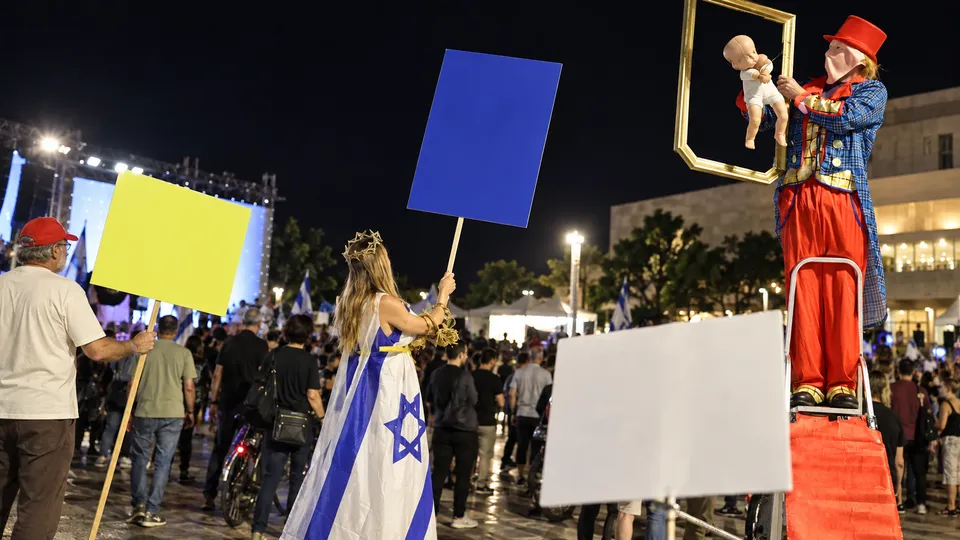
On Saturday, the last day of October and four days after Israelis voted, thousands of people gathered in Tel Aviv to ask one man for one thing. They wanted Gadi Eisenkot, leader of the opposition, to do what he had said he would not do: make a deal with the Arab parties and use their seats to remove Benjamin Netanyahu, the longest-serving prime minister Israel has had.
Protesters told the AFP news agency, as Al Jazeera reported, that this might be the “last chance for real change”. They described the man they wanted gone as a “great manipulator”.
Tel Aviv was not the only city. According to Haaretz, crowds calling for a government that includes the Arab parties also gathered in Jerusalem, Haifa and the north. Reports of the size differ. Al Jazeera and Haaretz counted thousands; the Associated Press, carried by Arab News, said hundreds.
The arithmetic
Start with the numbers, because in a parliament the numbers come first and the arguments later. In Tuesday’s election Netanyahu’s bloc won 53 seats and Eisenkot’s won 48. The Knesset has 120 members, and a government needs 61. Neither man has them. The Central Elections Committee’s tally after the double-envelope count, published by Israel Hayom, gave Likud 27 seats, Yashar 21, the Joint List 11 and Ra’am 8, on a turnout of 77.9 percent. The certified result is not expected before November 4, according to the Times of Israel, and seats could still move slightly.
Between them the Arab-led parties, running as Ra’am and the revived Joint List, took 19 seats. Nearly 840,000 people voted for them, according to the Central Election Committee. That is 64 percent more than in the 2022 election. Organizers had pushed for exactly this turnout in the weeks before polling day.

Add 19 to 48 and you get 67, a comfortable majority.
For many Israelis it is also a majority they will not accept.
The pledge
Eisenkot has ruled out a coalition with the Arab parties in the past. The AP reports that he has not yet decided whether to seek one now. Avigdor Liberman, whose right-wing Yisrael Beytenu opposes Netanyahu, has said he will not join a coalition that relies on Arab parties, even for support from outside the government. As the count closed, it was already clear that every route to 61 broke somebody’s campaign promise.
The street has made its choice. On October 29, two days before the Tel Aviv rally, protesters stood outside Eisenkot’s home in Herzliya chanting “There is no change without partnership,” the Jerusalem Post reported. The paper has noted that if Eisenkot keeps his promise not to serve under Netanyahu, he will probably need at least some of the Arab parties, whether as coalition partners or as outside support for a minority government.
Speaking from Ramallah, Al Jazeera correspondent Nour Odeh summed up the mood of the crowd:
People really want this vote for change to work out, and they believe that… Gadi Eisenkot and other leaders of the Jewish-Israeli parties need to listen to their voice.
A reflection, not a finding: the ruled often move faster than the people who would rule them. A politician gives a pledge to win votes. Once the votes are counted, he finds that the pledge is the only thing standing between him and the office.

The other crowd
Netanyahu’s supporters came out on Saturday too. Odeh said they were heard shouting that “Israel should not have a government with so-called terrorists”. Haaretz counted more than 100 counterprotesters in Tel Aviv. It reported that they tried to push through the police cordon toward the rally and called for the election to be annulled.
Their slogans echo the prime minister’s own. Netanyahu has accused the Palestinian-Israeli parties of “stealing” the election and of taking money from Qatar to do it. Qatar has rejected the charge and calls it a disinformation campaign. Netanyahu has also written on social media that working with the Arab parties would be “a disaster for Israel”.
The language has gone further still. According to Odeh, right-wing circles have described the historic turnout of Palestinian citizens as “electoral terrorism” and compared it to the October 7th attack, when Hamas-led fighters stormed southern Israel, killed more than 1,200 people and took hundreds captive. In that comparison, citizens casting ballots in their own country’s election are set beside a massacre.
Odeh said “Palestinian-Israeli votes and voices” are under attack because they now hold a “prominent position” in deciding whether Eisenkot can form a government. For decades these voters were told their ballots changed nothing. In this election they changed the outcome, and the reaction has been to call the ballots themselves an act of war.
The certified count is due on Wednesday. After that the result is settled, and Eisenkot has to decide what to do with it.