
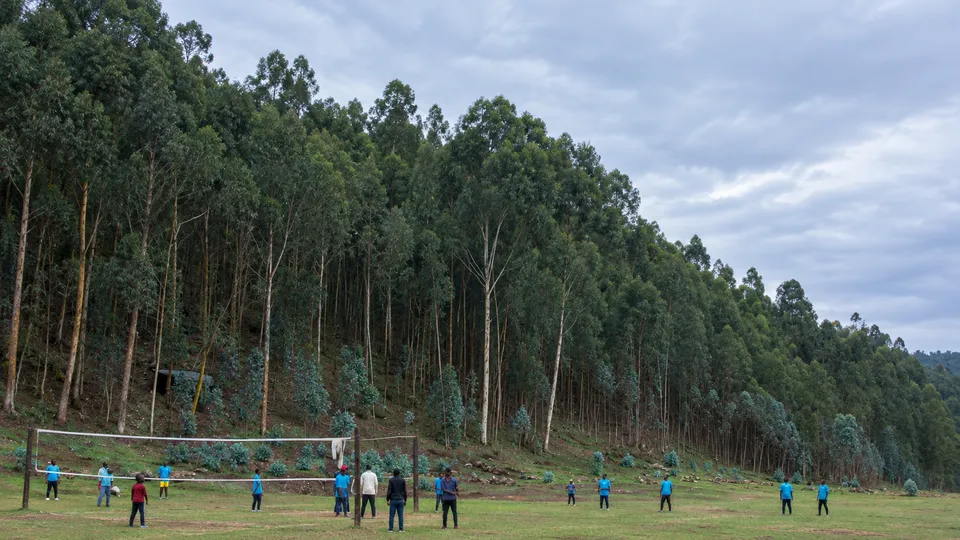
Jean Claude Hategekimana was born in 1996 in Rutsiro District, in western Rwanda, two years after the genocide. He moved to the Democratic Republic of the Congo with his parents and grew up in territory held by the Democratic Forces for the Liberation of Rwanda, the FDLR. In 2018 he joined the group, went through military training and rose to captain. He never chose the forest. He was raised in it, and later he enlisted in it.
His war ended in defeat. “I arrived at the Mutobo Centre after fighting to defend Goma. Following our defeat, I fled to Masisi. After realising that I was fighting for nothing, I decided to return to Rwanda. I came back on February 24,” he told Layth Mushtaq of Al Jazeera.
He said the movement taught its members one thing about the country across the border: anyone who went back would be killed. “Upon arriving in Rwanda, I realised that the FDLR had been lying to us. For me, returning home felt like embarking on a suicide mission,” he said.
Here is a reflection, not a finding. An army in exile can lose a battle and survive. What it cannot survive is its soldiers learning that home is still standing. So the gate to home has to be guarded by a story, and in this case the story was death.
An army born of 1994
The FDLR grew out of the aftermath of the 1994 genocide against the Tutsis, when soldiers of the former Rwandan army and militiamen fled into what was then Zaire. Kigali accuses the group of attacking Rwanda and feeding insecurity along the border. In the Washington agreement of June 2025, Kinshasa committed to neutralising the FDLR and Rwanda committed to lifting its “defensive measures”. On July 28 this year the Congolese government announced that one FDLR faction had signed a protocol on disarmament and cantonment. Foreign Minister Olivier Nduhungirehe called that a “gross manipulation”, because the agreement demands neutralisation, not negotiation.
In August Kigali rejected an FDLR proposal to resettle reluctant fighters in third countries. “Its fighters should be repatriated to Rwanda without any further conditions,” Nduhungirehe said, according to a Rwandan outlet. In September, talks in Geneva tested whether the deal could hold at all, while a war that is growing new fronts went on in the east.
Mutobo
The road home ends in Musanze, in the Northern Province, at the Mutobo Demobilisation and Reintegration Centre. Francis Musoni, secretary-general of the Rwanda Demobilisation and Reintegration Commission, said it was set up in 2001 to receive FDLR members and fighters from other Rwandan armed groups coming back from Congo. The programme covers medical care, psychosocial support, civic education and help finding family. A telephone service lets returnees call relatives and friends.
“We help them to build confidence among themselves, build trust, and empower them to go back into the community and contribute to the development of the country together with their families,” Musoni said. Residents can go home for short visits during their rehabilitation. “They are given written permission for a week or two, and we even facilitate transport,” he said. The centre also lets visitors and journalists meet the returnees.

The numbers are rising. At the end of March, 214 people were reintegrated, Africanews reported: 178 former combatants and 36 civilians associated with armed groups, among them 11 women. By June the centre held 682 people in its 77th cohort, according to KT Press. The process has its doubters. In August, 39 Congolese were sent back to the DRC after months in Rwanda under the UN’s repatriation programme. Some of them claimed that UN agents had persuaded them to register as FDLR fighters in exchange for money.
The commanders’ reasons
Al Jazeera spoke to several of the former commanders at Mutobo. Their reasons were family, disillusionment and fear for their own lives.
Major-General Anastase Munyaneza served in the former Rwandan army in Kigali’s Kicukiro District during the genocide. He left the country afterwards and later commanded the FDLR’s South Kivu sector. He came to accept the group’s beliefs, but he never lost touch with his relatives in Rwanda. “I was the only one who had fled to the DRC. I regularly received news about them. I knew they were still alive, attending school, working for the government and improving their lives. I began asking myself what I was doing in the forest,” he said. Seeing other members return safely helped him decide. He contacted the UN stabilisation mission, MONUSCO, whose staff took him to Bukavu, then to the border, and from there he went to Mutobo.
Lieutenant-Colonel Idrissa Bizimana ran ideology, propaganda and recruitment. He was the man who taught the story. “I no longer believed in the ideology I had been promoting. After receiving verified information about what was happening in Rwanda, I decided to return home,” he said. A MONUSCO general had offered to help. Bizimana said he used a satellite phone with GPS to send his location and a date, and a helicopter came for him.

Colonel Augustin Nshimiyimana, a former FDLR intelligence commander, came back in 2022. After a disagreement over a mission in Bujumbura, another commander accused him of working for Rwanda. “When they accuse you of working with Rwanda, it means they consider you a Tutsi, and the next step is to kill you,” he said.
A movement built on fear of the outside finds, sooner or later, a traitor inside.
Certificates and families in Europe
Febronie Mukankiko teaches at the centre. “Our students are different from ordinary students. They are adults who grew up in the forest, so teaching them requires special skills,” she said, adding that teachers take extra training for the work. Many of her students had little formal schooling before. “When they graduate and receive their certificates, they are very happy,” she said.
Musoni said the average stay is five months, followed by formal discharge. After that the commission may provide financial support, vocational training, schooling and help starting income-generating work, and it checks on how former residents are coping. Then the hard part begins, outside the gate: finding a job and a place in families that went on living without them.
Lieutenant-Colonel Emilien Mpakaniye joined the FDLR in 1998 and handled economic affairs at its headquarters. He described his disillusionment as growing out of the group’s lies, and partly out of who in the movement paid the cost. “First, their family members live in Rwanda and in Europe, while ours are in the forest,” he said of the senior commanders.