
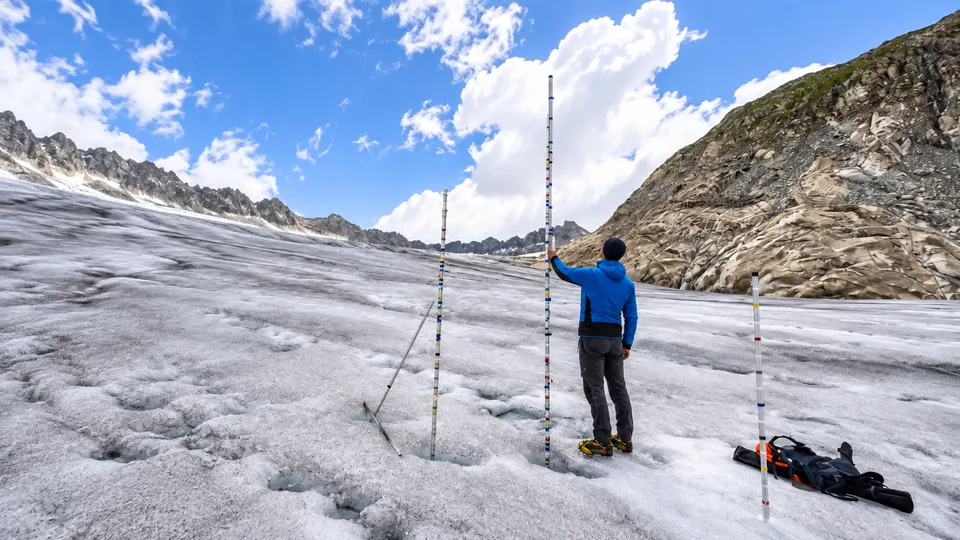
Swiss glaciers lost 5.5 percent of their volume in 2026, the second-worst year since measurements began, the Swiss Academy of Sciences said on Thursday, bringing the loss of Alpine ice over the past five years to almost 20 percent.
Average ice thickness fell by 2.5 to 4 meters in some areas, according to the assessment by the academy and GLAMOS, Switzerland’s glacier monitoring network. Only 2022 was worse. Temperatures were higher this year than four years ago, but many glaciers carried more protective snow and less sunlight-darkening Saharan dust settled on the ice, so more sunlight was reflected back into the atmosphere.
Some glaciers had no such cover. The Rhône Glacier and the Aletsch Glacier, the largest in the Alps, recorded their most intense melting ever. At the lowest monitoring point on the Aletsch tongue, the ice thinned by 13 meters.
“It’s staggering to see the enormous amount of ice that has melted,” Matthias Huss, the GLAMOS director, told SWI swissinfo.ch. “But what is even more striking is that events of this magnitude are now recurring year after year. What used to be extreme events, by definition rare and very intense, now occur almost every summer.” The losses show “that the climate is warming too rapidly for glaciers to adapt,” Mr. Huss said.
Two measures captured the year’s severity. The “glacier loss day,” the date when glaciers exhaust the snow and ice stored over winter and begin to shrink, came on June 29. Since 2000 that date had always fallen in July or later, except in 2022, when it came on June 26. And the altitude at which the air cools to freezing stayed above 4,000 meters for 76 days between May and September, “more than double the average and a record,” the academy wrote. Under such conditions, it said, “Alpine glaciers have no chance of surviving in the long term.”
Around 30 small Swiss glaciers likely vanished this summer, Mr. Huss said. Over the past 50 years the country has lost more than 1,000, about 40 percent of its total. Among this year’s casualties was the Plattalva Glacier in the canton of Glarus, declared extinct after it disappeared completely in September. In the 1950s it had hosted what Mr. Huss described as probably the world’s most detailed glacier monitoring program, and seasonal measurements taken there from 1947 to 1985 form a rare record from an era when few glaciers were watched at all.
Without a drastic cut in greenhouse gas emissions, half of all Alpine glaciers could disappear within 20 years, according to a study published last year. By the end of the century, only the largest, such as the Aletsch and the Rhône, may survive.
For now, the melt feeds the lowlands. Glaciers released roughly 2,200 billion liters of water between July and September into rivers including the Rhine, the Rhône and the Danube, more than four times the annual drinking-water use of every Swiss household, and river levels would have been lower without it. But Alpine glaciers have reached, or soon will reach, “peak water,” the point after which meltwater runoff declines, leaving less water in Alpine valleys for navigation, farming, drinking supplies and power production.
“The problem isn’t just that there will be less water,” said Giovanni De Cesare, operational head of the Hydraulic Constructions Platform at the Swiss Federal Institute of Technology Lausanne. “Today, glaciers melt all summer long, providing a steady stream of runoff. When they’re gone, we’ll have to rely directly on precipitation, rain and snowfall, which is much less predictable.”