
Sixty years ago yesterday, on 26 November 1966, teenagers gathered outside Pandora’s Box, a coffeehouse and nightclub on West Hollywood’s Sunset Strip, for the third weekend in a row. They were protesting a 10pm curfew for under-18s and what their flyers called “police mistreatment of youth on Sunset Boulevard.” That night police reportedly “viciously clubbed and beat” them, as Matt Glazebrook recounts for the BBC. Stephen Stills of Buffalo Springfield was among the music people watching. He drove home to Laurel Canyon and wrote For What It’s Worth. He later told Rolling Stone the police looked “very much like storm troopers,” and recalled thinking, “Jesus, America is in great danger.”
The usual way to tell this is as a story about youth, freedom and rock music, and that version is true. But underneath it is a fight over commercial real estate, and I find that part clarifying.
The Strip is the 1.7-mile (2.7km) stretch of Sunset Boulevard through West Hollywood. Back then it was an unincorporated part of Los Angeles with light regulation, which made it popular with movie people and mobsters in the 1940s. In the 1950s that business moved to Las Vegas and the neighbourhood went into decline. Falling rents brought in music venues and coffeehouses. The Byrds had a 1965 residency at Ciro’s. In early 1966 Buffalo Springfield got a regular slot at Whisky a Go Go, with the Doors soon opening for them. Love and Canned Heat played the Trip, the Troubadour and the Sea Witch.
Then came the regulation that made the trouble. In 1965 Los Angeles County issued permits that split venues into two tiers: clubs for over-18s that served liquor, like the Whisky, and alcohol-free rock clubs for 15-to-18-year-olds. Pandora’s Box, painted purple and sitting on a triangular traffic island where North Crescent Heights Boulevard came down from Laurel Canyon to meet Sunset, was in the second group. Think about what that does to a business. A bar makes its money on drinks. A teen club sells admission and coffee to people living on pocket money. It needs a lot of them. They came, driving in from the suburbs to what a Life magazine feature in August 1966 called the “12-block-long no-man’s land of big beat and fast action.”
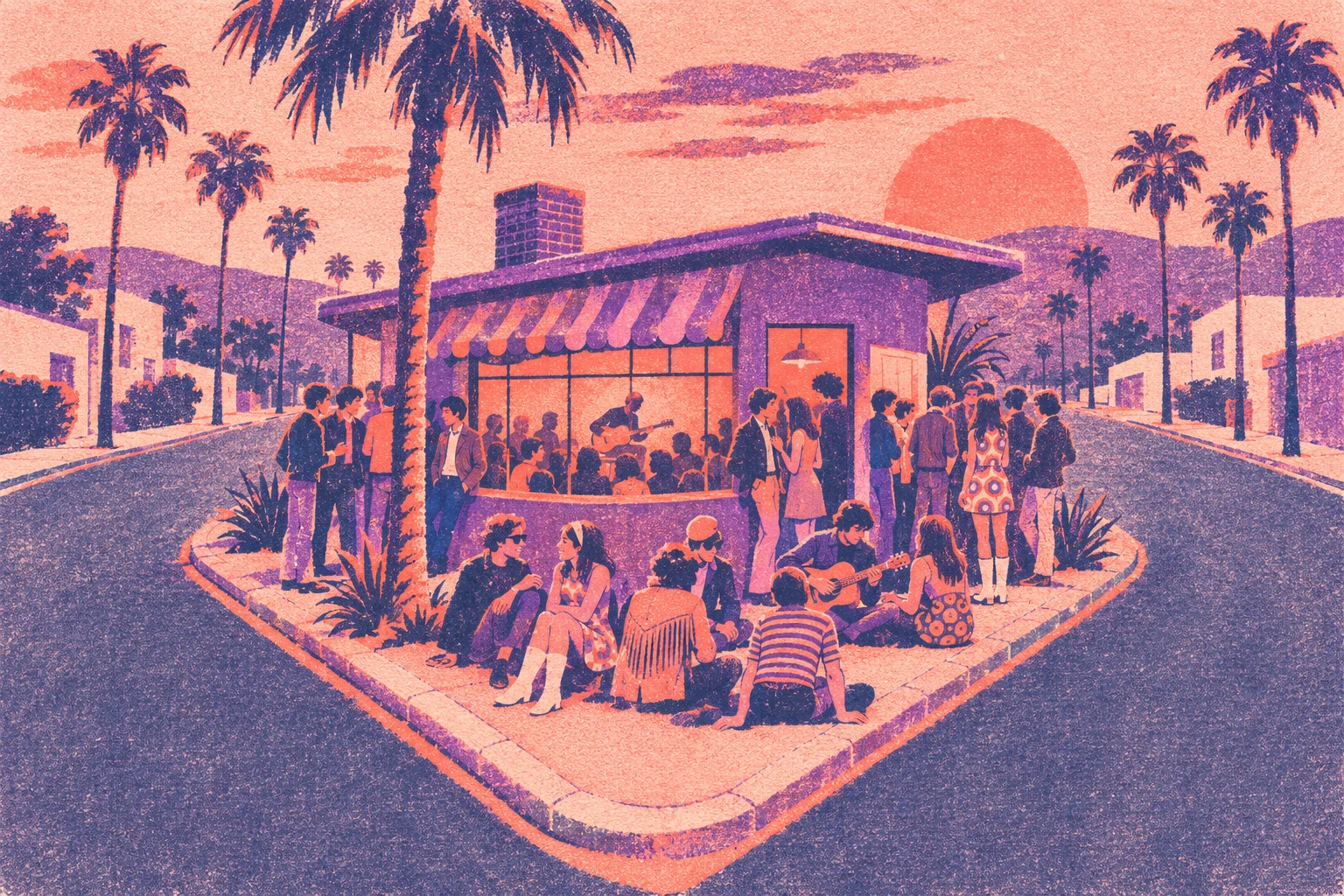
Now, purely as a hypothetical, imagine you run an expensive restaurant on the same street. Your customers can’t park. The sidewalk is full of long-haired kids who will each spend about the price of a coffee somewhere else. You have a trade association and the kids don’t have a vote. Two such groups did exist, the Sunset Plaza Association, which spoke for the remaining upscale restaurants, and the LA Chamber of Commerce. In the summer of 1966 they persuaded the West Hollywood Sheriff’s Department to enforce the curfew. Some accounts, including Wikipedia’s history of the riots, describe it as a decades-old law that was newly being enforced rather than a new rule. Deputies swept the Strip and arrested hundreds of teenagers at a time, reportedly to humiliate and intimidate them as much as to enforce anything. Officials also used eminent domain to acquire and condemn Pandora’s Box and other underage clubs, which meant demolition, not just closure. The [Los Angeles City Council voted to buy and demolish](https://en.wikipedia.org/wiki/Pandora’s_Box_(nightclub)) Pandora’s Box in November 1966. If a tenant is ruining your block, the most thorough fix is for the government to buy the building with public money and knock it down.
The first protest was the idea of two teenagers on the Strip. Al Mitchell, who managed the Fifth Estate, another under-18 coffeehouse, helped them print flyers and paint signs. At 10pm on Saturday 12 November a crowd gathered with signs reading “Blue Fascism” and “Let Us Alone.” The BBC puts it at a couple of thousand people. Other accounts say up to 1,000. It was disorganised and peaceful until traffic jammed. Off-duty servicemen started a fight after a minor collision. A bus driver honked and yelled, and demonstrators rocked the bus and climbed onto its roof. Once the passengers were off, a teenager set off a fire extinguisher inside. A liquor store window was smashed, and police with billy clubs moved in.
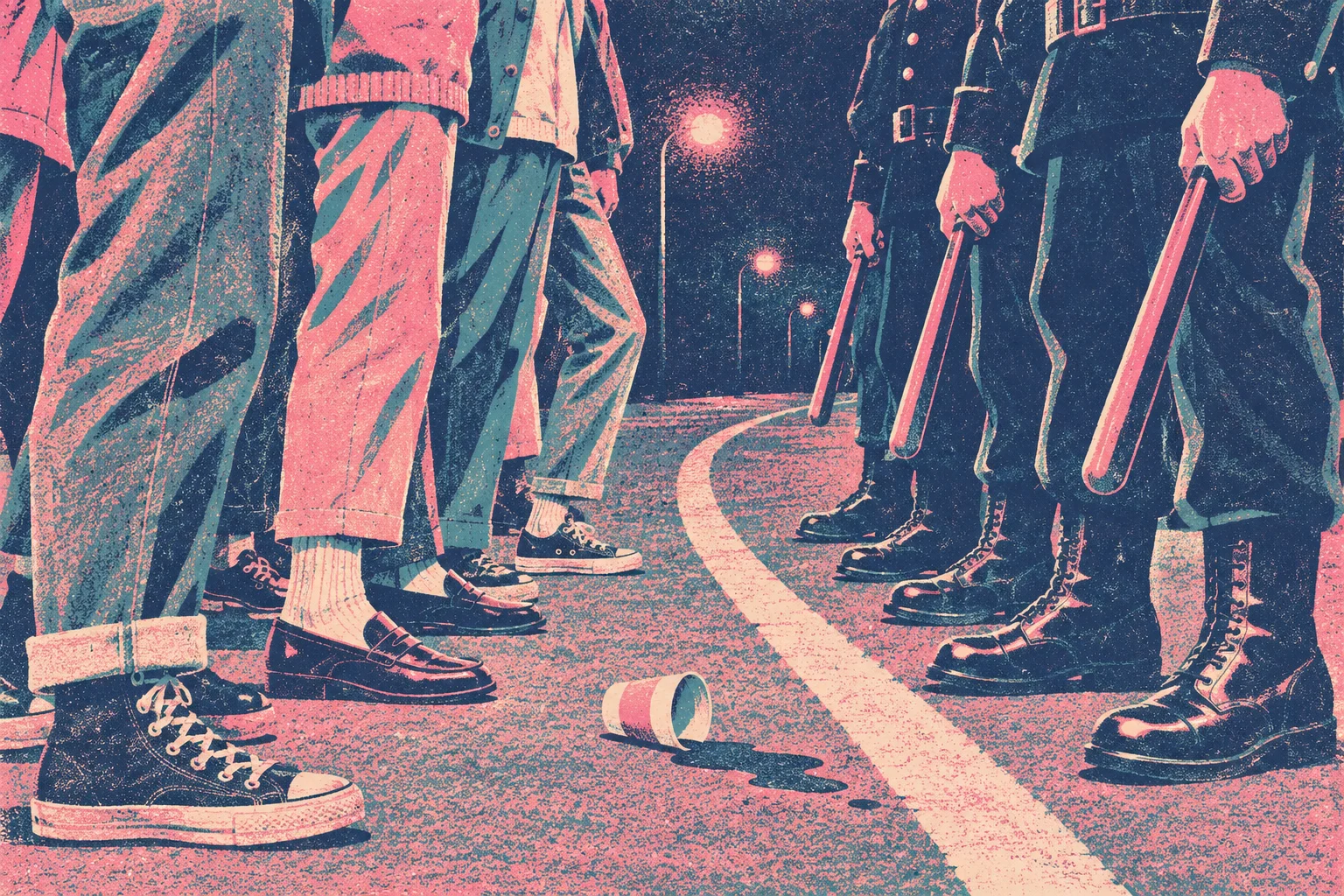
Monday’s papers ran “Long Hair Nightmare” and “Anarchy on Sunset Strip.” A Los Angeles Times editorial blamed adolescent “irresponsibility.” The LAPD’s Hollywood commander blamed “left-wing groups and outside agitators.” In fact the protest was spontaneous and run by teenagers. By the standards of the 1960s the riots were small: beatings, arrests, a few damaged vehicles and windows.
The riot as a product
What happened next is the funny part. The restaurants wanted teenagers off the street, and the entertainment industry turned the fight into something it could sell to teenagers everywhere. Jack Nicholson and Peter Fonda came along one night, and Fonda was arrested. The Mamas and the Papas, Frank Zappa and the Standells all put out records about it. The Standells’ song was for Riot on Sunset Strip, an exploitation film released scarcely three months later that invited audiences to “Meet the Hippies… The Teenyboppers… The Pot Partygoers.”
In December, Sonny and Cher showed up outside Pandora’s Box, officially to call for calm. Their manager, Brian Stone, joined Mitchell, Byrds manager Jim Dickson and others to form the Community Action for Facts and Freedom Committee. It fought the closures in court and sent members to act as legal observers as policing got heavier. On Christmas Day, Pandora’s Box ignored the demolition order and reopened for one night, and Stills played For What It’s Worth. The band had recorded it on 5 December. It entered the Billboard Hot 100 at No. 90 and peaked at No. 7 on 25 March 1967, roughly four months after the beatings it describes. By the end of that summer Pandora’s Box was rubble. The officials won the property fight, and the people they were fighting got a hit single out of it.
The education
The protests went on, into early 1967 by the California Historical Society’s count and sporadically beyond. Some nights felt like happenings, with flowers, songs and bubbles. Others looked like ordinary marches, with speeches from American Civil Liberties Union lawyers. In February 1967 the Strip activists coordinated with campaigners in Silver Lake, where gay clubs had faced repeated raids and mass arrests. Alliances with Black and Chicano youth mostly didn’t happen. “They largely failed to forge alliances with other advocacy groups such as black liberation activists in Watts,” Patrick Burke, a professor of music at Washington University in St Louis, told the BBC, “and therefore the political impact of the protests was inevitably limited.”
Still, the people involved learned how to protest. “The kids who stood up for their rights on the Strip were given a political education that made them all the more ready to lend their voices to other crusades against the government and the establishment,” the music historian Peter Doggett said. The historian Mike Davis, who saw it himself, put the social value plainly: “to claim that you had been busted on the Strip in ’66 or ’67 was the Southern California equivalent of boasting that you had been at Woodstock.” The 16-year-olds of 1966 became the student activists, anti-war marchers and Democratic Convention protesters of 1968. In 1970 Stills, by then in Crosby, Stills, Nash & Young, had a top-20 hit with Ohio, about the Kent State shootings. (Curfews are still a favourite tool for governments facing young crowds. France added some this autumn.)
One of the last Strip demonstrations, in September 1968, was organised by the socialist, anti-war Peace and Freedom Party. Its flyers read: “Free the Strip. End Police Brutality. Free Huey Newton.” Two years earlier the complaint had been about parking.