
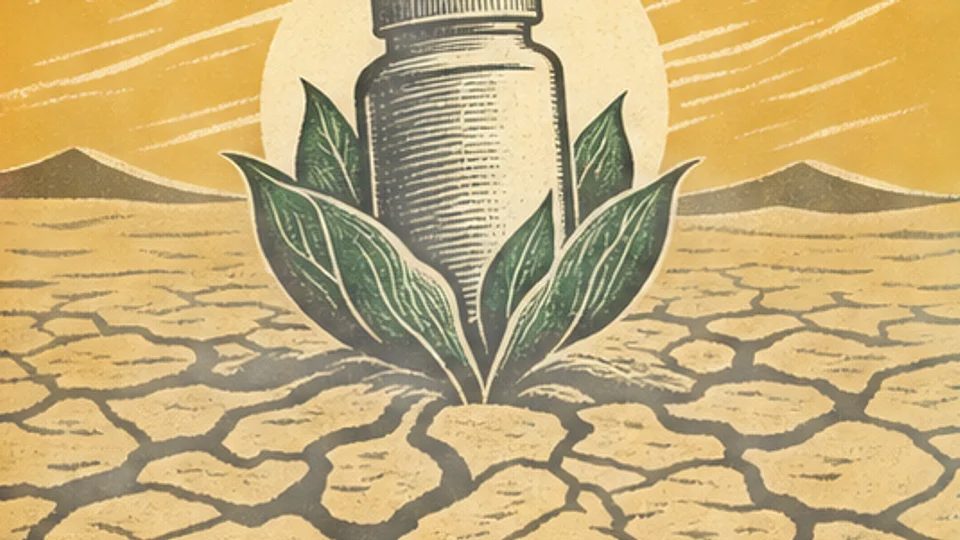
The Mohamed Embarek Fakal·la Pharmaceutical Production Laboratory is sometimes called “a desert rose,” because nobody expected anything like it to grow here. “Here” is the Algerian hamada, a stony, hostile expanse in the southwest of the country where the wind whips sand under the doors and, as the lab’s deputy director Mulai Mesaud Jarrachi tells EL PAÍS, between your teeth. It is not the address a pharmaceutical industry would choose. It is the address the Sahrawi people got.
For fifty years, some 173,000 Sahrawi refugees have lived in the Tindouf camps, established after the Moroccan occupation of Western Sahara, a former Spanish colony. Under these conditions they have built schools, film and nursing institutes, fish farms — and, for the past three decades, a laboratory producing paracetamol, ibuprofen, eye drops, serums, ointments, ultrasound gels and antibiotics. The entire operation is run by eleven Sahrawi technicians: seven men and four women.
The lab sits in a small building on the grounds of the Bachir Saleh National Hospital in Rabouni, the camps’ administrative center, under a portrait of Fakal·la, a historic figure in Sahrawi healthcare. It began with a visit in 1992, when Carles Codina, a pharmacist with the NGO Medicus Mundi Mediterrània, watched a Sahrawi technician at a camp dispensary preparing an antiseptic and had an idea. The laboratory was inaugurated in 1996 and produced its first medicines two years later.
“We started with just a few formulas, between five and eight. By 2000, [we had begun producing] half-a-million capsules [annually] of various medications. Now we maintain a list of about 15 or 20 drugs,” says its director, Mohamed Lamin Abdi, who has worked there since 1998. Born in Western Sahara in 1968, he studied pharmacy in Kharkiv, earned a doctorate in Italy and worked in Spanish pharmacies — and keeps coming back, for family and for the cause. “It’s part of our lives,” he says.
Abdi is honest about the scale: the lab covers perhaps 5% of the medicines the camps need. The rest flows through a central pharmacy funded by the European Union, and healthcare workers and NGOs consulted by EL PAÍS report shortages regardless. What the lab provides is a reserve. “Ten years ago, there was a delay in the arrival of medicines. We had to work twice as hard to at least guarantee the availability of painkillers, syrups and antiseptics,” he recalls. In 2020, when COVID-19 stopped the world, technician Brahim Saleh Labeid’s work turned essential: “There was no hand sanitizer, so we started producing it here. We managed to manufacture enough to distribute to all the wilayas (camps).”
For some products the little factory is the whole supply. The lab meets 100% of the camps’ demand for three-liter sodium chloride bags for urinary irrigation — about 200 a month, prepared in the morning and walked 650 feet down the road to the hospital’s operating room, replacing an arrangement where the urology committee bought them elsewhere at ruinous transport costs. Since 2024 it has also compounded dermatology treatments to order — corticosteroids, antibiotic ointments, creams — which Abdi calls a “window of opportunity to obtain more funding.”
The constraints are the desert’s own. “In the desert, there are only four things: sun, sand, drought and the wind, which blows sand under the doors and through the windows,” Abdi reflects. Add serious problems with equipment maintenance and a shortage of technicians, especially for medical equipment.
It is a continuous struggle
Fatimetu Ahmed, the lab’s secretary for 21 years, adds the materials: “There’s a shortage of both active ingredients and empty containers.” Money comes up in nearly every conversation. The project, run by Medicus Mundi Mediterrània, has in recent years been funded by the Catalan Fund for Development Cooperation — an entity pooling Catalonian municipalities — with past support from Spain’s AECID and the Catalan agency ACCD. It has avoided the cuts hitting other internationally funded projects, but there is never enough. “One municipality gives you €800 ($930). Another one gives you €3,000. And that’s how you fill in the gaps,” says the NGO’s María Elena del Cacho, noting the team was still struggling to cover costs up to mid-January. “Over the last two years, there’s been a noticeable decline in funding; it’s harder.”
The hardest shortage, the one no municipality could fund away, was belief. Mesaud, who has worked at the lab for 25 years, remembers when patients collected their medicine and threw it away the moment his back was turned. “They didn’t believe that medicine could be made in the desert,” he says. That era is over. “People want our local medicines, because they’re very effective. They even tell us, ‘I only want the ointment that’s made here.’” The lab’s diclofenac, technician Saleh says, is “of very good quality”; Sahrawis now come for it from Mauritania and Morocco, and some carry it to Spain. “We’ve earned the trust of our patients,” Mesaud says.
In 2015 the lab opened a cleanroom in another wing of the building, where the strictest work gets done — glaucoma eye drops, amoxicillin capsules — behind coats, caps, gloves, masks, clogs and shoe covers, in a building the sand is actively trying to enter.
Five percent of the medicine, everyone agrees, is a drop in the ocean. But the desert rose was never supposed to be an ocean. The desert supplies four ingredients; the lab, out of eleven people, some Catalan municipalities and thirty years of stubbornness, supplies the rest — two hundred bags of saline a month, walked down the road by hand, to a hospital that would otherwise wait for the world to deliver.