

Charles Cahn III resigned Sunday as head of Suffield Academy, ending a 22-year run atop the Connecticut boarding school four days after the Boston Globe reported that he had spent eight years headlining recruiting events for a Shanghai company that promised wealthy Chinese families it could “ensure admission” to American prep schools. Cahn, 56, is also the subject of an Internal Revenue Service investigation that Suffield’s board says it learned of on Oct. 21. He has not been charged with any crime, and there is no public evidence of financial wrongdoing.
The timeline compresses a 22-year tenure into 18 days. On Oct. 16, Suffield held a campus celebration for what it called Cahn’s “remarkable 23-year tenure.” On Oct. 21, a Wednesday, the board says it first learned of the IRS inquiry. On Oct. 22, it put Cahn on immediate leave, effective that day, and handed control to his designated successor, Casey Bobo, eight months ahead of the July 2027 handover both sides had already announced in January 2025. Somewhere in that 24-hour window, Cahn went missing.
Two missing days
A family member told the school Cahn hadn’t been seen or heard from in a day and asked for a welfare check, according to the Globe’s reporting on the episode. Police searched the property, found no one, then filed a formal missing-person report. They located Cahn that afternoon in Maine — property records tie a house in Harrison, Maine, once owned by Cahn and his wife, Hillary Rockwell Cahn, to an LLC called Islands East — and notified his family. Suffield announced his leave of absence a few hours later. Cahn has issued no public statement since; Bobo relayed his resignation message for him on Sunday, as she had relayed the leave announcement in October.

“Charlie’s tenure has ended suddenly and painfully, in ways none of us could have anticipated,” Bobo told the school community. “We can have profound compassion for Charlie as a person, for the trouble he is experiencing, and for those who love and care about him, while still recognizing the seriousness of the circumstances that have brought us here.” Cahn’s attorney, Duncan Levin, said his client “loves the Suffield community and is proud of what he, the faculty, and the staff have built together” and that he “fully supports Casey Bobo and has every confidence in Casey’s leadership.”
A $150,000 admissions pipeline
The company at the center of the second thread is XueMei Education, headquartered in Shanghai with a claimed office in Newton, Mass. Corporate filings from a 2016 listing on a Chinese stock exchange, reviewed by the Globe, show Lillian Chen owning 20 percent of the company and her husband, Henry Chang, owning nearly 80 percent; the filings put its most expensive contracts at $150,000 — roughly 1.9 times a year of Suffield’s own $79,400 boarding tuition. XueMei delisted voluntarily in 2019 but kept operating. Its pitch to “high net worth” Chinese families was that it could “communicate directly with admissions leaders” and “ensure admission” to selective schools.
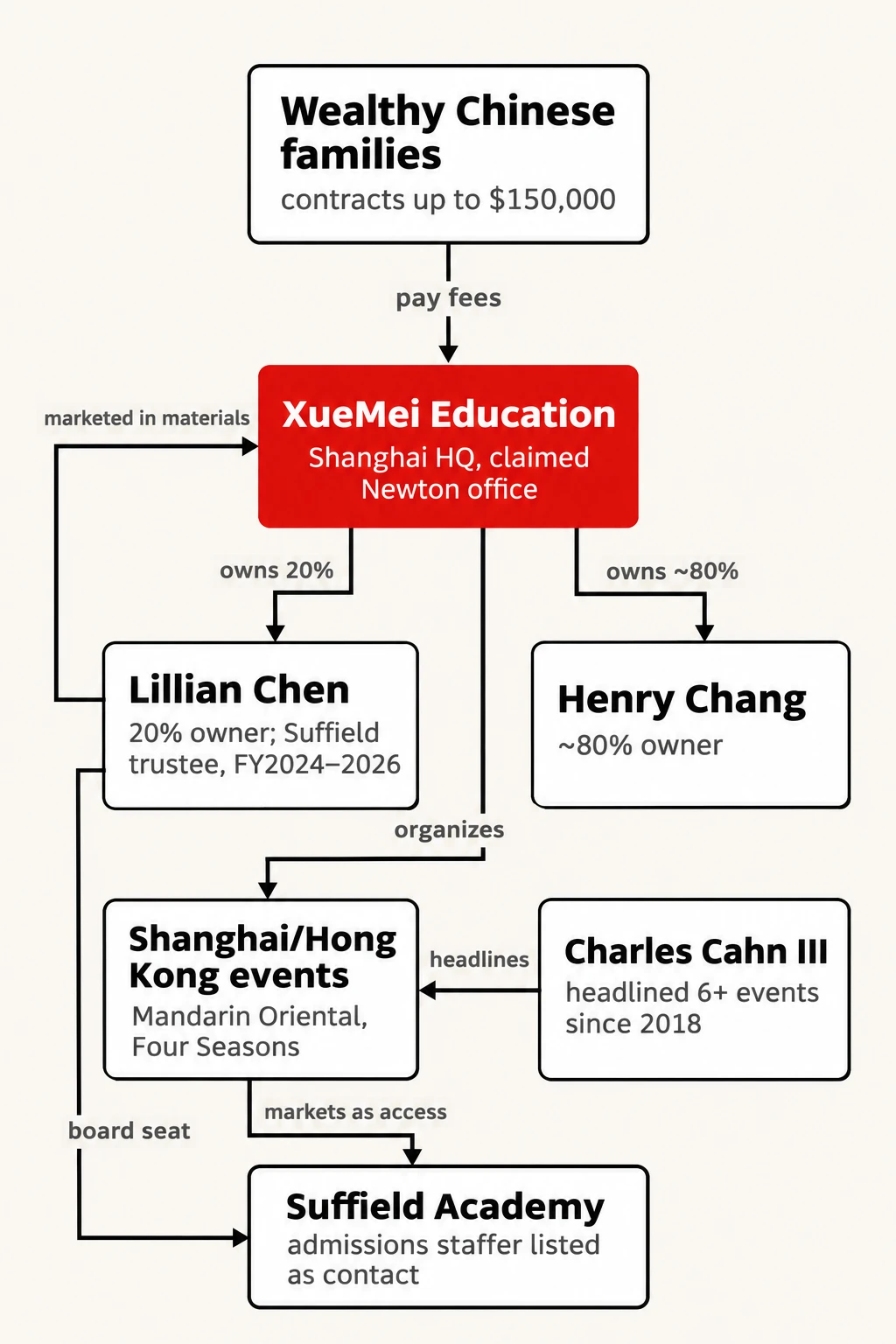
| From | To | How |
|---|---|---|
| Wealthy Chinese families (contracts up to $150,000) | XueMei Education (Shanghai HQ, claimed Newton office) | pay fees |
| XueMei Education (Shanghai HQ, claimed Newton office) | Lillian Chen (20% owner; Suffield trustee, FY2024–2026) | owns 20% |
| XueMei Education (Shanghai HQ, claimed Newton office) | Henry Chang (~80% owner) | owns ~80% |
| Lillian Chen (20% owner; Suffield trustee, FY2024–2026) | Suffield Academy (admissions staffer listed as contact) | board seat |
| XueMei Education (Shanghai HQ, claimed Newton office) | Shanghai/Hong Kong events (Mandarin Oriental, Four Seasons) | organizes |
| Charles Cahn III (headlined 6+ events since 2018) | Shanghai/Hong Kong events (Mandarin Oriental, Four Seasons) | headlines |
| Shanghai/Hong Kong events (Mandarin Oriental, Four Seasons) | Suffield Academy (admissions staffer listed as contact) | markets as access |
| Lillian Chen (20% owner; Suffield trustee, FY2024–2026) | XueMei Education (Shanghai HQ, claimed Newton office) | marketed in materials |
Based on Boston Globe reporting
The chart lays out the structure the Globe’s reporting describes: XueMei took fees from families, then sold access to Suffield through two separate channels. One was Chen’s board seat itself — company materials advertised her trusteeship and said she “personally coaches students in the president’s package,” a line that only works as a selling point if the audience believes a seat on the board buys influence over admission decisions, which both the school and basic nonprofit-governance norms say it does not. The other channel was Cahn, who headlined at least six XueMei events in China since 2018, including at least one at which marketing material said he would conduct “one-on-one interviews with prospective applicants.” A Suffield admissions staffer was listed as the contact for XueMei events in Shanghai and Hong Kong in 2024 and 2025, so the school’s own staff, not just its headmaster and one trustee, show up in the company’s event logistics.
The Independent Educational Consultants Association’s own Principles of Good Practice flag exactly this setup — a consultant who is also a board member, consultant, or employee of a school — as a conflict that at minimum requires written disclosure to clients, because it creates “the appearance of a conflict of interest” even absent proof that any decision was actually bought. Whether XueMei disclosed anything of the kind to the families paying $150,000 is not addressed in the public filings. Chen resigned from Suffield’s board last month; the school’s spokesperson, Amy Randall, said it “would not be appropriate” to discuss why, and XueMei did not respond to the Globe’s requests for comment. By last week, a receptionist at the Newton coworking space listed as XueMei’s U.S. office said the account was in default and no staff had been seen in months.

What the money built, and what the IRS wants
Separate from the China ties, Cahn’s compensation and the school’s finances are the actual subject of the IRS inquiry, as far as anyone outside it has said. His total pay topped $1.3 million in 2024, according to tax filings reviewed by ProPublica’s Nonprofit Explorer, exceeding $1 million annually from 2020 through 2024 and putting him above the heads of Andover, Exeter, Deerfield and Groton, per the Globe’s review of the same filings. Over his 22 years, Suffield says it put $120 million into construction — new athletic facilities, a dining hall, academic buildings — averaging roughly $5.5 million a year, while the endowment reportedly doubled to $100 million over the six years before his departure. Trustees created an endowed “Charles Cahn III Head of School Chair” in his honor.
Suffield’s board, through president Frederic B. Powers III, has said the IRS matter concerns only Cahn’s personal finances, not the school’s, and that the school is cooperating and has hired outside counsel “to conduct a thorough investigation of matters involving school leadership and finances” — a scope wider than Powers’ earlier public line that it was purely personal. The Globe has not been able to independently confirm what the IRS is investigating, and the IRS has not responded to requests for comment from any outlet covering the story. Board member Tracy O’Keefe said trustees were told the school is “cooperating with the IRS and providing information,” which is the kind of statement that describes posture, not substance.
None of the public record ties the IRS inquiry to XueMei specifically; the two threads converged in press coverage, not in any filing. What happens next depends on whether the outside counsel’s review, or the IRS’s, surfaces anything connecting the admissions-fee flows to Cahn’s own finances — and on what a school with roughly 420 students, a third of them paying $79,400 a year to board, finds when it goes looking at exactly how a 22-year, $120 million building program and a headmaster’s compensation that outran four older, richer New England rivals were put together.