
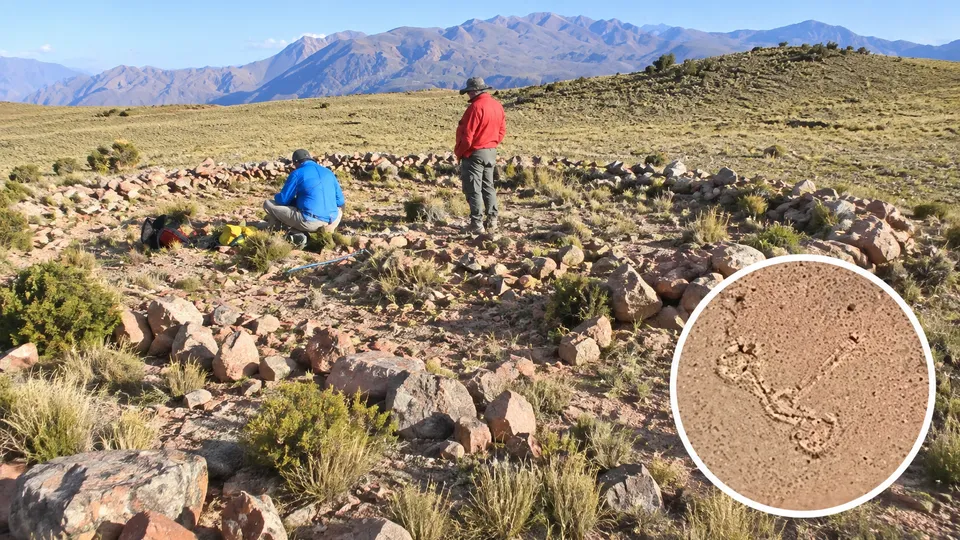
The Andes of western Argentina have been walked, climbed and surveyed for generations, yet the most unusual stone complex ever noted in Mendoza province was seen first not by an archaeologist in the field but by a mountaineer at a screen. Carlos Gobbi was studying satellite imagery of the remote Cordillera del Tigre on Google Earth when he picked out shapes that did not look like geology: large circular forms joined by narrow passages, with rectangular sectors completing a broader pattern, all of it lying more than 3,000 metres above sea level.
Reaching the place took repeated attempts and, finally, a journey of several days through the high Andes in early 2026. There was no nearby water source and no phone signal. What Gobbi found on foot did not resemble what he had seen from above: low stone walls and corridors, some sections partly buried, some built into trenches, giving no immediate hint of the geometry that satellite imagery makes obvious. That gap between the ground view and the view from orbit is now one of the central questions of the investigation.
The scale is not domestic. According to the Mendoza newspaper Los Andes, the circular structures measure between roughly 27 and 35 metres in diameter, connected by corridors, far too large to be written off as household features. Gobbi passed his photographs and coordinates to archaeologists Cristina Prieto-Olavarría and Horacio Chiavazza, who now lead the inquiry.
No precedent in the record
Prieto-Olavarría, a researcher at IANIGLA-CONICET, says the size and complexity of the structures stood out at once. Researchers have found nothing comparable in Mendoza, neither in published studies nor in existing archaeological records. Beyond that, almost everything is open. Who built the circles, when, and for what purpose are all unknown.
The setting argues against easy answers. Above 3,000 metres the site is isolated, exposed and hard to reach, and researchers have so far reported no obvious concentration of pottery, food remains or other everyday material that would mark a conventional settlement. That absence has pushed the team toward ceremonial or symbolic interpretations, though there is not yet evidence enough to say whether people lived there permanently, visited periodically, or used it for something unrelated to ordinary settlement. A link to the Inca period, or to communities that occupied the Andes before Inca expansion, has been discussed but not dated. The researchers are explicit that the Andes were shaped by many societies over long periods, and that altitude alone does not make a site Inca.
A design read from above
The word geoglyph, meaning a large human-made design whose full form is grasped best from the air, has attached itself to the story, and with it the inevitable comparison to the Nazca Lines of Peru. The team treats that comparison carefully. There is no evidence connecting the Mendoza structures to Nazca culture; the resemblance is one of scale and perspective. Stone features that look almost ordinary at boot level resolve, in satellite imagery, into circles, corridors and rectangular sectors arranged with what looks like deliberation. The Google Earth image is therefore not merely an illustration of the discovery but part of its mechanism: it revealed that individual structures may belong to a single larger design. Whether that design is truly ancient, whether all its components were built at the same time, and whether the overhead pattern reflects the builders’ original intention are the questions now on the table.
The work falls under ArqueoAndes, a joint Argentine-Spanish research project on how human activity transformed Mendoza’s high-altitude landscapes, drawing on CONICET, the National University of Cuyo and the University of Jaén in Spain. The coming campaigns will document the structures systematically, study surrounding sediments, and hunt for material that can carry a reliable date, with environmental evidence to reconstruct the conditions under which the site was used. Snow, weather and the absence of easy access compress the field season into the Andean summer.
Until then the circles keep their secret: a ceremonial landscape, an unusual settlement, a geoglyph-like construction, or something archaeologists have not yet thought to name. The first person to see the whole of it was a climber with a laptop.