
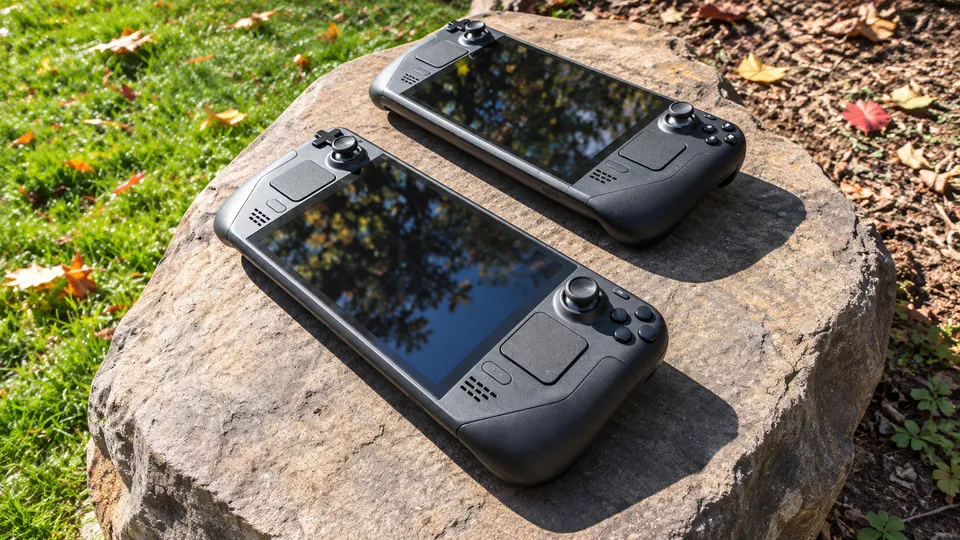
The Steam Deck Verified badge requires a default configuration that hits 30 FPS at 800p (1280×800), according to Valve’s own Steamworks compatibility documentation. That is the entire frame-rate bar. Everything above it, from a stuttering 31 FPS to a locked 60, counts as the same pass. Valve has now published the data that shows how wide that gap actually is: Cyberpunk 2077 and Skyrim: Special Edition both carry the Verified badge, but real players report Cyberpunk averaging 30–40 FPS on Deck while Skyrim holds 50–60 FPS, as Ars Technica found looking at the new numbers.
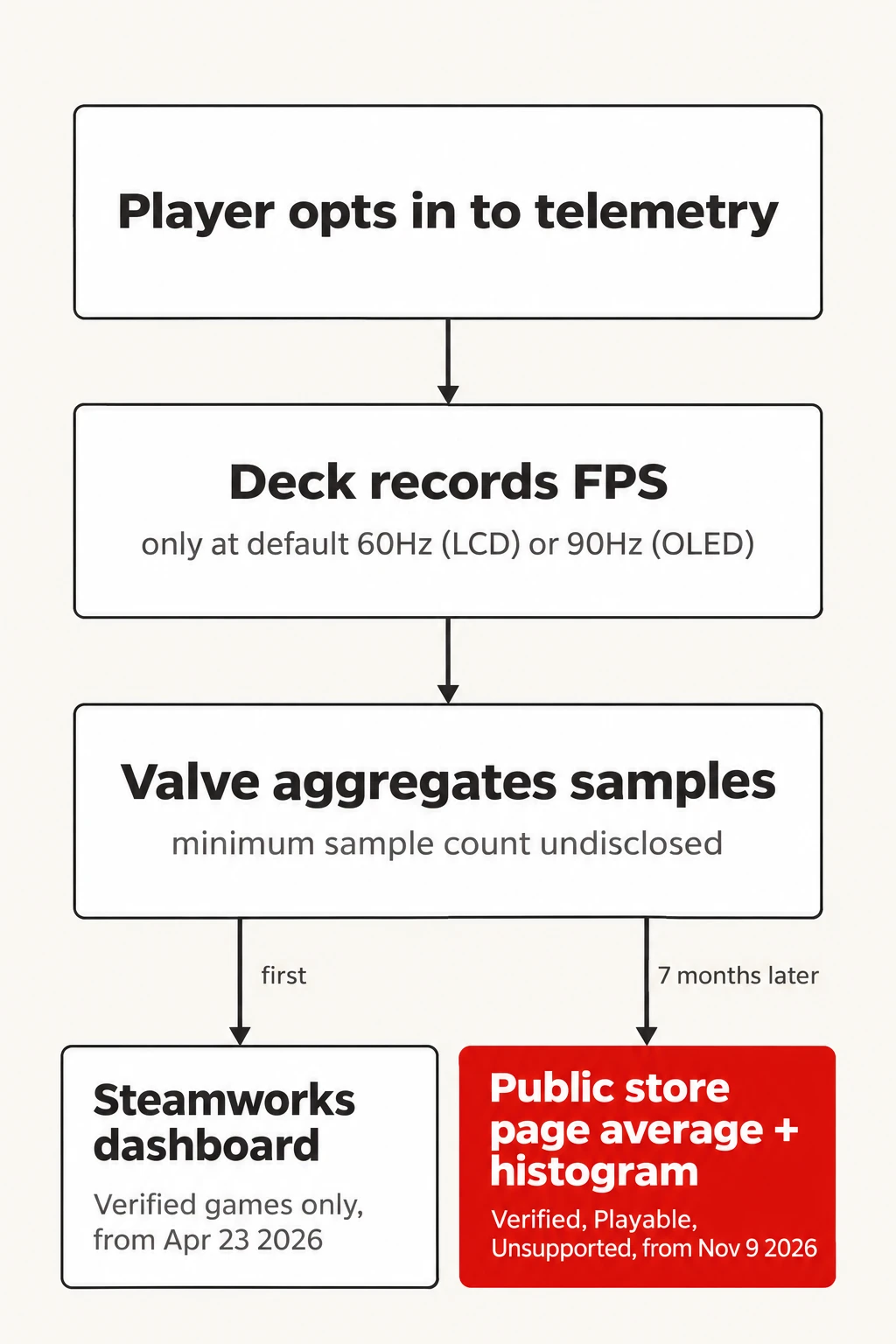
Valve has been collecting anonymized frame-rate telemetry from Steam Deck players who opt in since February 2026. On November 9, it published a Steam News post called “Steam Deck Framerate” announcing that average FPS and a frame-rate histogram would now appear on Steam store pages, under the Steam Deck Compatibility panel, for any game Valve has tested as Verified, Playable or Unsupported. Valve says thousands of titles already have enough submitted sessions to show a number, and more will clear that bar as data accumulates; it has not disclosed what the minimum sample count is.
The averages only count sessions recorded at the hardware’s default refresh cap: 60 Hz on the original LCD Deck, 90 Hz on the OLED model. A player who has set a custom frame limiter or turned on VSync is excluded from the pool, because that choice reflects battery-life preference, not what the hardware can deliver. Valve told press, per coverage of the announcement, that despite the variety of settings players actually run, “the framerate data consolidates around relatively narrow ranges” once that filter is applied. The company gives no figure for what share of its Deck install base has opted in beyond calling it a majority.
| From | To | How |
|---|---|---|
| Player opts in to telemetry | Deck records FPS (only at default 60Hz (LCD) or 90Hz (OLED)) | |
| Deck records FPS (only at default 60Hz (LCD) or 90Hz (OLED)) | Valve aggregates samples (minimum sample count undisclosed) | |
| Valve aggregates samples (minimum sample count undisclosed) | Steamworks dashboard (Verified games only, from Apr 23 2026) | first |
| Valve aggregates samples (minimum sample count undisclosed) | Public store page average + histogram (Verified, Playable, Unsupported, from Nov 9 2026) | 7 months later |
An average that was never on screen
Valve’s own illustrative example, cited in coverage of the announcement, is a Deck OLED alternating between 90, 90 and 45 FPS across three samples. The mean of that sequence is 75 FPS, a number the game never actually rendered. That is why the histogram matters more than the headline average: it shows what fraction of recorded sessions landed in each FPS bucket, rather than collapsing a bimodal game into one misleading midpoint.
The published numbers bear that out. Elden Ring averages 42 FPS on Deck OLED and 38 FPS on the LCD model, according to Tech Times’ reading of the new store data, with the LCD’s distribution clustered around 30 and 60 FPS and little in between, suggesting most players are locking the frame rate rather than letting it float. Final Fantasy VII Rebirth averages 37 FPS on OLED. Oblivion Remastered averages 33 FPS on LCD, weighted heavily at 30 with a secondary spike at 60, per Hardware Busters’ reading of the live listings on November 10. Hades II, a far lighter 2D title, averages 88 FPS on OLED, close to that device’s 90 Hz cap. The spread between Hades II and Oblivion Remastered is 2.7x, and both are on the same hardware family.
Unsupported but playable
The mismatch runs the other way too. Valve tags some games “Unsupported” on Steam Deck, meaning its testers found the graphics settings can’t be configured to run well, or that support simply isn’t finished. Yet the new telemetry shows Starfield, Silent Hill 2 and Assassin’s Creed Syndicate all posting playable frame rates in practice, Ars Technica reported, with Assassin’s Creed Syndicate approaching a 60 FPS average on Deck OLED despite the warning label. Verified doesn’t guarantee smooth, and Unsupported doesn’t guarantee unplayable. Both badges describe whether Valve’s compatibility team has signed off, which is a different question from what the hardware actually does.
The rollout itself tracks a staged, cautious release. Valve added a 30-day rolling average chart to the Steamworks developer dashboard on April 23, 2026, limited to Verified titles. It added a frame-distribution chart to that same developer-only dashboard on October 1. Only on November 9 did either number reach a shopper, seven months after Valve started collecting it and five weeks after giving developers the fuller histogram view. That gap reads as Valve testing whether the metric would embarrass developers privately before exposing it to buyers.

The caveats Valve has disclosed don’t cover everything. Because the sample is opt-in, it isn’t guaranteed to be representative of the installed base, even if a majority of Deck owners participate. Nothing in the methodology distinguishes a natively rendered frame from one produced by upscaling or frame generation, so a game leaning hard on either technique can post a high average without the histogram showing why. And the small gap between Elden Ring’s OLED and LCD numbers (42 vs. 38 FPS, both well under either device’s refresh cap) likely has less to do with the OLED’s 90 Hz ceiling than with its 6nm APU sustaining its 1.6 GHz boost clock longer under load without throttling, a thermal advantage Valve built into the OLED redesign rather than a speed increase, as outlets covering its teardown reported at launch.
Valve already treats the Deck rollout as provisional. The desktop Steam Client Beta now asks PC owners to opt into the same anonymized telemetry, and Valve calls the Deck numbers “a stepping stone” toward covering more hardware, which eventually should include the Steam Machine mini-desktop and Steam Frame headset it announced a year ago. On a Deck, three numbers (the LCD’s 60 Hz cap, the OLED’s 90 Hz cap, and roughly comparable silicon) explain almost all of the variance between any two players’ results. On a desktop PC, with an unbounded combination of GPUs, drivers and in-game settings, a single average FPS per game will carry far less information unless Valve buckets it by hardware tier. Whether that segmentation is coming, or whether PC owners get the same flattened one-number-plus-histogram treatment the Deck just got, is the open question the November announcement leaves unanswered.