
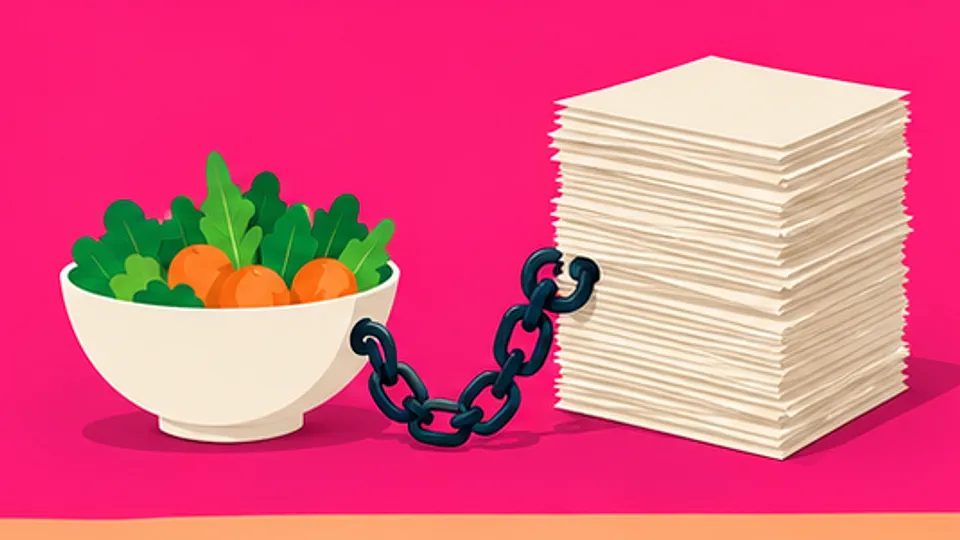
Here is a rough model of how running a government program goes. The federal government decides there should be a program — say, food assistance for low-income families. It sets the rules: who qualifies, how much they get, what counts as income, what paperwork needs to exist. Then it hands the whole thing to the states to actually operate, which means the states hire caseworkers, process applications, answer phones, check eligibility and mail out the benefit cards. Historically, Washington split the cost of all that administration with the states, fifty-fifty. The feds write the rules; the states do the work; they split the overhead.
As of last week, that split changed. Under the Republican budget package that President Donald Trump signed into law last summer — the One Big Beautiful Bill Act — the federal government’s share of state SNAP administrative costs dropped from 50 percent to 25 percent, with the change codified in a USDA proposed rule and taking effect at the start of the fiscal year on Oct. 1, as ABC News reported. Which means the states now cover 75 percent of the cost of running a program whose rules are written entirely in Washington.
TheFood Research & Action Center, an anti-hunger group, described the arrangement with some precision: “States are being asked to administer a more complicated program with fewer federal resources. That is not an efficiency strategy. It is a fiscal transfer.”
Translate that out of policy-speak and it goes like this. Imagine you run a bank, and your head office tells you it has designed a new line of loans with extremely fiddly eligibility rules — your branch will have to check more documents, apply more tests, do more interviews. Also, head office will now reimburse you for half as many tellers as before. Also, the loans are your branch’s problem if they go wrong. Head office has not made the loans cheaper. It has made them your expense. Congratulations on your efficiency strategy.
The “more complicated program” part is not hypothetical. The same law layered new work requirements onto SNAP, which is to say it made eligibility conditional on employment status that someone, in an office, in a state agency, has to verify. As Rep. Shontel Brown, an Ohio Democrat, put it in a statement — the law creates new bureaucratic burdens for states and recipients at the exact moment it halves the federal money for bureaucracy. “It’s a devastating gut punch and it’s intentional,” Brown said. “This is a plan to wreck state SNAP programs and push millions off of SNAP and into hunger.”
You do not have to accept the “intentional” part to see the mechanism. The Center on Budget and Policy Priorities estimates that more than 5 million people, including more than a million children, have lost SNAP since the budget measure became law last year. Some of that is the work requirements working as designed. But there is a second, quieter channel, and it is the one that just switched on: a state that cannot afford to process applications promptly is, functionally, a state where fewer people get benefits. Katie Bergh, a food policy expert at CBPP, framed it as an arithmetic problem: “every state now gets half as many federal dollars to ensure SNAP gets to eligible families on time and in the right amount.”
“Some states didn’t increase state funding to make up for this federal funding cut, which could lead to staff shortages, backlogs, and low-income families waiting months for help,” Bergh warned. “Other states and counties are weighing property tax increases or cuts to other services to fill the gap.”
That menu of options is worth pausing on, because it is the whole policy in miniature. If you are a state legislator, you can raise property taxes to fund a federal program. You can cut something else — schools, roads, whatever your budget has that SNAP applicants probably also use. Or you can appropriate nothing and let the phone lines go unanswered, at which point eligible families simply do not get enrolled, which from a certain fiscal-conservative perspective is not a bug at all. Backlogs are a budget cut that never has to take a vote.
The FRAC analysis put state-level numbers on the shift, estimating the new cost burden “ranges from $3 million in Wyoming to $168 million in New York.” Three million dollars is not much until you remember Wyoming’s entire population is smaller than the crowd at a medium-sized music festival, and $168 million is real money even in a state the size of New York. The group also made the point that the transfer does not stop at state agencies: “It affects every family waiting for an application to be processed, every community experiencing rising food insecurity, and every state budget attempting to balance growing needs with fewer available resources.”
The timing adds a certain piquancy. The change took effect amid what Common Dreams described as a nationwide affordability crisis, with grocery prices high and food banks reporting heavy demand. SNAP benefits themselves are still federally funded — the federal share of the actual food money did not change — so in theory nobody’s benefit amount depends on any of this. In practice, a benefit that takes four months to be approved is a benefit you did not have for four months.
Anyway. There is an old trick in fiscal politics where you cannot get the votes to cut the program outright, so you make the program expensive and annoying for the people who run it, and then you wait. The beauty of the design is that when enrollment falls, no one in Washington had to vote for anyone losing anything. The states just administered it.