
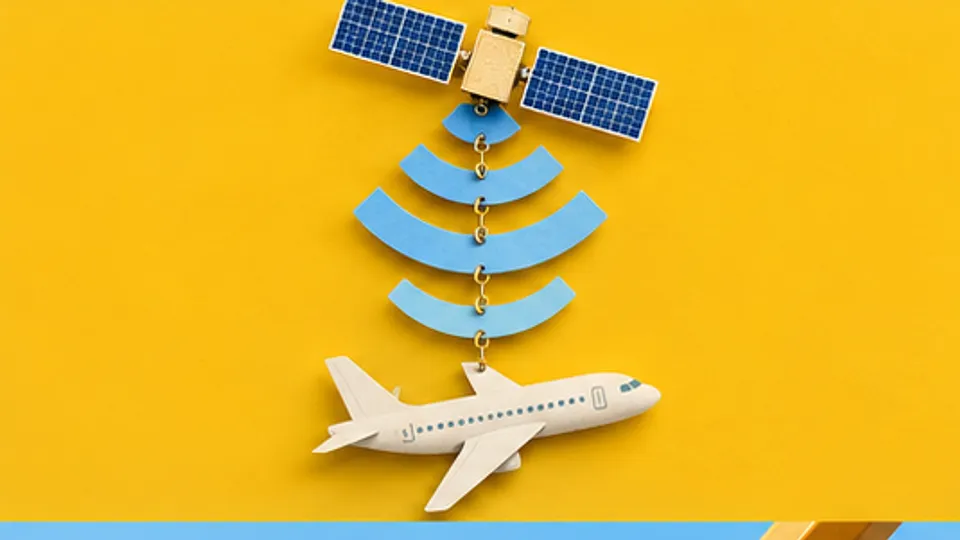
More than 1,400 commercial jets worldwide now carry Elon Musk’s Starlink satellite internet, with more than 40 airlines having announced deals to offer it, Business Insider reported on Monday.
The spread is fast by airline standards. Air France expects installation across its fleet to be finished by the end of this year, with about 60 percent of its planes already equipped, and every airline that offers Starlink provides it free to passengers, though some require signing up for a loyalty program first.
Business Insider tried the service on Qatar Airways’ first Starlink flight in October 2024, and speeds peaked at 215 megabits per second, its reporters said. That is enough for a lag-free video call, and faster than many cable-based internet services on the ground.
Starlink runs on a constellation of more than 11,000 satellites in low-earth orbit, which keeps them far closer to the plane than older systems and makes connections quicker, though the satellites can also disrupt astronomy.
Rivals are pursuing airlines too. JetBlue Airways and Delta Air Lines have signed on with Amazon Leo, which works similarly and has launched about 400 satellites. Viasat, a common airline pick for more than a decade, relies on fewer high-capacity satellites parked in geostationary orbit 22,000 miles above Earth, which carry more data but with higher latency than Starlink.
The largest deals are spreading the service through entire airline groups. The Lufthansa Group, which announced its agreement in January, plans to equip every aircraft in its own fleet and those of subsidiaries like Austrian Airlines, Brussels Airlines, Swiss and Eurowings by 2029, with installation beginning in the second half of this year. Access will be free for status customers and Travel ID users. International Airlines Group announced its deal in early November and has already put Starlink on select jets flying for Aer Lingus, British Airways and Iberia.
American Airlines said in May that it would install Starlink on more than 500 narrowbody planes starting in early 2027.
Indigo Partners, a private equity firm, has a deal to install Starlink on 1,000 aircraft across five carriers: Frontier Airlines of the United States, Cebu Pacific of the Philippines, Volaris of Mexico, Wizz Air of Hungary and JetSMART of South America.
In Asia, Korean Air announced in December that it would add Starlink starting as early as the third quarter of this year, prioritizing its Boeing 777 and Airbus A350 jets and completing the fleet by the end of 2027. Its sister airlines Air Busan, Air Seoul and Jin Air will follow, and Asiana Airlines, which Korean Air is absorbing, is to be fully equipped by the end of 2027 as well.
Emirates flew its first Starlink-equipped airplane, an Airbus A380, in April and plans to fit all 232 of its in-service aircraft by mid-2027. Its Dubai neighbor flydubai intends to install the service on 100 Boeing 737s.
Passengers can learn whether a flight has Starlink during booking, in pre-flight messages or in the airline’s app, and an independent tool called Starlink Flights tracks which tail numbers carry the equipment, using airline announcements, public records, flight-tracking data and passenger reports. The site is not connected to Mr. Musk or the carriers. Aircraft swaps happen, so travelers who cross-check a tail number on a tracker like FlightRadar24 should treat the result as an educated guess, not a guarantee.
The first airline to offer Starlink at all, the regional charter carrier JSX, equipped its jets only in 2023. Hawaiian Airlines, now part of Alaska Airlines, was the first major carrier. Three years later, the count of connected commercial aircraft stands at more than 1,400.