
AT&T fell almost 7%, Verizon more than 6% and T-Mobile 6% in after-hours trading on October 8, after SpaceX said it would buy a nationwide portfolio of 800 MHz spectrum from the investment firm Grain Management. SpaceX’s own stock, which doesn’t trade publicly but is tracked through private markets, rose almost 3% on the same news, according to a Reuters-sourced account in Yahoo Finance. The mechanism behind the move matters more than the one-day price swing: SpaceX is buying its own terrestrial spectrum so Starlink Mobile no longer needs to lease frequencies from a carrier partner to reach a phone on the ground.
What SpaceX actually bought
The spectrum has a traceable chain of ownership. It started as part of Sprint’s 800 MHz Specialized Mobile Radio band, passed to T-Mobile in the 2020 Sprint merger, then moved again in August 2026 when T-Mobile sold its nationwide 800 MHz portfolio to Grain Management for $2.9 billion in cash plus Grain’s 600 MHz licenses, a deal T-Mobile closed on August 11, per Yahoo Finance’s reporting. Grain’s own announcement of the SpaceX sale discloses no price and describes only “100% of Grain’s nationwide 800 MHz spectrum portfolio,” subject to FCC approval. The Wall Street Journal put a number on it that SpaceX and Grain wouldn’t: roughly $8 billion, a figure repeated by Benzinga and Broadband Breakfast citing people familiar with the matter. Elon Musk gave the deal its tagline on X: “To the casual observer, this won’t seem like much. To those who understand the spectrum wars, it’s an earthquake.” He called it “the last critical piece of the spectrum puzzle needed for SpaceX to provide complete phone coverage in America.”
Scale the number against the industry it’s attacking. The three largest US carriers spent about $110 billion over the past decade buying up most of the country’s low-band spectrum, per the same Yahoo Finance report. SpaceX is picking up a nationwide 14 MHz slice of that resource, at a reported price under a tenth of what it took the incumbents a decade to assemble, on top of the roughly $17 billion AWS-4/H-Block purchase and $2.6 billion follow-on it already struck with EchoStar in September 2025. Call it close to $28 billion in disclosed and reported spectrum spending in just over a year, against stock-market reactions that erased tens of billions in incumbent market value in a single session.
| Share price change (%) | |
|---|---|
| AT&T | -7 |
| Verizon | -6 |
| T-Mobile | -6 |
| SpaceX (private) | 3 |
Source: Yahoo Finance, citing Reuters. Reported as 'almost 7%', 'more than 6%', '6%' and 'almost 3%'; figures rounded as published, not exact closing prices.
Why 800 MHz, and why towers instead of satellites alone
Low-band spectrum like 800 MHz travels farther and penetrates walls better than the higher frequencies carriers use for capacity, which is why it’s valuable for exactly the gap Starlink Mobile has struggled with: getting a usable signal inside a building. In its FCC filing seeking approval of the purchase, reported by Ars Technica, SpaceX described a network of “radios feeding sectorized antennas on towers, rooftops, and other structures,” citing 800 MHz’s “long-range coverage, strong performance against terrain and clutter, and superior building penetration” as making it “an efficient coverage layer for markets of all sizes and densities, including areas where higher-frequency networks cannot serve.” That’s a description of ordinary cellular infrastructure, not a satellite dish. Musk said in August that Starlink would deploy many small base stations rather than the large, hard-to-site cell towers carriers use today, with the broadband antennas already bolted to rooftops for home internet service doing double duty as part of that ground network.
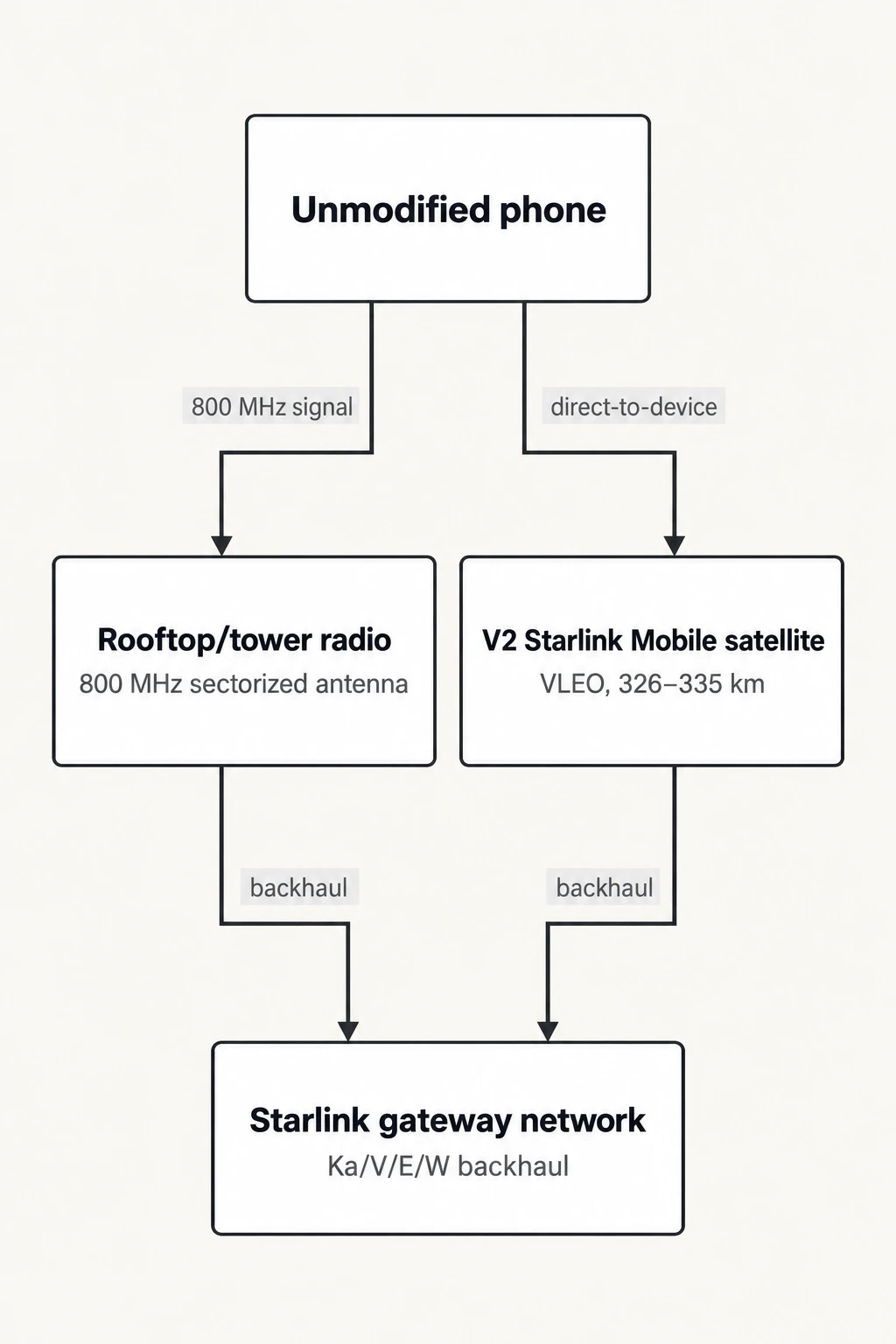
| From | To | How |
|---|---|---|
| Unmodified phone | Rooftop/tower radio (800 MHz sectorized antenna) | 800 MHz signal |
| Rooftop/tower radio (800 MHz sectorized antenna) | Starlink gateway network (Ka/V/E/W backhaul) | backhaul |
| Unmodified phone | V2 Starlink Mobile satellite (VLEO, 326–335 km) | direct-to-device |
| V2 Starlink Mobile satellite (VLEO, 326–335 km) | Starlink gateway network (Ka/V/E/W backhaul) | backhaul |
Based on SpaceX FCC filing, as reported
The satellite half of the bet
Two days before the Grain deal surfaced, the FCC approved SpaceX’s application to launch up to 15,000 next-generation satellites for Starlink Mobile, as rews reported at the time. The order authorizes nine orbital shells between 326 km and 335 km, among the lowest altitudes any large satellite system flies at, along with mobile satellite service spectrum acquired from EchoStar, supplemental coverage from space using wireless bands, and the full Ka/V/E/W backhaul set used by Starlink’s existing V3 broadband satellites, per Via Satellite. The FCC deferred SpaceX’s request for domestic mobile satellite service in the 2020–2025 MHz band and took no action on two higher bands it said face “heavy federal use.” SpaceX’s rights to the EchoStar spectrum itself stay conditional until a second closing step, expected around November 30, 2027, transfers the licenses out of a trust; until then SpaceX can only test with EchoStar’s permission.
SpaceX has launched roughly 650 direct-to-device satellites for the mobile service running today through T-Mobile’s T-Satellite brand, which Via Satellite’s reporting pegs at roughly 4 Mbps per user. SpaceX says the new V2 satellites will deliver “more than 100 times the bandwidth” of that current generation; SpaceX President Gwynne Shotwell separately described the coming service as “100 times better than what we’ve got right now” and said she expects the second-generation satellites to start flying in 2027 with service following by the end of that year. A hundredfold bandwidth increase at the satellite level and the 150 Mbps per-user speed SpaceX has floated for the new constellation aren’t the same claim — one measures aggregate capacity across a satellite serving many users, the other a single connection — and SpaceX hasn’t published figures reconciling the two. SpaceX told Canadian regulators it plans service beginning “by late 2027” and “thousands more” satellites by the end of 2028, which is also, not coincidentally, after the EchoStar spectrum fully clears.
What the carriers are saying, and doing
AT&T CEO John Stankey has been consistent in public dismissal of the threat. Speaking at the Goldman Sachs Communacopia + Technology Conference, he argued terrestrial networks already handle 98% of mobile use cases and that satellite is “solving the last 2%, not trying to come up with a new way to solve the 98%.” In July, he told investors SpaceX was “coming to the game very late after this industry has been established.” Those comments predate the spectrum deal, and the stock moves since suggest the market isn’t fully buying the dismissal: AT&T, T-Mobile and Verizon shares had already fallen about 4% in July when Semafor first reported SpaceX was shopping for spectrum, before this week’s larger drop.
The carriers’ hedge against their own rhetoric arrived a week before the Grain deal. On October 1, AT&T, T-Mobile and Verizon formed a joint venture, with former AT&T and Ameritech executive Paul Roth as interim chief executive, to pool spectrum and build shared satellite coverage for dead zones, according to Light Reading. The venture has no name, no launch date and no disclosed financial terms yet, and existing deals including T-Mobile’s Starlink partnership stay in place alongside it. Three companies that say satellite only matters for the last 2% of use cases are, simultaneously, building a joint satellite network to make sure Starlink doesn’t own that 2% alone.
AST SpaceMobile, which partners with AT&T and Verizon rather than competing with them directly, took the sharpest single-day hit of any company in the sector. Its shares fell as much as 16% intraday on October 9 and closed down 10.48% at $50.97, a 52-week low and about 63% below its 52-week high of $133.86, according to TradingKey. Part of that reaction was about spectrum access specifically: the 800 MHz portfolio AST SpaceMobile had reportedly pursued went to SpaceX instead, closing off a low-band option the smaller satellite operator had been counting on.
None of this is live service yet. The Grain transaction still needs FCC transfer approval, with no disclosed price, closing date or build-out schedule. The EchoStar spectrum SpaceX is leaning on for the satellite side can’t fully transfer until late 2027 at the earliest. What ships in 2027 against what SpaceX promised in its FCC filings and in Musk’s posts is the number to watch next, given how often SpaceX’s own launch schedules have slipped against SpaceX’s own stated dates.