
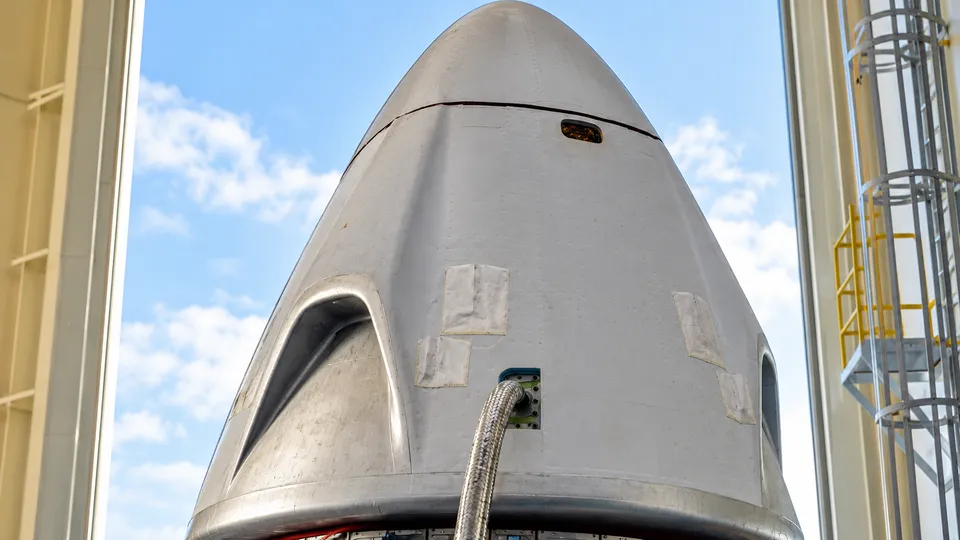
A SpaceX Falcon 9 rocket carried four astronauts into orbit from Cape Canaveral Space Force Station in Florida on Thursday, opening a six-month space station expedition led by Jessica Watkins, the first Black woman to command a spacecraft.
The rocket lifted off from Space Launch Complex-40 at 11:10 a.m. Eastern time and put the Crew Dragon capsule, named Grace, into orbit nine minutes later. The spacecraft was on course to dock with the International Space Station about eight hours after launch, the fastest launch-to-docking trip to the outpost by an American spacecraft.
The mission, designated Crew-13, had been scheduled for mid-September, but NASA postponed the flight in late August after ground teams detected a leak of nitrogen tetroxide, the toxic oxidizer Dragon’s thrusters use with hydrazine fuel, inside the propulsion system. SpaceX traced the leak to a valve and, rather than drain the propellant and partly disassemble the ship, cut the valve out of its line and welded in a replacement. The oxidizer tank was full at the time, and the work, done at SpaceX’s fueling and hazardous processing facility, known as Area 59, required special permission from the Space Force’s Eastern Range. It was the first repair of its kind on a fully assembled, fueled Dragon.
“By cutting it out, we physically went in and actually cut the valve out of the line,” Bill Gerstenmaier, SpaceX’s vice president of build and flight reliability, said at a prelaunch news conference on Wednesday. “It was welded in place, and then we actually re-welded a new valve in place.”
No leaks appeared during final launch preparations, and the propulsion system worked well after the capsule reached orbit. “We looked at the plans, all of the data coming out of that, the welds, the leak, everything looks great,” said Dana Weigel, NASA’s program manager for the space station. “Really happy with how that repair was done.”
Ms. Watkins, a 38-year-old geologist, is the only veteran astronaut aboard; she spent 170 days in orbit on a 2022 flight. Her pilot, Luke Delaney, is a Marine Corps veteran. The other crew members are Joshua Kutryk, a Canadian astronaut and former Royal Canadian Air Force pilot, and Sergey Teteryatnikov, a Russian cosmonaut who worked as a naval engineer before joining the Roscosmos corps in 2021.
Mr. Kutryk’s wife, Heather, is expecting their third child this year. “Leaving these three (plus one on the way) is the hardest thing I’ve ever done. But that has always been the nature of exploration,” he wrote on X. Astronauts have been off the planet for a child’s birth before: Randy Bresnik, who is set to command NASA’s Artemis III mission next year, was flying aboard the shuttle Atlantis in 2009 when his daughter was born in Houston.
“What an epic ride. What an epic ride it was,” Mr. Delaney radioed mission control after reaching orbit.
Crew-13 is the 13th station rotation SpaceX has flown under its multibillion-dollar NASA contract and the company’s 21st human spaceflight over all. SpaceX has nine more Crew Dragon flights in its backlog, including three station missions NASA recently added in a $946 million contract extension that brings the agency’s total for 17 SpaceX crew flights to $5.92 billion. The company plans to retire both the Dragon capsule and the Falcon 9 around 2030, and, now publicly traded, it is prioritizing its most lucrative lines of business, which station flights are not, according to Ars Technica. Asked whether the extension would be the last, Mr. Gerstenmaier declined to say there was any hard cutoff. “We were just awarded Crew flights 15, 16, and 17, so I think our real focus is to make sure we get the most out of those flights,” he said.
Crew Dragon restored the United States’ ability to launch its own astronauts after a nine-year gap that followed the shuttle’s retirement in 2011. Boeing, NASA’s other commercial crew provider, has stumbled repeatedly in Starliner test flights, and the space agency plans to keep the station, staffed continuously since 2000, running through at least 2030. On board, Crew-13 will replace Crew-12, which is scheduled to return to Earth in mid-October after eight months in orbit.