
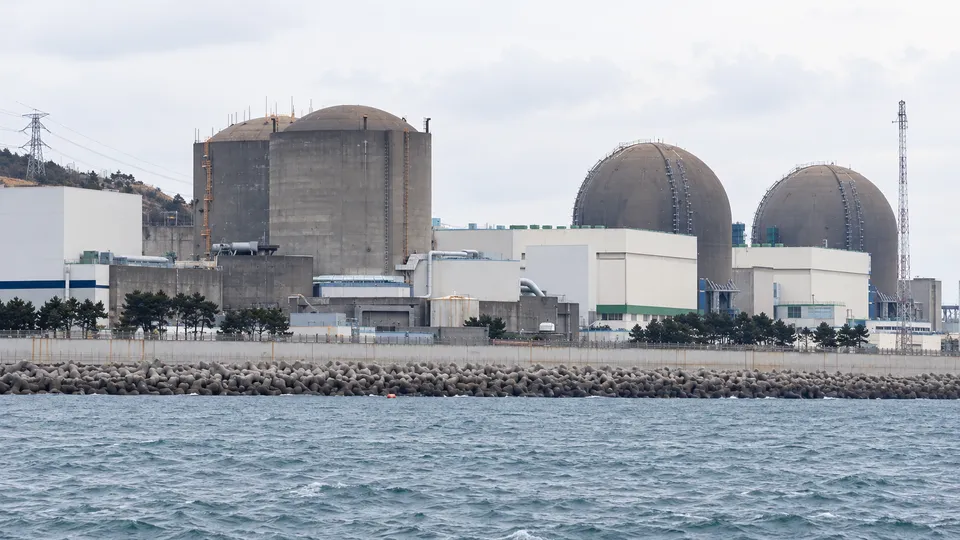
South Korea’s nuclear regulators are in no hurry, and the meter is running. Four reactors undergoing safety reviews to operate beyond the end of their design lives could, had they kept generating, have produced some 23.95m megawatt-hours of electricity by September 22nd, according to data obtained from the state-run Korea Hydro & Nuclear Power (KHNP) by Hwang Jeong-a, a Democratic Party lawmaker, and reported by the Chosun Ilbo. That is more than Busan, a city of about 3.4m, consumed in the whole of last year.
The figure—equivalent, the report notes, to a year’s electricity for roughly 3.5m people—was calculated from each plant’s average power sales over the decade before its design life expired. The four idle units, Kori 3 and 4 and Hanbit 1 and 2, have a combined capacity of 3,800MW, enough to supply around a dozen large 300MW semiconductor factories or about ten 360MW artificial-intelligence data centres. That is pointed arithmetic: both industries are central to South Korea’s economic strategy and chronically hungry for power.
Valued at last year’s average nuclear sale price of 79 won per kilowatt-hour, the forgone generation represents an opportunity cost of about 1.89trn won (roughly $1.4bn). The Chosun Ilbo is careful with the caveat: this is the value of power that could have been sold had the reactors run continuously, not an actual realised loss.
The stoppages vary widely in length. Kori 3, has been down for about 24 months, the longest; Kori 4 for around 13 months and Hanbit 1 for about nine. Hanbit 2 reached the end of its design life only this month and had been halted for 18 days at the time of reporting. The reviews at issue determine whether reactors built for a fixed lifespan can safely keep running beyond it—a question that matters more each year as much of South Korea’s fleet, built in a construction boom decades ago, approaches the same threshold.
The two sides of the argument are familiar. KHNP says it submitted its continued-operation safety assessments roughly two to three years before each licence expired, and that since such reviews normally take three to four years, it is hard to conclude that any delay has occurred. Ms Hwang counters that the country can have both rigour and speed: safety must be upheld, she says, but faster reviews, better-timed applications and assessing identical reactor designs in parallel would shrink the generating gap.
The debate is unlikely to stay abstract. The Yoon administration’s pro-nuclear policy counts on existing reactors running longer while new ones are built; every idle month renders the arithmetic of that plan a little harder. South Korea wants to power chip fabs and data centres with clean, always-on electricity. For now, some of the cleanest megawatts in its fleet are doing nothing at all—safely, one assumes, but expensively.