
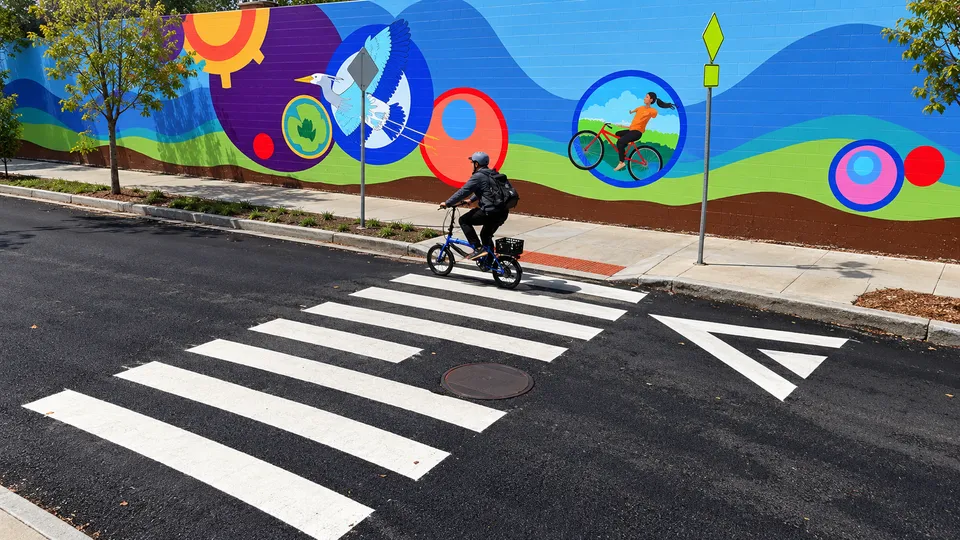
Somerville, Mass., the densest city in New England, is finishing a remake of a stretch of Tufts Street in East Somerville that piles speed humps, jutting curbs, winding lane lines and a mural several hundred feet wide into a road that barely looks like a road anymore.
The work, underway since summer 2025 and set to wrap in the coming days, turns the street into what the city calls a “neighborway” — one of several experiments in making roads harder to drive fast on, so that people who aren’t in cars can use them. Tufts, the city found, had become a cut-through carrying as many as 3,000 cars a day, often at speed, past homes, a bike path, a new East Somerville MBTA stop and an early childhood center.
“They were flying,” said Bernie, 59, who lives in a mixed-income housing complex on the street and asked that his last name not be published to protect his privacy.
Brad Rawson, the city’s director of transportation and infrastructure, put the design logic plainly: “Think about everything everybody knows about the interstate highway system. Curvilinear geometry and wide lanes are designed for cars and trucks to move fast.” Tufts Street is built to do the opposite. “Tight corners, narrow geometry, narrow lanes are designed to slow down traffic,” Mr. Rawson said. “That is the best practice around North America that cities like Somerville are implementing to save lives.”
The centerpiece is a set of “pinch points” where curbs stick out and leave a gap only one car can pass through at a time. Drivers coming from opposite directions must slow, pull over or stop altogether. Mayor Jake Wilson has a name for the negotiation that follows. “I call it Somerville chicken,” he said in an interview. “Typically, it works itself out. Someone pulls over, the other person goes, and then you proceed. People figure it out.”
The city has results it can point to: not a single traffic death in four years, despite a large numbers of cyclists. Deaths and injuries on the roads of Boston, Cambridge and other Massachusetts cities have kept the hazards to cyclists and pedestrians in the news, and Somerville’s record is drawing attention from transportation planners elsewhere.
Drivers on Tufts are less impressed. “I don’t know if it helps because people still zoom through,” said Billy Kan, 28, a real estate developer who lives in the neighborhood and was out walking his dog, an 11-year-old Havanese named Wally. “The people who are going to speed are going to speed.”
Michael Pauls, 28, a software engineer who moved to the street from Chicago this year, acknowledged the logic and rejected the experience. “I hate driving on Tufts because of those narrow things,” he said. “I can see the rationale behind it if the city wants to keep people from gunning it, but from a driver’s perspective, I don’t like it.”
Some of the tricks work below consciousness. New pavement markings show what looks like a child on a bicycle instead of the usual adult stick figure, on the thought that a driver will brake sooner for a little kid. “Everybody bikes,” Mr. Rawson said. Even the 300-foot mural, painted on what was the blank wall of an industrial building, is traffic policing of a kind: it makes the block look less like a back alley and more like a place where people live.
“Before, when I first moved to the area, the wall was a giant swath of dirty white concrete,” Nova Reilly, an artist who lives in the neighborhood and was hired to help paint it, said in a video about the project. “Now it’s a very beautiful community contribution.”
The approach has had bumps. Speed humps installed a few years back caught drivers by surprise, and the city’s miniature rotaries have left some of them lost. In public meetings for Tufts, neighbors considered making the street one-way before settling on the neighborway, which keeps two-way traffic while narrowing it into what amounts to an obstacle course.
City officials want to take the thinking bigger — to McGrath Highway itself, the commuter artery residents have long called unsafe, which is set for a major rebuild as soon as 2028. “We’re excited for the McGrath to be more like a city street than a freeway, because we want it to be for Somervillians,” Mr. Wilson said, “as opposed to serving as a commuter highway through the middle of our city.”