

Here is a pleasant financial product. You put after-tax money into an account and it gets invested. If you eventually spend it on qualified education expenses (tuition, textbooks, laptops, room and board and more), you never pay tax on the gains. That is a 529 plan, and it has been very popular. Business Insider reports that the number of 529 plans in the US has grown 80% since 2010, and the average balance has more than doubled. The catch is the word “qualified.” The tax break is a reward for spending the money on one particular thing. If you stop being sure your kid will want that thing, the reward starts to look like a restriction.
Some parents are no longer sure. Henry Chandonnet and Juliana Kaplan spoke with six families who are cutting their 529 contributions, moving money into more flexible accounts, or still saving while wondering whether a traditional college will pay off. The reason is mostly AI. Entry-level hiring has seized up and many people blame AI for it. Students use chatbots to cheat. Tech executives say chatbots beat human teachers, and Silicon Valley keeps pitching AI-powered alternatives to college.
Nataliya Konovalova set up 529s for her sons when they were babies and told relatives to skip the birthday presents and contribute to the accounts instead. The boys are now eight and 10. She had read about degree-holders working at McDonald’s and about prestigious fellowships that take students straight out of high school, and then came long conversations with her husband, who works in tech, about AI squeezing the entry-level job market. The couple halved their contributions. “I honestly don’t think they will go to a traditional four-year college,” she said.

She is not alone. In a Harris Poll survey of 921 parents of K-11 children for Intuit Credit Karma, more than a quarter said they were rethinking how much they need to save for education, and 15% had already cut back. According to the Harris Poll’s summary, the exact figure is 27%, and 69% of those parents said AI makes thinking about their child’s future career more stressful than it used to be.
If you want expert guidance, here it is. In 2025 a mother of two asked Mustafa Suleyman, the CEO of Microsoft AI, whether she should save for college. “Probably not,” he said, laughing, and then corrected himself: “I don’t know. It’s really hard to judge.” Those are two forecasts in one answer, and the second is probably the honest one.
Paying for an option
David Graham, a 52-year-old retired physician in Billings, Montana, thinks college may still be worth it when his 12-year-old son finishes high school, but not by the time his 8-year-old twin daughters do. He stopped funding their 529s entirely two years ago. His reasons: falling birth rates will squeeze colleges’ finances, “learn to code” has gone from good advice to a punchline, and AI tutors will push down the cost of education. He likes the hybrid Alpha School model, which leans heavily on AI instruction. He estimates his son’s 529 holds $50,000 and each twin’s holds $15,000. That is $80,000 already in the accounts, and it keeps its tax break if anyone does enroll. Graham has simply stopped adding to it. If his son chooses college anyway, he said, “I’ll just write a check.”

I think that is a perfectly sensible plan, and also one that works much better when you are a retired physician. Graham is effectively self-insuring: if college happens, he pays for it from money that never got the tax break. Not every family can treat the tuition bill as an optional extra, which is a reason many families buy the 529 in the first place.
Omar Khan, a millennial father of two, skipped the 529 and invests for his kids through taxable brokerage accounts. He knows he will pay tax on the gains, and he thinks brand-name colleges may lose their appeal. If his kids go into a technical field, buy a house or bootstrap a company, the money can go there. Put in finance terms, the tax on his gains is the premium on an option: he pays every year for the right to decide later what the money is for. Michael Reynolds, a certified financial planner in Indianapolis, said about 30% of the parents he works with are moving some money out of 529s because they doubt what college will be worth. “More and more conversations are happening around: Do we put all our eggs in this basket?”
Betting on Congress
The other strategy is to keep the 529 and wait for the rules to loosen. Matthew Crowson, a 39-year-old physician on the faculty at Harvard Medical School, is saving for sons aged 3 and 5. He says some of his best students don’t need to come to class; they learn on their own with AI tools and bring him their questions. He expects students to start comparing high tuition with cheap chatbots. He hopes the government will broaden the definition of “school” by the time his kids are grown (apprenticeships and continuing education already qualify), and ideally hand out a “get-out-of-jail-free card” that lets parents withdraw everything tax-free and spend it on anything. “That’s a very cautiously optimistic take,” he said.
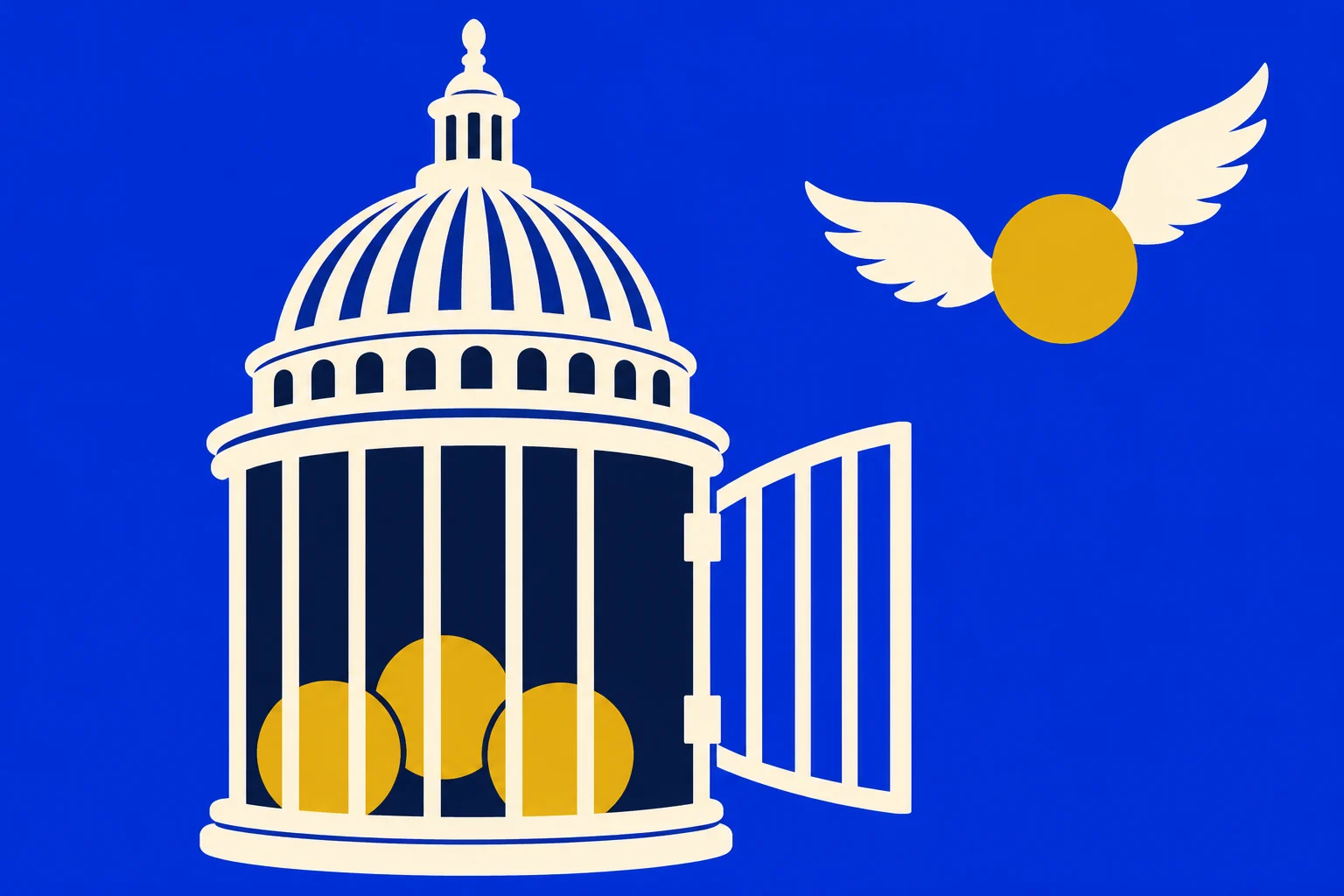
It is not a crazy bet, because the rules have been loosening for years. In 2018 parents got to use some 529 money for private high school. Six years later, some 529 money could be rolled into a Roth IRA tax-free. Post-graduate courses and certificates now qualify too. The 2025 tax law added postsecondary credentialing programs and doubled the annual K-12 withdrawal cap to $20,000 starting in 2026. The Roth escape hatch already exists in a limited form, with a $35,000 lifetime cap per beneficiary. The account must have been open at least 15 years, contributions from the last five years don’t count, and each year’s rollover is limited to the annual Roth contribution limit, which is $7,500 in 2026. At that pace the full $35,000 takes at least five years to move. “Even if you’re not saving exactly for college, there are still other ways to be using that money,” said Eric Reale, a financial advisor in New York.
So there is a real chance that Congress keeps widening the list of approved uses until the 529 is just a tax-advantaged account for children. Whether that ever reaches “anything at all” is a political question. College finance has a habit of changing its rules mid-game, as anyone tracking the student-loan repayment overhaul has noticed.
Plenty of AI-literate parents are still saving the old way. Matthew Seeger, who runs AI strategy for a software company in Chicago, has been saving steadily for his kids, aged three and five, because he wants to spare them the financial burden college can bring. He is getting more worried about AI’s longer-term effects on jobs, but he is still saving.
Meanwhile the children may have their own views. According to a Common Sense Media report, 9 in 10 kids have used AI, but only 26% think it will have a mostly positive effect on their lives. During Graham’s interview his 12-year-old came home, and Graham asked him whether he uses AI. “No,” the boy said quickly, then changed his answer to “every once in a while” and ran upstairs.
“They actually hate AI,” Graham said of his kids. “And I don’t let them use the H-word.”
The whole plan rests on a forecast that AI will make college unnecessary, and the people it is meant for are, so far, unenthusiastic about AI.