
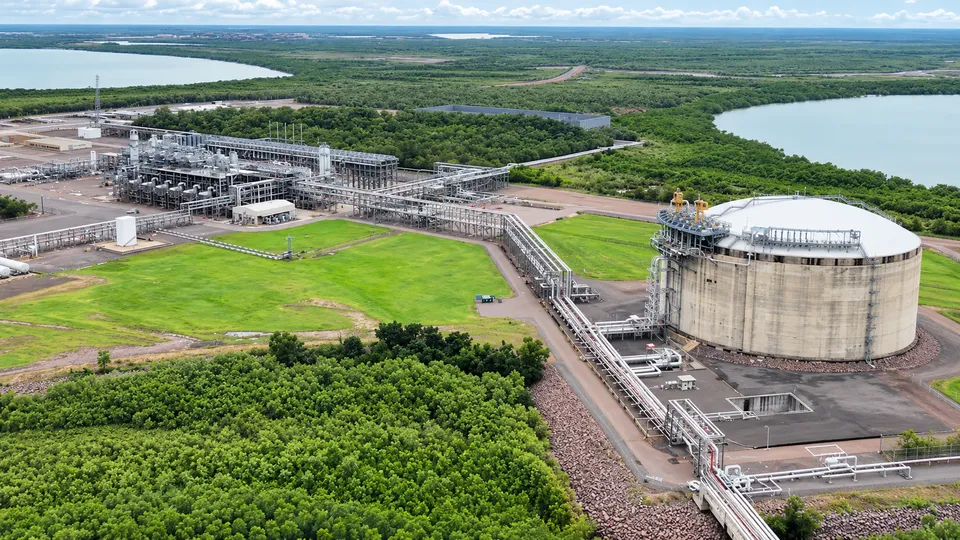
SK Innovation E&S has begun supplying South Korea with liquefied natural gas from Australia’s Barossa gas field along a route that bypasses the Strait of Hormuz.
At full production the project will supply 1.3 million tonnes of LNG a year for 20 years, the company said, about 26 million tonnes in total and roughly 3 percent of South Korea’s annual imports.
Shipping from the Darwin LNG terminal in Australia’s Northern Territory to South Korea takes about 10 to 12 days, compared with 18 to 25 days from the Middle East and 22 to 28 days from the United States, according to the company. The first Barossa LNG cargo arrived at the Boryeong terminal in South Chungcheong province in February, and about 300,000 barrels of condensate reached Incheon in August, the Chosun Ilbo reported.
The supply line opens as energy security concerns mount after Russia’s war in Ukraine and this year’s war in the Middle East. European Union gas storage stood at about 70 percent, 12 percentage points lower than a year earlier, according to Reuters, and South Korea’s Ministry of Trade and Industry set out its first basic plan for resource security on Sept. 23, calling for diversified gas supplies and more medium- and long-term contracts.
At the 700,000-square-metre Darwin terminal, gas arrives through an 86-centimetre pipeline from the Barossa field about 300 kilometres to the northwest, is stripped of impurities and liquefied at around minus 162 degrees Celsius. It is held in a storage tank 50 metres high and 90 metres across before loading at the jetty.
SK acquired its stake in Barossa in 2012 and drilled five appraisal wells between 2014 and 2017, confirming recoverable reserves of 3.4 trillion cubic feet, more than double the initial estimate. “The underground structure holding the gas is the size of Seoul,” Kim Hyun-jun, a technical fellow in the LNG business division of SK Innovation E&S, told the Chosun Ilbo. “With reserves more than twice the original figure, the economics improved.”
Gas is drawn from 3 kilometres below the seabed, in waters more than 200 metres deep, to a 356-metre floating production, storage and offloading vessel that separates out condensate before sending the gas by subsea pipeline to Darwin. The terminal had halted production in 2023 when its original gas field ran dry, and renovating it cut investment costs. SK holds 37.5 percent of Barossa and 25 percent of the Darwin terminal, working with the Australian firm Santos.
The 2021 final investment decision put total development costs at about $4.3 billion, with SK’s share near $1.6 billion. The COVID-19 pandemic disrupted equipment procurement and shipping, and a lawsuit over Indigenous consultation and cultural heritage concerns stopped construction for 470 days. “It was not easy for a private company to stay with one project for 14 years while accepting a delayed payback on its investment,” Kim said. A company official said the result followed “perseverance” through setbacks since the first equity investment 14 years ago.
Barossa cuts SK’s reliance on spot purchases at a time when competition for cargoes between Europe and Asia is lifting spot prices. With 2.2 million tonnes a year from the United States and 500,000 tonnes from Indonesia, its long-term secured volume rises to 4 million tonnes, and even after the Indonesian contract expires next year more than half of its roughly 6 million tonnes of annual volume will remain locked in under long-term fixed contracts, the company said.
SK plans to use its four company-owned LNG carriers on the Barossa route. In South Korea it is building terminal infrastructure at Gwangyang and Boryeong, owns about 5 gigawatts of gas-fired generation in Paju, Yeoju and Gwangyang, and supplies the condensate — about 1.1 million barrels a year, rich in the petrochemical feedstock naphtha — to SK Incheon Petrochemical. The company called the project the first by a South Korean firm to span the LNG chain from overseas exploration to domestic power generation.
“Through new developments such as the Barossa project, we will work to move beyond our current LNG value chain of about 6 million tonnes and become a more full-fledged global LNG player,” said Kang Ryun-kwon, head of management planning at SK Innovation E&S.