
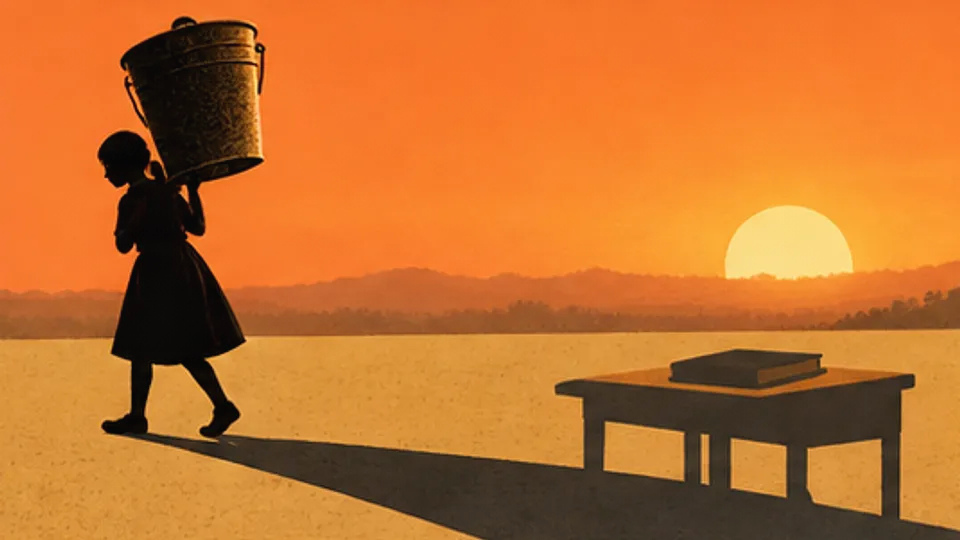
In the mountain villages of Uttarakhand, in northern India, the springs are dying, and the arithmetic of a girl’s day is dying with them. A report and photo essay in The Economist, shot by the photographer Deepti Asthana, follows girls such as Babita, who treks for hours to fetch water from a spring that has nearly disappeared. As summer comes on, the seasonal springs vanish altogether, and the walk grows longer. Children from these villages may already walk as far as 8km to reach a classroom; the water errand, done each morning before lessons, eats what is left of the day for study.
The work falls on girls because it has always fallen on girls. One teenager is photographed carrying buckets home from a forest spring; she has an older brother, but the morning haul is hers. Women and girls collect the water in 70% of households that lack a mains connection. Besides exhaustion, the carrying brings headaches and back pain. Bhavana, a postgraduate student from the region, is one of a growing number of women asking why this burden should be theirs to shoulder. “There’s so much potential which is going to waste because we are not able to provide a very basic commodity,” as one woman in the report puts it.
The injustice runs deeper than buckets. Anita and her sister attend a government school while their brother is educated privately. Since many men have left the mountains to find work, women in Uttarakhand carry the weight of the household and the farm both — irrigating fields from streams that are themselves shrinking. Sony, 22, married while still in her teens and now has a three-year-old son; women, the report notes, often have little choice in the matter of marriage at all.
The old infrastructure was elegant and is failing. Villages once drew on naulas — stepped stone wells, traditionally held sacred and still worshipped at, which trap rainwater and store groundwater. In the village of Rautela Nitu, girls crowd around one of the few naulas still usable. The river Kosi has begun to run dry in the summer months, leaving Almora, one of the state’s biggest towns, in extreme shortage. Rapid development and new dams along Uttarakhand’s rivers have hurt the local environment and raised the risk of floods. Even the schools feel it: some have no running water, so teachers fetch it from springs so that children can wash their hands.
The predictable exodus has begun. As the water runs out, villagers leave the mountains in search of work, and the villages empty. Yet the wells are not quite abandoned: girls still dress up to honour Mesar Kund, the Himalayan lake that supplies their villages, and gather at the springs to bathe, wash clothes and talk — the old rituals persisting above the water line, while below it the springs run out.