
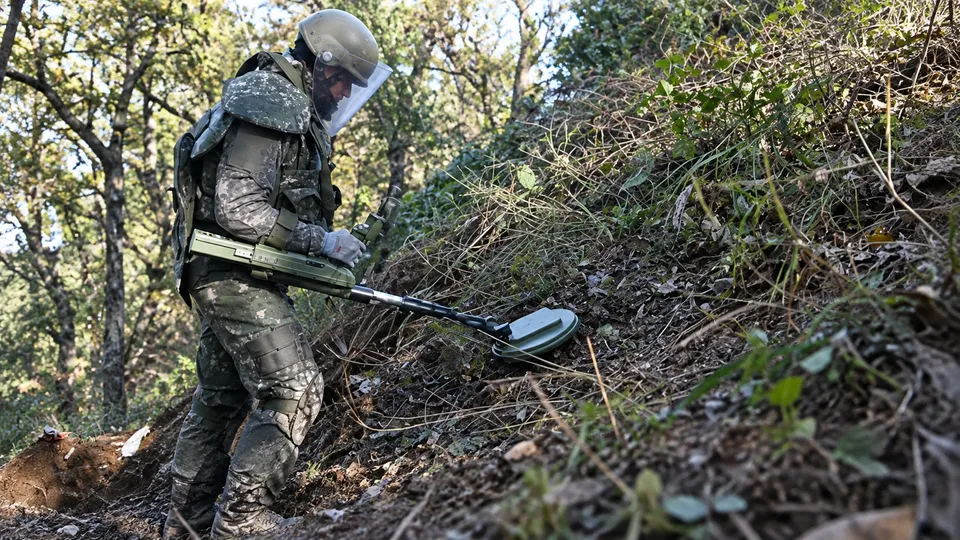
Six days after the explosion in the woods of the Demilitarized Zone, the investigators arrived in the woods. On the morning of September 27, a joint team — the Joint Chiefs of Staff, the UN Command, intelligence agencies, operations troops, some forty people — entered the DMZ in Paju, Gyeonggi Province, to survey the ground where, on September 21, a presumed landmine blast had injured three South Korean soldiers. They began at 9 a.m. They searched for mines and widened the access route. By day’s end they had reached what the Joint Chiefs called a “close area.” The origin point of the blast they did not reach.
“The survey area is an unconfirmed minefield inside the DMZ, with a high degree of danger,” the JCS said. “Considering safety as the top priority, today’s operation will end and the survey will be reattempted at a later date.” The personnel, the military added, were severely fatigued.
The military had originally fixed the survey for September 29. When the criticism hardened — dawdling, was the word — it brought the date forward by two days. Rain had fallen on Paju on the 24th, raising the possibility the scene was compromised before anyone walked it. “If the public loses trust in the investigative process,” a military official told the Chosun, the conservative daily whose reporters covered the survey, “whatever result the military produces will run into people saying they cannot believe it.”
Multiple military officials told the paper that personnel on the scene at the time have testified they saw a North Korean wooden-box mine — whether an intact mine lost during route-clearing, or fragments and debris after the explosion, is not clear; the gist, the officials said, is that there were wooden-box mines in that vicinity. The military’s own stated position is that eyewitness accounts cannot be trusted 100 percent. Yet the joint task force was constituted on September 24, three days after the blast, and boots reached the site only on the sixth day. “There is testimony that a North Korean wooden-box mine was there, and the UN Command said it would actively cooperate,” one military source said. “Three days to stand up a team and six days to get people on the ground — it is hard to understand.” From frontline units, the paper reports, came the same argument, made early: get manpower in before the scene was disturbed. “Why are they saying the survey will be on the 29th, more than a week later?”
The JCS has said this ground “is entirely different from the site of North Korea’s 2015 wooden-box mine provocation” — that it lies close to the Military Demarcation Line, where troops were for the first time opening a search route with mine detectors so the ground could be confirmed with the UN Command, when the explosion happened. The danger, it said, was very high.
The army says it will collect and analyse mine debris and release an interim result within this week; a first forensic examination of mine fragments and explosive residue, commissioned from the National Forensic Service, is already complete. “That an announcement is possible within the week means there is conviction from the testimonies and the initial findings,” a military official said. “And yet to not even say ‘presumed North Korean, pending detailed examination’ — is that not watching North Korea’s face?”
A second report by the same paper fills in what came before the blast. Multiple military sources say that since last year, satellite photographs and other imagery had shown a number of suspected North Korean minefields taking shape south of the MDL in the 25th Infantry Division’s Paju sector — a fact the JCS concedes only in the careful formula that “terrain changes were detected.” The division was ordered by the JCS and the Ground Operations Command to verify the sites on the ground and watch the North’s work directly. The division commander at the time, sources say, declined. He is the same Han Ki-sung who rose to command the 1st Corps and is now suspended from duty over the “empty-rifle guard” directive at the corps’ frontline; as division commander, one source said, he had already won a poor name for evading orders that called for operations inside the DMZ. A military official said the early passivity may have emboldened the North to work more aggressively.
The suspected mine areas sat in the division’s surveillance blind spots. There was no way to watch North Korean soldiers come over the MDL in real time, and in a crossing situation neither warning broadcasts nor warning shots were possible. What was needed was a new search route to examine the work, and under the former commander no such measure was taken; the DMZ search operations began only after a new division commander arrived in January. A retired general said it must not be that commander who pays: the accident, he argued, happened in the course of a normal operation carried out on higher orders, and punishing the officer who ordered it could shrink the whole of the South’s DMZ operations against the Northern minelaying.
Some have argued the blast occurred near a guard post dismantled under the September 19 inter-Korean military agreement. The JCS says that is not true — “it was normal duty performance.” A military source says the nearby GP was indeed removed under the agreement but has since been restored and is operating normally, though from that post neither the suspected mine areas nor the blast point can be observed.
The larger problem is that even a confirmed North Korean mine would leave Seoul with few moves. “We cannot stop North Korea’s activity around the MDL with warning shots alone, but aimed fire, or laying our own mines near the MDL, is hard to imagine,” a serving general said. “The military has no sharp alternative — that is my understanding.” Since 2024, North Korea has been erecting triple fences and digging minefields along the line; the South’s responses — warning fire at crossings, extra surveillance equipment in the blind spots — have been, by the paper’s account, the whole of it. The blast had already set Seoul’s politicians quarrelling before the surveyors ever got their boots on.
The newly appointed defense minister, Kang Shin-cheol, met reporters just after his inauguration on September 22. “The fortification of the border must stop,” he said. “Of course we must say so to the North.” There is no known way, the Chosun notes, to effectively compel it. After the 2015 wooden-box mine provocation, the military’s answer was to resume loudspeaker broadcasts across the border — a card harder to play now, the loudspeakers having been dismantled after President Lee Jae-myung took office.
On the 27th the joint team withdrew without reaching the origin point. The mine, whoever laid it, stayed where mines stay — in the ground, unexamined, while above it the argument proceeds on schedule.