
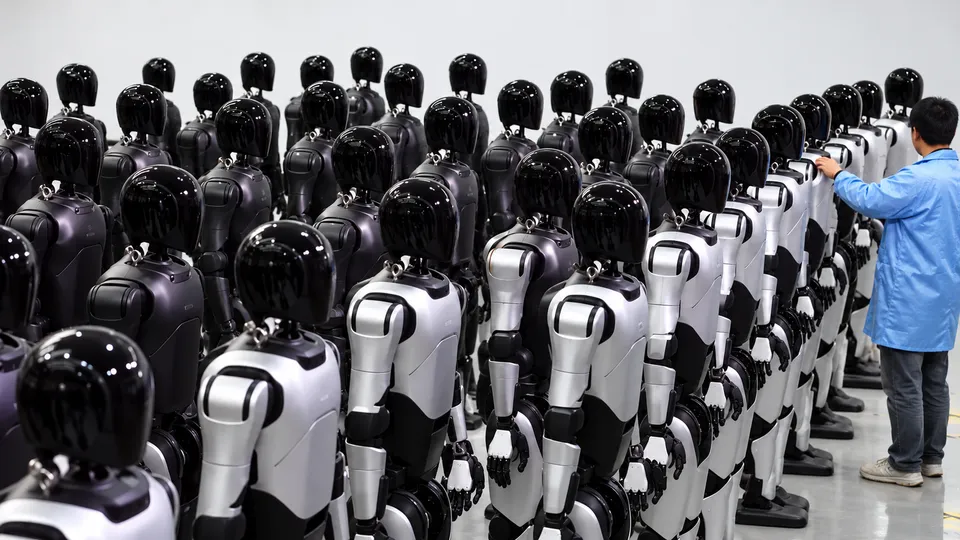
A standard venture capital research process is: you meet the founders, you read the pitch deck, you check the unit economics, you maybe call a couple of customers. A less standard one is: you leave your work laptop at home, board a 14-hour Air China flight out of San Francisco, and go stand in a Chinese factory so you can see whether your portfolio company is about to be crushed. That second one is increasingly the same thing as the first, at least if you invest in American robotics startups.
Business Insider reports a small boom in Silicon Valley diligence trips to China. Ryan Cunningham, founder of Edgerunner Ventures, floated the idea in an investors’ WhatsApp group last year and got jokes about smuggling home a humanoid robot; this year he’s organising an April trip for ten investors, and says nearly every investor group chat he’s in is swapping notes on China excursions. The point, mostly, is not to invest in Chinese companies — cross-border money flows being what they are — but to look at the competition. “I want to take them by the shoulders and say, ‘Guys, if you want to get serious, this is what we should be learning from,’” Cunningham says. Investors from Eclipse, G2 Venture Partners and Chemistry VC have made trips in recent months; The Information reported that partners from Founders Fund and Khosla Ventures have gone too.
The reason they are going is that the numbers have gotten a bit rude. Chinese companies Unitree and AgiBot together shipped 71% of the world’s humanoid robots last year, according to research firm Omdia. China controls 63% of the key companies in the global humanoid-components supply chain, per the Mercator Institute for China Studies. Most American humanoids are still prototypes you cannot buy, and most US robotics firms depend on Chinese suppliers for parts or assembly, according to Stanford’s 2026 Emerging Technology Review. In a 2023 policy document, Beijing compared humanoid robots’ potential impact to that of computers, smartphones and electric vehicles, and set a goal of deploying them across the economy by 2027. Meanwhile the US government has noticed too: in July the FCC banned new foreign-made “advanced robotic devices,” citing “unacceptable risks” to national security, which is a kind of compliment.
What do the tourists see? Factory floors, mostly, plus data operations. Neel Mehta, an investor at G2 — a growth-stage firm spun out of Kleiner Perkins that backs physical-industry companies — structured his trip around Morgan Stanley’s China Summit in Shenzhen and visited Xiaomi and BYD. He went in holding the standard American assumptions: China wins on manufacturing, but the US will always build the better AI. “We knew they were ahead, but it doesn’t really hit you until you’re on the ground,” he said. He came back convinced both assumptions were wrong. The Xiaomi SU7, an electric car starting around $30,000 that Americans can’t buy due to restrictions and a 100% tariff, had “the quality and finish... everything you’d expect in a luxury car like Porsche, no exaggeration.” And at a data-collection farm, he watched hundreds of workers in pods teleoperating robots around the clock, generating the real-world training data that robotics models need. “If you think data is the core bottleneck in robotics, there’s a world in which they have better models than anyone else.”
The $10,000 wake-up call
Naturally, someone is selling tickets. Rui Ma, who runs the Tech Buzz China podcast and research platform, has restarted the China tours she began in 2019 — two this year already, one for AI and one for robotics — at about $10,000 a head for a week of factory visits, fireside chats with English-speaking executives, five-star hotels and logistics. “I like to take people to see things they’ll be reading about six months later,” she told Business Insider; a recent stop was a brain-computer-interface company. Doon Insights, a California research and events firm, is pitching a 12-day “Robotics Study Mission” for November — Shanghai, Changzhou, Shenzhen, Beijing — with visits to AgiBot, air-taxi maker EHang, component manufacturers, the Huaqiangbei electronics market and, for balance, an automated farm and an instant-noodle giant. “It’s direct access to the people and technology defining what is coming next out of China,” says the itinerary, which is also a decent description of what makes a US investor nervous. Doon declined to comment. Ma dates the whole trend to the 2025 arrival of DeepSeek’s shockingly good model: “People are like, ‘Oh wow, China actually has AI and other technologies worth paying attention to.’”
The investors insist they are not being seduced. Charly Mwangi, a partner at Eclipse and a former Tesla and Rivian executive, came away with a useful taxonomy: “In the US, we’ve figured out vibe coding. In China, they’ve figured out vibe manufacturing.” That said, he noted the humanoids themselves can be more stagecraft than cognition — one robot he saw could dance and do martial arts but could not pick up a bottle and drop it in a bin. Dancing robots are a demo; a robot that tidies up is a business, and the ability to mass-produce the body is not the ability to give it a useful brain. Still, both Eclipse and G2 say China now weighs much more heavily in their investment decisions, and Mwangi frames the conclusion in terms that would not sound out of place in Washington: after seeing the state’s grip on the technology ecosystem, he believes building domestic robots “is a matter of national sovereignty.”
There is something circular and a little poignant about the whole arrangement. The US bans advanced foreign-made robots as a security risk. American investors respond by flying to China — presumably carrying burner phones — to admire the banned robots at close range, so they can come home and fund companies to compete with them. Wendy Chang of the Mercator Institute summarises the Chinese strategy as trying “to own the whole robotics supply chain.” The counterstrategy, apparently, involves tourism first and industrial policy to follow. The factory tours run about ten grand; the catch-up plan is someone else’s problem, and probably someone else’s trillion.