
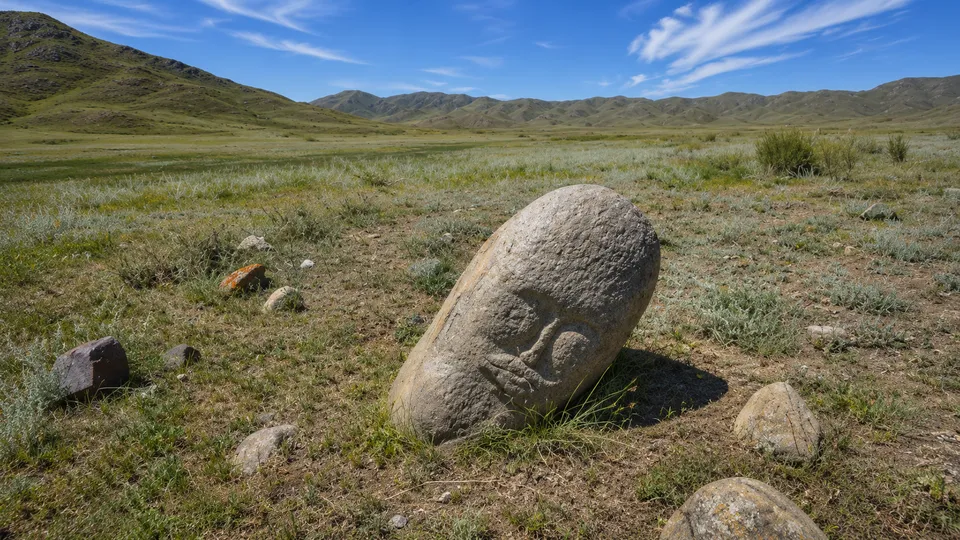
The longest row of standing stones documented in the new Tuva survey runs 600 metres. It is made of balbals: roughly worked stone pillars, set one after another, extending east from a carved human statue toward the point where the sun comes up. The Institute for the History of Material Culture of the Russian Academy of Sciences (IHMC RAS) announced on November 23 that its archaeologists had identified and registered new ritual-memorial complexes of this kind in four districts of the Republic of Tuva — Mongun-Taiga, Ovyur, Chaa-Khol and Ulug-Khem — dating to the sixth through eighth centuries CE, as arkeonews.net reported. That puts the monuments at roughly 1,200 to 1,500 years old, built during the First and Second Turkic Khaganates, the nomadic empires that controlled the Sayan-Altai steppe and much of the territory from Mongolia to the Black Sea after 552 CE.
Senior researcher Marina Kilunovskaya of IHMC RAS’s Central Asia and Caucasus archaeology department had previewed part of the fieldwork in October at the international conference “Altai in the Circle of Eurasian Antiquities,” where she reported seven new statues found during survey work commissioned by Tuva’s monument-protection service, in the Kargysem area and along the Magen Buren and Moldok Khem rivers, plus the Chaa-Khol district, according to m24.ru. The November announcement folds that count into a wider set of newly registered sites across the four districts; neither release gives a running total of complexes, only of statues.
The layout: a wall, a face, a line to the sunrise
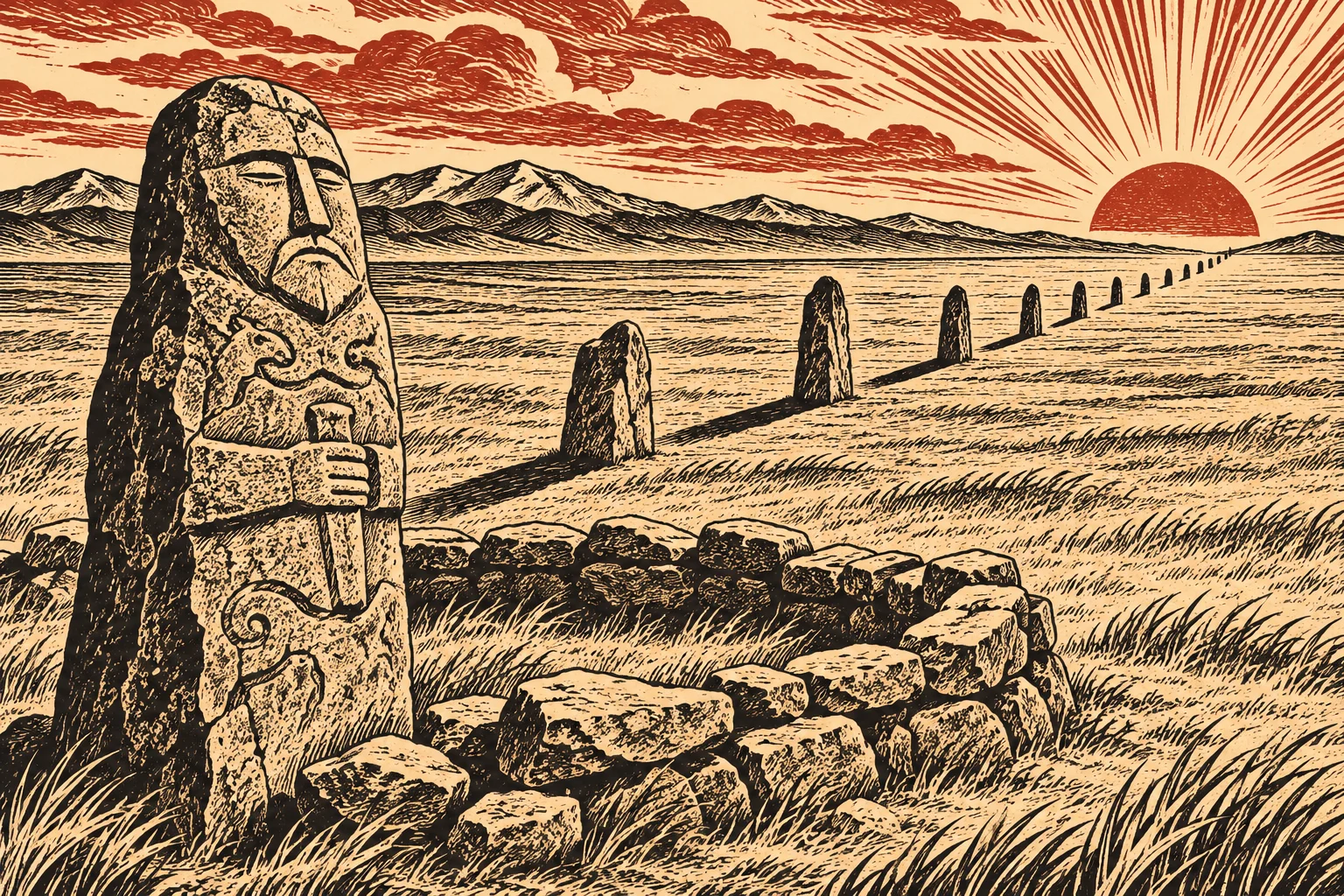
Every complex follows the same plan. A rectangular enclosure of worked stone runs north–south. On its eastern side stands a tall carved stone, usually shaped into a human figure — sometimes a full body, sometimes a bust, sometimes just a face incised on the rock. From that statue, a line of balbals runs east, the direction of the rising sun, carrying on for tens of stones and, in the longest recorded case, 600 metres. The statues carry carved detail — mustaches with upturned ends, belts with buckles, sabers, daggers, sharpening stones, smoking pipes, vessels held in both hands — while the balbals are left roughly shaped, unworked beyond standing them upright.
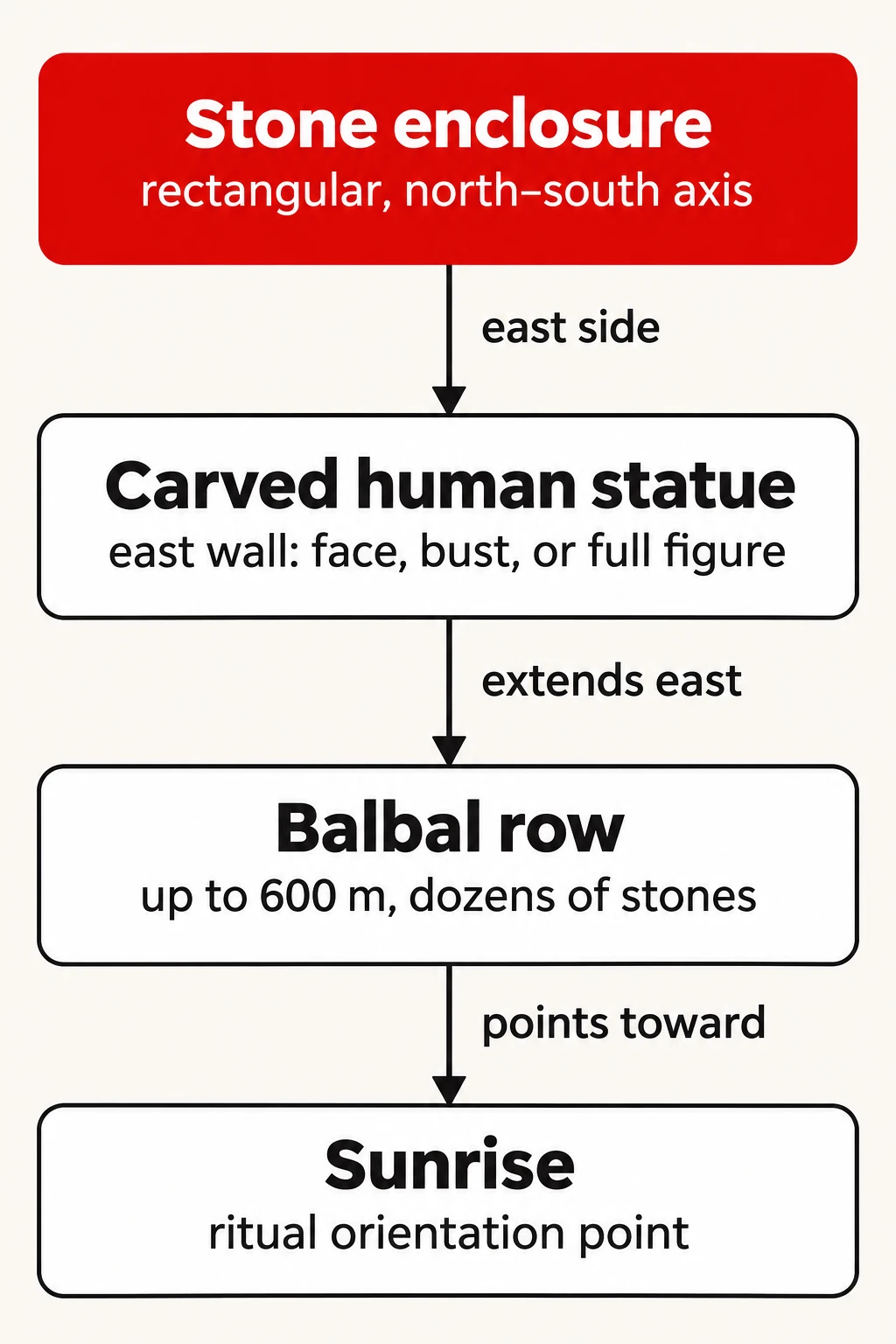
| From | To | How |
|---|---|---|
| Stone enclosure (rectangular, north–south axis) | Carved human statue (east wall: face, bust, or full figure) | east side |
| Carved human statue (east wall: face, bust, or full figure) | Balbal row (up to 600 m, dozens of stones) | extends east |
| Balbal row (up to 600 m, dozens of stones) | Sunrise (ritual orientation point) | points toward |
Based on IHMC RAS
That diagram is the whole argument for treating statue, enclosure and stone row as one structure rather than three unrelated finds. Earlier Tuva surveys, going back to work directed by Alexander Grach in the 1950s, mostly catalogued the carved statues on their own. The current project records the enclosure and the balbal line as parts of the same monument, which is why a chain of rectangular walls on a riverbank now reads as a single ceremonial complex rather than a scatter of sculpture.
What the stone rows are actually for
The question of what a balbal represents has no settled answer. The dominant reading, going back to Old Turkic inscriptions and repeated in Gerard Clauson’s etymological dictionary of Old Turkic, treats the word as meaning something close to “slaughtered enemy”: each stone stands for a foe the buried warrior killed in life, planted around the grave so the defeated would serve him in the afterworld — the more balbals, the greater the reputation. A more recent academic reassessment challenges that reading, arguing the archaeological pattern fits better with balbals as escorts accompanying the dead rather than captives, a distinction laid out in a philological review of the term. Kilunovskaya’s team does not resolve the dispute; the consistent eastward orientation toward sunrise is the one pattern the new Tuva sites add to it, and it fits either interpretation equally well.
Uneven hands on the same wall
Within single complexes, the carving quality varies sharply — some statues show detailed, confidently cut facial features and clothing, others are crude. The researchers’ inference is that skilled stoneworkers cut some figures while other community members made their own, cruder versions alongside them. That is a reasonable read of a skill gradient, not a measured fact: nothing in the survey dates the statues finely enough to say whether the rough ones came first, last, or from a poorer family working at the same time as a chief’s commissioned mason.
The November survey involved no digging. Earlier excavations at comparable Tuva sites turned up animal bone and broken pottery around the enclosures, which archaeologists read as the remains of memorial feasts rather than burials — the complexes appear to be commemorative shrines, not graves, sited on high riverbanks with wide views. Whether any of the four newly registered groups were used once or revisited across generations, and for how long, is a question the current survey leaves open, since answering it needs excavation the team has not yet done.
A separate project may eventually put calendar years on sites like these instead of a two-century bracket. Researchers from the Institute of Archaeology and Ethnography in Novosibirsk, working with IHMC RAS staff including Kilunovskaya, are building a tree-ring chronology for Tuva from live cores, old timber and charred wood, aiming eventually to date material back 5,000 to 6,000 years, as Tuva-Online reported. The method has already moved one Tuva site, the Kara-Dyt-3 iron-smelting furnace, roughly 500 years earlier than its previous assignment to the 3rd century CE, pushing it into the Xiongnu period instead. None of the newly registered balbal complexes have wood to date — stone rows don’t carry tree rings — so the 6th-to-8th-century bracket on them stands until an excavation turns up something organic nearby, or a dendrochronology sample from an adjacent, datable structure narrows the window.