

The animal Sarah Woodland walks into dementia wards and children’s hospital rooms stands about 30 inches at the withers, just above knee height on an adult, a size British breed registries class as Miniature Shetland: one rung below the standard Shetland pony, which runs 34 to 42 inches, and a different breed entirely from the American Miniature Horse, whose own registry caps height at 34 inches and does not recognise it as a Shetland at all. Writing as a first-person essay in Business Insider, Woodland, founder of Dinky Ponies, describes turning two animals she found in a roadside field into a seven-pony operation that now visits care homes, special-needs schools and hospital wards across three English counties.
Woodland says she started looking for the two ponies on her commute “just after the pandemic” and was eventually given them, with no plan for what to do with a pair of animals too small to ride or plough. A separate account in Fox News pins the handover to summer 2022 and fills in background the essay leaves out: Woodland is 42, had worked in London HR before years spent as a professional horse groom, and had never worked specifically with the miniature breed before taking on Poppy and Tinks. Four years on, as of the November 2026 essay, the herd has grown to seven: Poppy, 16, Tinks, 17, Abby, 13, Georgie, 12, Gracie, 5, Charm, 12 and Evie, 15 — an average age of just under 13, roughly mid-life for a breed that typically lives 25 to 30 years.
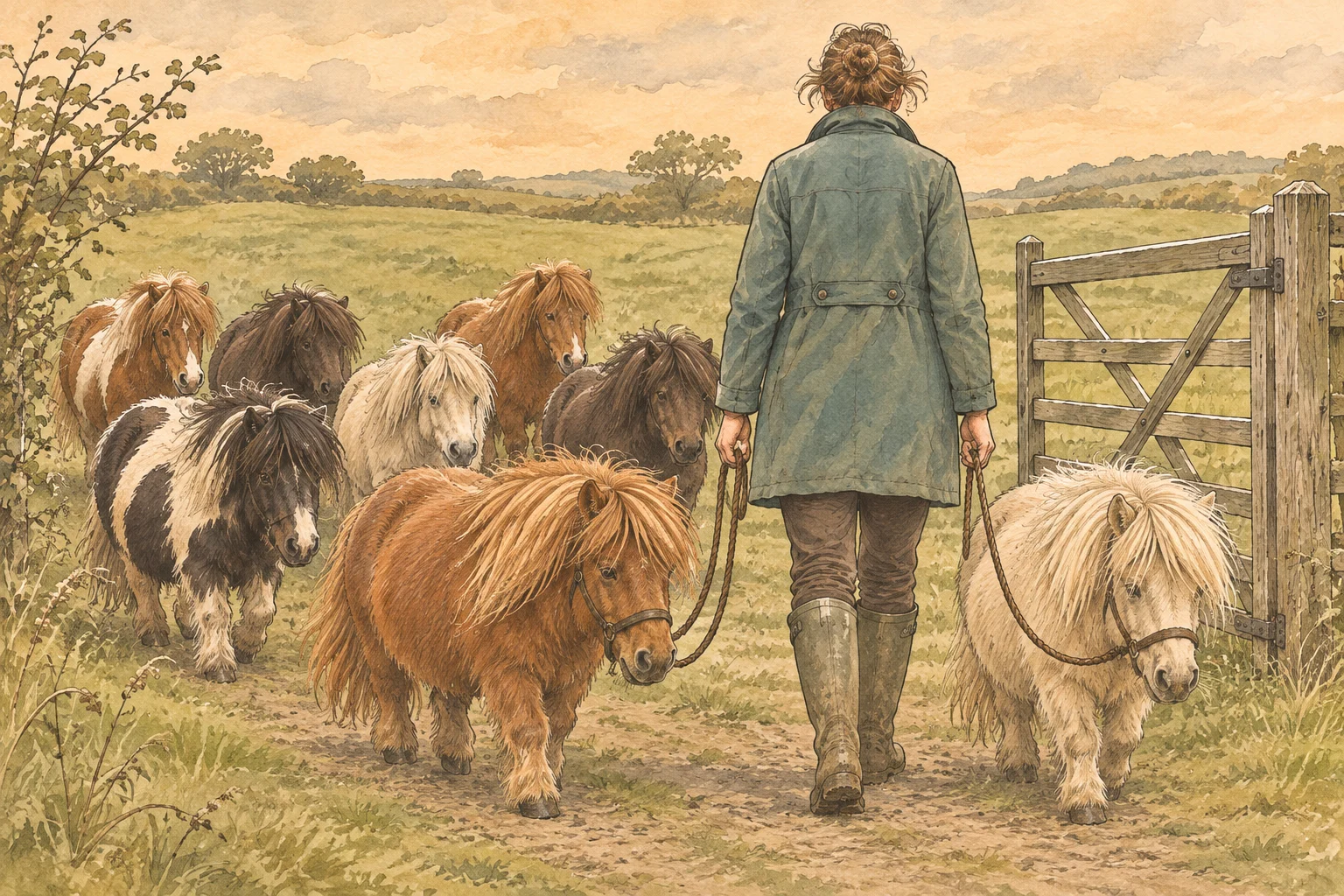
There was no pilot program and no consultant. Woodland ran outdoor sessions in pub car parks and fields through her first summer, then hit the obvious problem: British weather rules that out for autumn and winter. The fix came from a photograph of a horse in an elevator, which she tested first at a friend’s children’s day care, then at a single nursing home that agreed to let her try. Both worked, and the care-home visit became the template.
The template has settled into a fixed set of welfare limits, not a scripted therapy protocol. A new venue gets one pony first, to see how the space and the animal handle each other, before the rest of the herd is introduced. Visits are capped at one hour per Woodland’s own rule, and no single pony is booked more than about once a week, to avoid what she calls over-petting. Laminate floors turned out to be a hazard — pony hooves slide on them — solved with custom indoor shoes; elevators are managed with a mint as a reward each time a pony steps in, a standard operant-conditioning fix rather than anything specific to this breed.
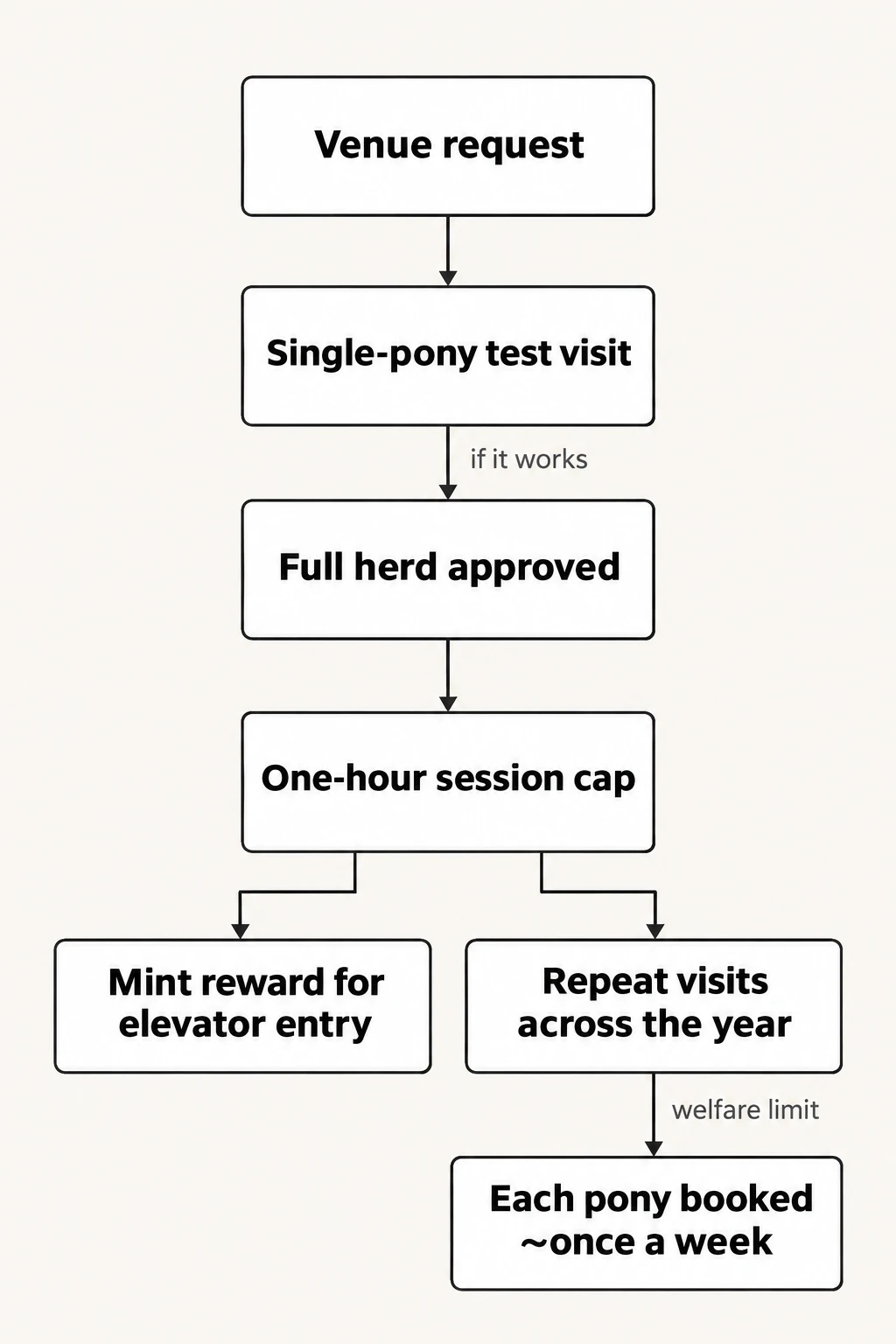
| From | To | How |
|---|---|---|
| Venue request | Single-pony test visit | |
| Single-pony test visit | Full herd approved | if it works |
| Full herd approved | One-hour session cap | |
| One-hour session cap | Mint reward for elevator entry | |
| One-hour session cap | Repeat visits across the year | |
| Repeat visits across the year | Each pony booked ~once a week | welfare limit |
What happens when a pony reaches a resident’s chair is, by Woodland’s own description, unpredictable: some laugh, some cry, and she says she cannot explain the split. Her guess — that a foal-sized animal reads as young, even though every pony in her herd is well into adulthood — is speculation, offered as such.

What the trials actually show
Woodland’s own evidence for the method is observational: four years of visits, no control group, no measured outcome. The controlled literature on animal-assisted therapy in dementia is older and narrower than the anecdote suggests. A 2019 Cochrane review by Lai and colleagues pooled nine randomised controlled trials run across Europe and the US — six parallel-group RCTs, one crossover trial and two cluster-randomised trials — and found low-certainty evidence that animal-assisted therapy slightly reduces depressive symptoms in people with dementia. It found no evidence of effect on social functioning, behaviour, agitation, activities of daily living, self-care or balance, and reported no data at all on adverse effects or on outcomes for the animals themselves.
A broader 2026 overview of systematic reviews, published on PubMed Central, pooled 16 systematic reviews covering 60 original studies and 2,694 participants, then re-screened the underlying trials down to 12 studies suitable for a fresh meta-analysis. Its conclusion matches Cochrane’s direction if not its certainty rating: moderate-certainty evidence of benefit on depression, none on agitation, quality of life, cognition or activities of daily living. Dogs dominate the sample in both reviews, followed by the robotic seal Paro; horses appear only in three small primary studies the overview could find — nine participants over ten weeks in one, six in another, sixteen in a third — too small and too few to produce a pooled estimate specific to equines. No randomised trial of miniature ponies, as distinct from dogs, Paro or full-sized horses, appears in either review. The mechanism Woodland is selling has not itself been tested at any scale.
The business side is thinly documented by design: bookings go through direct email rather than a published rate card, and the “donate” button on Dinky Ponies’ partner site, Country & Stable, routes to a merchandise search page rather than a payment form. The clearest number comes from the project’s GoFundMe page, which as of this writing has raised £40,377 against a £60,000 goal from 961 donations — an average of about £42 each, and 67% of target. Woodland’s own summary of four years running the operation: “incredibly hard and not hugely profitable.”
The equine-specific trials the 2026 overview found ran 6, 9 and 16 people. The dog studies behind the Cochrane pooled estimate are themselves small enough that the review’s authors call the certainty low. Nobody has yet run the obvious next study: a randomised trial of miniature-pony visits, at a sample size larger than the two-digit pilots the field has produced so far, measuring the outcomes — agitation, cognition, loneliness — that care homes actually want moved, rather than the one outcome, mood, where the pooled evidence happens to clear the bar.