
Eight published opinion polls since April have called Serbia’s parliamentary election eight different ways: four put President Aleksandar Vučić’s ruling coalition ahead, four put the two-year-old Student List ahead, and the gap between the two runs as wide as 16 percentage points in either direction depending on which firm did the asking. That spread is the first fact to grapple with before Sunday’s vote. After more than 14 years of unbroken rule by Vučić’s Serbian Progressive Party (SNS), Serbia has no polling house that both sides trust, which matters because the vote count itself is also disputed before a single ballot is cast.
| SNS-led coalition (%) | Student List (%) | |
|---|---|---|
| 30 Apr (Faktor Plus) | 46.4 | 28.7 |
| 26 Jun (Faktor Plus) | 47.1 | 30.7 |
| 15 Jul (CRTA) | 35.7 | 44.9 |
| 30 Jul (NSPM) | 37.5 | 39.6 |
| 4 Sep (Faktor Plus) | 47.2 | 31.5 |
| 21 Sep (Faktor Plus) | 48.6 | 37.1 |
| 20 Oct (NSPM) | 42.7 | 44.4 |
| 22 Oct (Ipsos) | 47.4 | 40 |
Source: Opinion polling for the next Serbian parliamentary election (Wikipedia aggregation of published polls). Faktor Plus and Ipsos consistently show SNS ahead; CRTA and NSPM consistently show the Student List ahead. The gap tracks the pollster, not the calendar.
The Student List is not a party. It is 250 names, one for every seat in Serbia’s parliament, chosen by daily assemblies (‘plenums’) that students at the University of Belgrade and other campuses set up to replace their old student parliament, with working groups handling strategy, donations and security and no single leader empowered to negotiate on the movement’s behalf. Eighteen lists are registered for Sunday’s vote, but only seven field a full slate of 250 candidates, and the Student List persuaded most of Serbia’s fragmented opposition parties to step aside rather than split the anti-Vučić vote. Its lead candidate, the cardiologist Ilija Srđanović, campaigns on an 11-point ‘Student Plan’ built around an asset-origin law, a dedicated anti-corruption prosecutorial unit and rural health-clinic funding, deliberately without firm deadlines, under the slogan ‘Serbia or Mafia.’
The movement traces to a single event: the collapse of a concrete canopy at Novi Sad’s main railway station on 1 November 2024, which killed 16 people. The station had been renovated between 2021 and mid-2024 under a contract tied to China’s Belt and Road Initiative, according to Wikipedia’s account of the collapse. Serbia’s interior minister initially put the toll at 12; it rose to 14, then to 16 as victims died of their injuries over the following weeks. Prosecutors eventually charged 13 people, including a former transport minister, and the trade minister and the head of state-run Serbian Railways resigned. The cause of the collapse was still under investigation as of this spring. What began as vigils for the dead became, over the following two years, the largest sustained protest movement Serbia has seen since the fall of Slobodan Milošević.
Vučić’s own position on the ballot is unusual. Barred by term limits from a third stint as president, he resigned the presidency on 27 September to lead the SNS list and, if it wins, install himself as prime minister — the post he held from 2014 before moving to the nominally ceremonial presidency in 2017, from which he kept direct control of the party. It is a reversal of his own career path, and it is aimed less at undecided voters than at hardening the SNS base against defections to smaller right-wing lists, as the backstory to that manoeuvre has already covered.
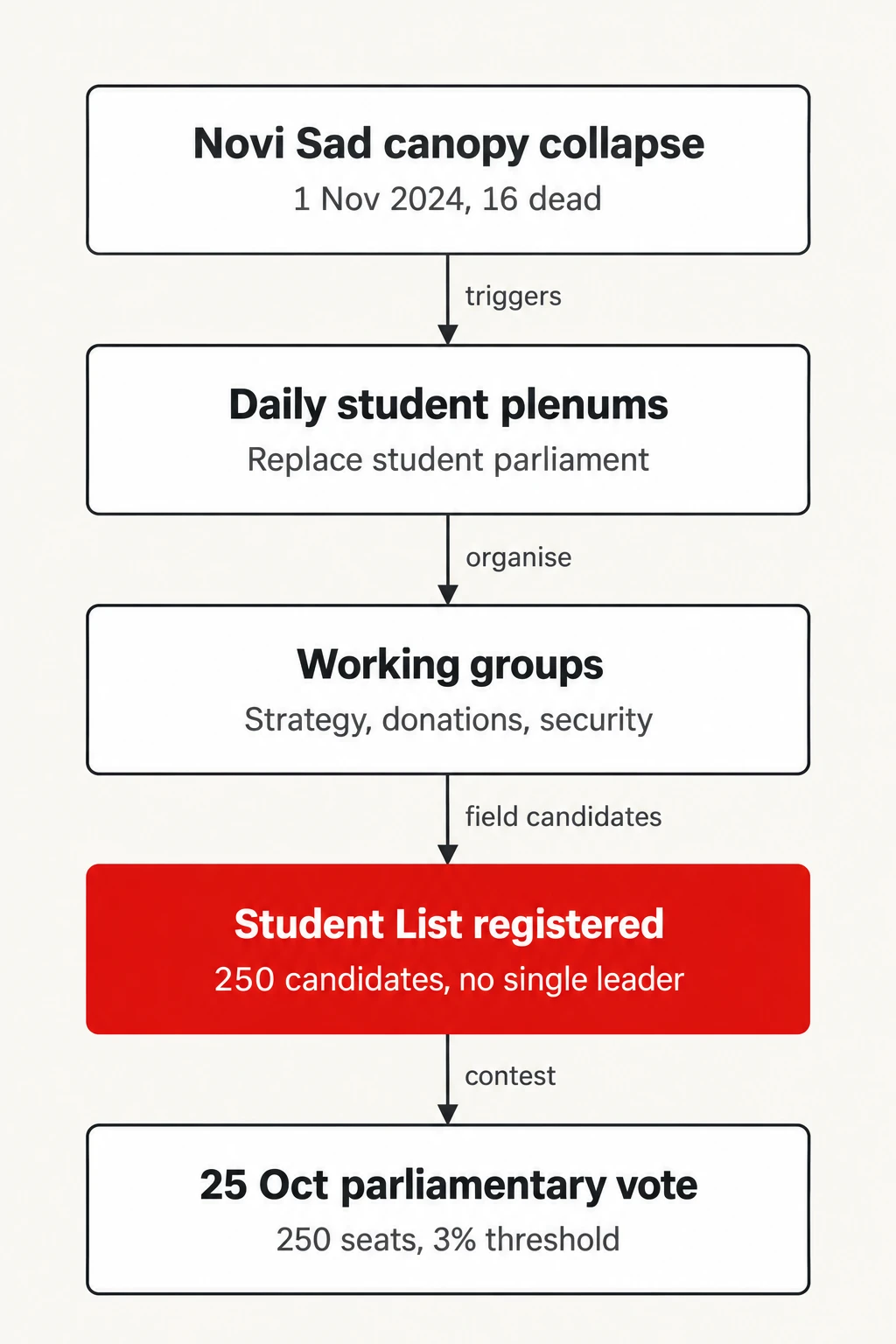
| From | To | How |
|---|---|---|
| Novi Sad canopy collapse (1 Nov 2024, 16 dead) | Daily student plenums (Replace student parliament) | triggers |
| Daily student plenums (Replace student parliament) | Working groups (Strategy, donations, security) | organise |
| Working groups (Strategy, donations, security) | Student List registered (250 candidates, no single leader) | field candidates |
| Student List registered (250 candidates, no single leader) | 25 Oct parliamentary vote (250 seats, 3% threshold) | contest |
The information environment the Student List is running in is lopsided by design, not accident. Monitoring by the watchdog CRTA over 21–27 September found representatives of the ruling majority got 75% of political airtime on commercial national channels plus public broadcaster RTS 1, against 25% for the opposition combined; Vučić alone, according to CRTA’s figures, took 60% of all airtime given to political actors — more than the entire opposition — and appeared on television 29 times in 31 days. A separate monitor, BIRODI, using a different window (11–30 September) and a five-channel sample, put Vučić’s share even higher, at 78% of political airtime. The two figures disagree because they measure different days and different channels; they agree that no other candidate comes close. Transparency International’s latest Corruption Perceptions Index, released this year, scores Serbia 33 out of 100 — its lowest since the index changed methodology in 2012, ranking 116th of 182 countries, below Bosnia and Herzegovina and ahead only of Belarus, Turkey and Russia within wider Europe.
That environment did not stop the Student List from filling central Belgrade on 22 October, three days before the vote. Organisers said more than 200,000 people packed Slavija Square and the surrounding streets for the movement’s closing rally, while Vučić held a competing SNS rally elsewhere in the city at the same hour, AFP reported. The political scientist Dušan Vučićević told AFP he expected the Student List to take more than 40% of the vote — which, if it holds, would be the strongest opposition showing against SNS since the party took power.

Prediction markets are not buying the close race the polls describe. On Kalshi, the SNS-led list was priced at roughly 66–69% to win the parliamentary vote as of 22 October, against 28–34% for the Student List, and Vučić himself at 72–73% to become prime minister versus 7–13% for Srđanović, according to the exchange’s own market pages. Polymarket shows a similar split, roughly 67–68% for Vučić’s list. That is a wider gap than almost any poll shows between the two lists, which suggests traders are pricing in something polls do not capture well: SNS’s institutional control over the count itself, not just over voters’ stated preferences.
The mechanics of the count give that scepticism a concrete hook. Any list below a 3% threshold of the national vote wins no seats at all; recent polls put the Socialist Party of Serbia, the European Serbia list and the Authentic Right list clustered around 2.5–4.9%, meaning a point or two of movement in either direction could hand or deny SNS the extra seats it needs for a governing majority without a coalition partner. Student List supporters staged a protest outside Serbia’s Electoral Commission on 7 October alleging fraud in the candidate-registration process, and CRTA has separately reported irregularities in signature certification, pressure benefiting the governing list, and threats and surveillance against opposition activists. Serbia’s Electoral Commission maintains the vote is free and the ballot secret.
Polls close Sunday evening. Whichever number the Electoral Commission publishes first, it will be checked against at least eight others that already disagree with each other by double digits, and against a set of betting markets that disagree with most of them. The number worth watching after that is not the top-line share for either list, but the seat count once the sub-3% lists are sorted out — the arithmetic that decides whether Vučić needs a coalition partner to keep the job he just resigned the presidency to chase.