
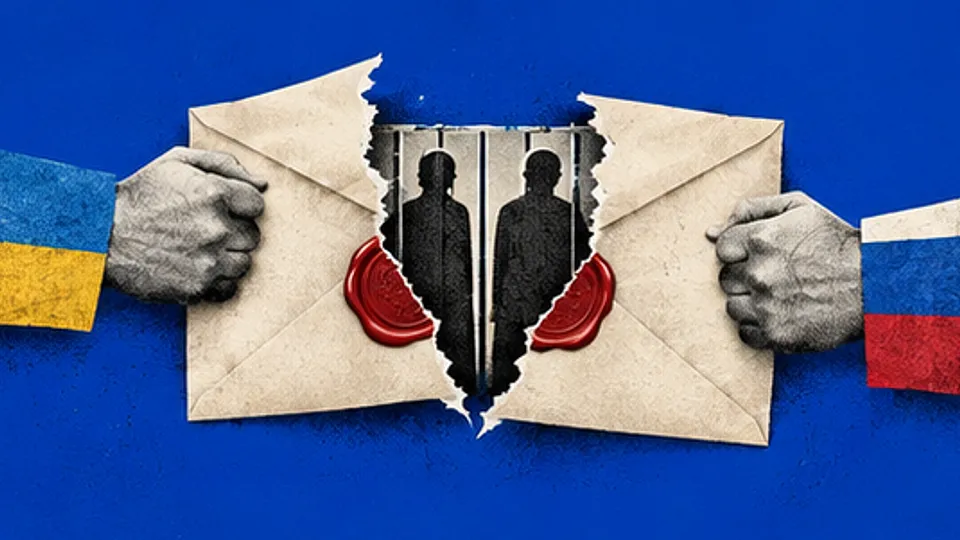
The statement went out from the Blue House at 11:16 p.m. on a Sunday. Issued in the name of Seong Ghi-hong, the senior presidential secretary for public relations, it demanded “an official explanation and apology” from the government of Ukraine, accused the Ukrainian presidential press office of a “false announcement,” and said Seoul was considering additional measures. The cause of a late-night diplomatic eruption between two friendly capitals was two young North Korean soldiers, captured early last year while fighting for Russia, and a sentence spoken from the rostrum of the United Nations General Assembly.
Ukraine had recently transferred the pair to South Korea, and President Volodymyr Zelenskyy chose to say so in his address to the UN General Assembly in New York on September 23, adding that North Korean soldiers were “not easy to capture alive.” One of the two has said he served in a reconnaissance unit, that he had not been trained on Russian military equipment as some of his comrades had, and that he was conscripted at seventeen and had been serving ever since. A South Korean lawmaker has said the two wanted to live a “normal life” in the South. Their existence had been public since their capture; their destination, Seoul says, was supposed to stay quiet.
A day after the speech, South Korea’s President Lee Jae Myung made his displeasure personal. “I do not know why the Ukrainian side broke the agreement and made the matter public, but it is very disappointing,” he wrote on X. Kyiv’s answer came from Dmytro Lytvyn, Zelenskyy’s communications adviser, who posted on social media on September 25 that there had been no confidentiality agreement at all — that the claim was “not true,” that hiding where a particular prisoner goes would be wrong, that Ukraine is an “open country” and that a secret handover would be “unusual.”
That denial, not the disclosure itself, is what brought the Blue House out past eleven on a Sunday night. Seong’s statement laid out Seoul’s version of the consultations: Ukraine, he said, had asked for secrecy, arguing that sending the prisoners to South Korea meant forgoing a chance to exchange them for a large number of its own captured soldiers, a move that could draw domestic criticism. South Korea agreed, Seong said, weighing the safety of the prisoners and their families alongside diplomatic and security considerations, and proceeded with the transfer on that basis. Then, without adequate explanation or specific consultation, Ukraine disclosed it from the UN podium.
Seoul does concede one layer of complication. It says it had received word from Kyiv that the transfer could be made public, but that the indication was unclear as to timing and content — and that it did not know the revelation would come in Zelenskyy’s General Assembly speech. Its grievance, as Seong framed it, is therefore double. “It is in itself a very serious matter that the Ukrainian side violated the confidentiality agreement between the two countries and made the disclosure unilaterally,” he said. “But the Ukrainian presidential press office’s false statement that there had been no confidentiality agreement seriously undermines trust between the two governments and gravely damages friendly relations between the two countries.” He added deep regret for South Koreans who had defended Ukraine’s conduct, saying they were harming the national interest.
By Monday, the grievance had a price tag. Kim Byung-joo, a ruling Democratic Party lawmaker and the party’s secretary on the National Assembly’s defence committee, posted on Facebook that “the government of the Republic of Korea should immediately reconsider its support for Ukraine.” “There is neither reason nor need to support a country that does not keep faith between governments, a country that disregards agreements between leaders,” he wrote. “Ukraine’s government should apologise. Humanitarian support so far, $100 million in economic support — what came back was the breaking of an agreement between leaders and the publication of false statements.”
The stakes reach past the two men at the center of it. South Korea has so far sent Ukraine no lethal weapons, citing a domestic ban on arms sales to countries at war, though it had been weighing requests for defensive weapons — particularly since North Korea deployed troops to Russia. The row now threatens those requests. And Seoul’s sensitivity about publicity is not abstract: “North Korea has been using the deployed soldiers to create a heroic narrative for regime propaganda,” Park Won-gon, a professor at Ewha Womans University, said, “and the South Korean government appears concerned that confirming the prisoners’ return to the South and publicising it could further fuel hostility towards Seoul.”
So a transfer that two governments arranged in private is now a public dispute over whether the private arrangement existed. Ukraine says there was nothing to hide and hiding would have been wrong. South Korea says there was an agreement, it was broken, and the breaking was then lied about. Neither side has moved. And somewhere in the South of the peninsula are two soldiers who, by a lawmaker’s account, crossed half the world for the chance at a normal life — and whose arrival their new country had hoped, for their sake and its own, not to discuss.