
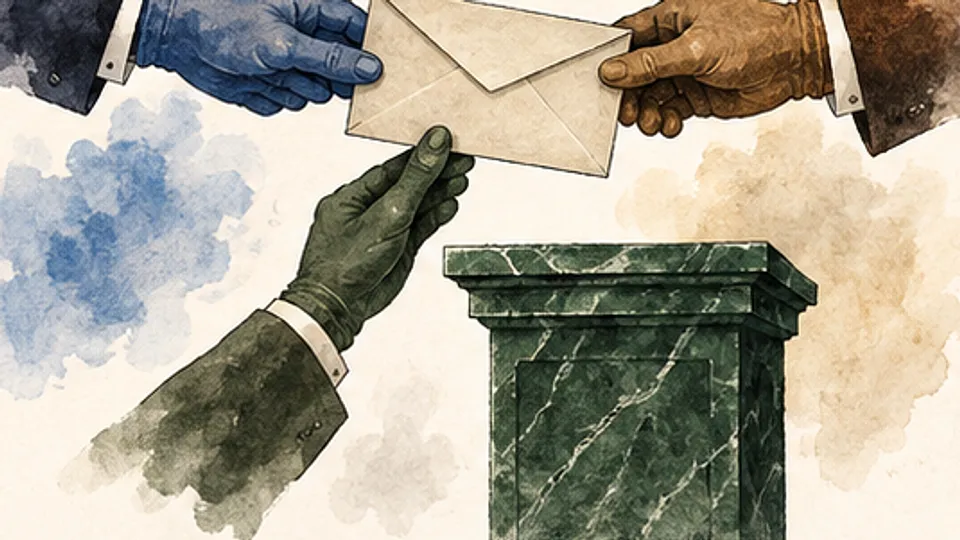
Some secrets travel badly. This one travelled from a frozen trench in Russia’s Kursk region to the green marbled podium of the United Nations General Assembly in New York, and by the time it arrived it had become a quarrel between two governments that were supposed to be on the same side of history.
On Monday, South Korea’s Foreign Ministry summoned Ukraine’s ambassador to Seoul, Andrii Vieshkin, to lodge a formal protest. The charge, as the ministry put it, was Kyiv’s “unilateral disclosure” of the transfer of two North Korean prisoners of war to the South, followed by what Seoul calls a false denial that the two countries had ever agreed to keep the matter confidential. Vieshkin said he would convey Seoul’s position to his government. Repeated calls to the Ukrainian embassy in Seoul went unanswered, according to the Associated Press.
The words spoken in New York
The trouble began last week, when President Volodymyr Zelensky stood before the General Assembly and said that Ukraine had recently transferred two captured North Korean soldiers to South Korea. The men had been taken prisoner in January 2025 in the Kursk region, where North Korean troops were sent to help repel a Ukrainian incursion — the first soldiers from Pyongyang’s army to be captured alive since North Korea entered the war in 2024 on Russia’s side.
Zelensky gave few details of the transfer itself. But he told the hall this of one of the prisoners:
one of them, when he realized he was going to be taken prisoner, tried to kill himself and he was shocked that fate didn’t let him die. This is how they raise people in the North.
It was a line crafted for the world’s ear, and some experts quoted by the Associated Press believe that was precisely the point: that Zelensky intended to dramatise the danger of North Korea’s deepening role in the war as an argument for greater Western assistance. Rulers, when they speak to vast assemblies, rarely spend their sentences carelessly. But the sentence had a cost, and the bill was presented in Seoul.
Strong regret, and a summoned envoy
South Korean President Lee Jae Myung moved first, accusing Ukraine days earlier of breaching a nondisclosure agreement. “I do not know what circumstances led the Ukrainian side to disclose the matter despite the confidentiality agreement, but it is deeply regrettable,” he wrote in a post on X, adding that “it was appropriate in every aspect not to disclose” the transfer given the potential consequences. Ukraine denied that any such deal existed. That denial — not the disclosure alone — is what turned friction into fury, as rews reported when the row first broke into the open over the dispute about whether a pact of silence existed.
Late Sunday, the presidential office escalated. Seong Ghi-hong, senior presidential secretary for public relations, demanded an official explanation and apology, expressing “strong regret over Ukraine’s unilateral disclosure and its subsequent false announcement that there had not been a non-disclosure agreement.” The denial, he said, was “an act that seriously undermines trust between the two governments and causes significant damage to friendly relations between the two countries.” The government, he added, is reviewing further measures if necessary.
According to Seong, Ukraine itself had requested secrecy, repeatedly and through various channels, arguing that public disclosure could provoke domestic criticism that Kyiv had surrendered a chance to exchange the two men for Ukrainian prisoners held by Russia. Seoul agreed to silence for its own reasons: the safety of the prisoners, and the safety of families they left behind in the North, where the regimes of Pyongyang have never been known for forgiveness.
Two men among fifteen thousand
The two soldiers sit at the narrowest point of a vast machine. South Korea’s intelligence service estimated last year that North Korea sent about 15,000 troops to Russia and that some 2,000 of them were killed. Pyongyang and Moscow confirmed in April 2025 that their soldiers fought together in Kursk, and South Korea, the United States and others say the North has also supplied artillery, ammunition and missiles in return for economic and military assistance — a partnership that has helped Kim Jong Un push back against American pressure and accelerate his nuclear programme.
While still in Ukraine, the two prisoners said in media interviews that they wanted to resettle in South Korea, and Seoul and Kyiv had been discussing a transfer, according to an opposition lawmaker in Seoul. Seoul urged Kyiv under no circumstances to send them back to the North, where they could face persecution. The South’s constitution regards the North as part of its territory, and the state maintains a standing policy of accepting and financially supporting defectors. More than 34,000 North Koreans have fled south since the end of the 1950-53 Korean War, most of them in the last three decades, most of them women from the poorer northern provinces. Defections by soldiers are rare. These two arrived not by crossing a frozen river or a wire fence in the dark of a moonless night, but through the machinery of someone else’s war.
Diplomacy’s cold arithmetic
For Lee’s liberal government, the timing could hardly be worse. Seoul is backing efforts to revive dialogue with Pyongyang, and President Donald Trump has renewed his willingness to engage with the North; last month he scaled back a joint military drill with the South in an apparent bid to restart talks with Kim, though Pyongyang has signalled the gesture was not enough. An angry reaction from the North over the two prisoners, Seoul fears, could spoil everything.
There is an older irony underneath the quarrel. South Korea, a growing arms exporter with a well-equipped, American-backed military, has sent Ukraine humanitarian aid and joined US-led sanctions on Russia, but has refused Kyiv’s and NATO’s calls for direct military support, citing a long-standing policy of not arming countries in active conflict. Kyiv asked for weapons and received rice and bandages; when it asked for silence, Seoul believed it had received a promise. Now each capital keeps its own ledger of the other’s debts, and somewhere in Seoul two young soldiers from the North learn what it means to be news.